
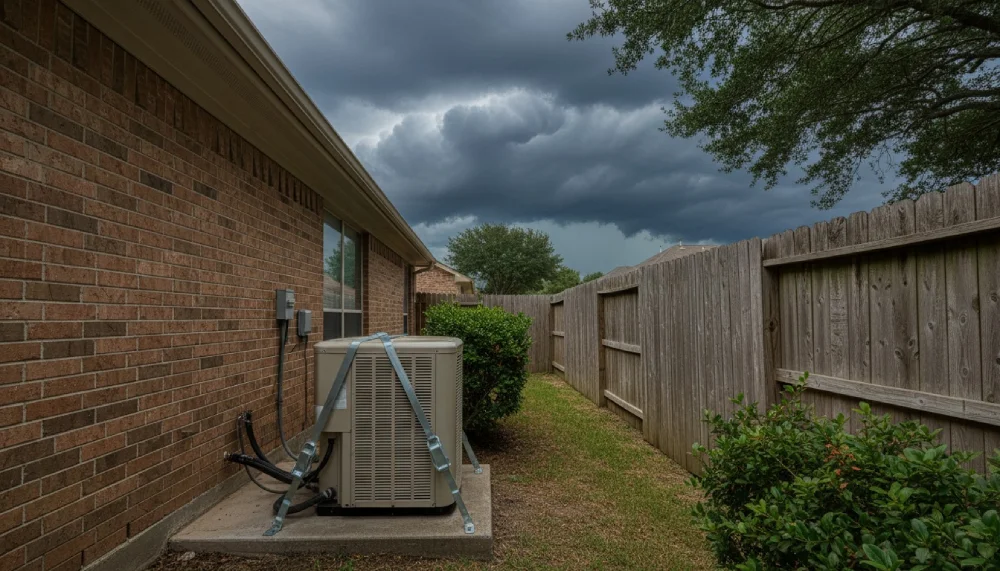
Protect your Houston HVAC system during hurricane season by installing hurricane straps securing outdoor condensers to withstand 150+ mph winds, adding HVAC-specific surge protectors preventing electrical damage from lightning and grid fluctuations, elevating units in flood-prone areas near Buffalo Bayou or Brays Bayou, pre-cooling your home 3-5°F before storms arrive, shutting off system breakers before hurricanes make landfall, and scheduling professional post-storm inspections before restarting equipment.
Houston's Gulf Coast location makes hurricane preparedness essential for homeowners. The 2026 Atlantic hurricane season runs June 1 through November 30, with peak activity in August and September. Beyond evacuation supplies and home fortification, protecting your HVAC system from wind, water, and electrical damage prevents costly repairs and ensures your home remains habitable in the extreme Texas heat that often immediately follows major storms.
Professional Houston HVAC installation includes hurricane-ready features like proper securing, surge protection options, and system configurations designed to withstand Gulf Coast weather conditions.
Understanding Hurricane Threats to HVAC Systems
Houston's flat terrain, clay soil, and proximity to the Gulf create specific vulnerabilities. High-speed winds (sustained 120+ mph in major hurricanes) can carry debris, turn unsecured outdoor units into projectiles, and damage refrigerant lines and electrical connections.
- Wind damage: Outdoor condenser units can be toppled, bent, or crushed by flying debris or falling trees. Fan blades, copper tubing, and electrical connections are particularly vulnerable to wind-driven impacts.
- Water damage: Flooding can submerge electrical components, corrode internal parts, contaminate ductwork, and create mold growth in insulation and air plenums that persists long after storms pass.
- Power surges: Lightning strikes and electrical grid fluctuations during storms can destroy compressors, circuit boards, capacitors, and thermostats, sometimes requiring complete system replacement.
Debris infiltration: Wind-driven rain, leaves, branches, and sediment can clog condenser coils, block supply vents, and contaminate ducts and filters, reducing system efficiency and air quality.
| Threat Type | Components at Risk | Potential Damage Cost |
| Wind damage | Condenser, fan blades, refrigerant lines | $500–$8,000+ |
| Water/flooding | Electrical components, compressor, ductwork | $2,000–$15,000+ |
| Power surges | Compressor, circuit boards, thermostat | $1,500–$10,000+ |
| Debris infiltration | Coils, filters, ducts | $200–$2,000 |
Pre-Hurricane HVAC Preparation (May–Early June)
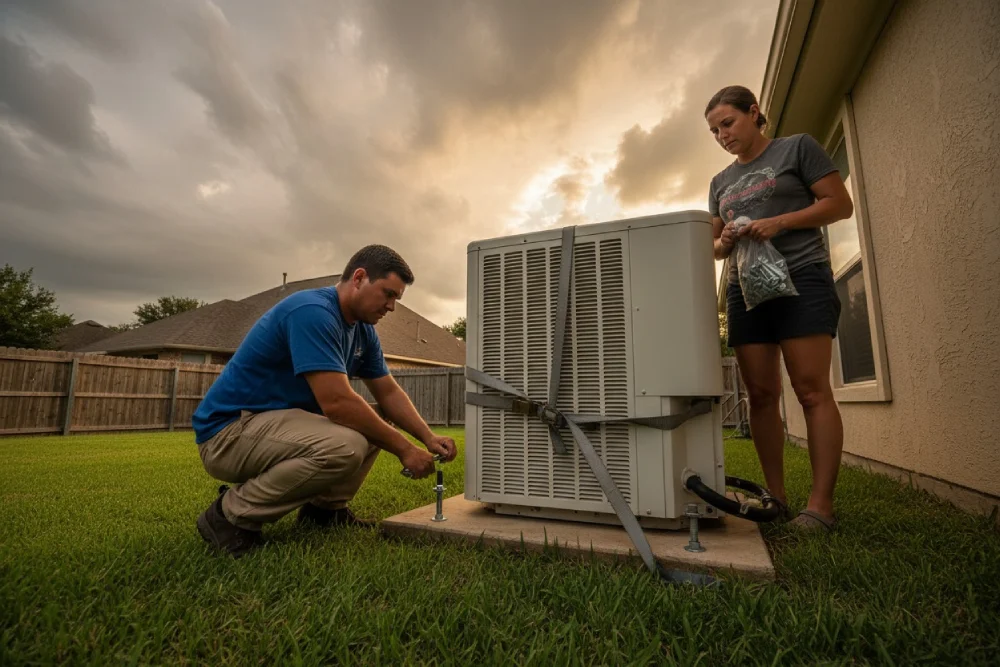
Preparation should begin before the official June 1 start of hurricane season. These steps take one to two days to complete and can prevent thousands of dollars in damage.
Secure the Outdoor Condenser Unit
The outdoor air conditioning or heat pump condenser is your HVAC system's most vulnerable component. Securing it properly is the single most effective pre-storm action.
- Install hurricane straps or tie-down brackets: If your unit isn't already bolted to a hurricane pad, install heavy-duty hurricane straps anchored to your home's structure and the unit frame. Modern hurricane-rated concrete pads are engineered to withstand winds up to 150 mph, exceeding the force of most major hurricanes.
- Elevate units in flood-prone areas: In neighborhoods subject to storm surge or repeated flooding near Buffalo Bayou, Brays Bayou, or White Oak Bayou, consider elevating the outdoor unit on a raised stand or platform. Even a few feet of elevation prevents water intrusion into electrical components and the compressor.
- Clear the surrounding area: Create a clear radius of at least 5 feet around the outdoor unit. Remove patio furniture, potted plants, branches, tools, and other objects that could become projectiles in high winds.
- Trim nearby trees and branches: Overhanging limbs can break in strong winds and fall onto your unit. Trim branches to at least 10-15 feet away from the condenser, and consider removing dead or weakened trees near your home before storm season.
Install Surge Protection
Lightning strikes and power grid fluctuations during hurricanes can inflict catastrophic electrical damage to HVAC systems.
HVAC-specific surge protectors are designed to protect against high-voltage spikes while withstanding temperature extremes and high humidity. These devices mount on the electrical panel or near the condenser, intercepting voltage surges before they reach your compressor, control board, and thermostat.
Installation costs: HVAC surge protectors typically cost $150–$300 installed and represent a prudent investment for homes in hurricane-prone areas. Whole-house surge protectors on your main electrical panel provide broader protection during lightning storms.
Schedule Pre-Season Maintenance
Professional maintenance before hurricane season ensures your system is in optimal condition to weather storms and recover afterward.
Spring maintenance should include:
- Refrigerant charge verification
- Condenser coil cleaning to remove dust and debris
- Tightening all electrical connections to prevent corrosion
- Checking condensate drain for blockages
- Testing thermostat and control board operation
- Verifying outdoor unit is properly secured
Cost: Spring HVAC tune-ups typically cost $75–$150 and often qualify for CenterPoint Energy rebates (approximately $25 discount).
Professional AC installation in Houston includes proper securing and surge protection recommendations tailored to your property's specific hurricane exposure.
Insurance and Documentation
Before hurricane season, verify that your homeowners insurance covers both wind damage to HVAC equipment and flooding (flooding often requires a separate policy).
Document your system: Take photos and videos of your outdoor unit, including manufacturer, model, and serial number. Document the age and estimated replacement cost. This documentation expedites insurance claims if your system is damaged.
Know your coverage limits: Standard homeowners policies typically cover wind damage but may cap HVAC replacement at $5,000–$10,000 or require high deductibles. Flood damage may require separate flood insurance through FEMA's National Flood Insurance Program.
Keep receipts: Maintain records of maintenance, repairs, and equipment purchases. These documents support insurance claims and demonstrate proper system care.
Weeks Before the Storm: Pre-Cooling and Shutdown
Once tropical weather develops in the Gulf and a hurricane watch is issued for the Houston area, take these immediate preparation steps.
Lower Your Home Temperature
Two to three days before the hurricane arrives, lower your thermostat by 3-5°F for several hours. This pre-cools your home and adds thermal mass, so your house stays cooler longer during power outages.
Why this matters: Most homeowners lose power after hurricanes. Pre-cooling your home buys hours (or even a day) of additional comfort without air conditioning, critical in Houston's sweltering post-storm heat when temperatures often exceed 90°F with high humidity.
Shut Off Power to the HVAC System
Critical timing: Turn off your HVAC system at the thermostat and circuit breaker before the hurricane arrives, not during or after the storm.
Why shut down:
- Power surges from lightning or grid fluctuations can destroy the compressor if the system attempts to run while electrical power is unstable
- If debris blocks the outdoor condenser, the unit can overheat and fail if it cycles on with partial power restoration
- Power cycling (repeatedly turning on and off during intermittent grid power) severely stresses compressor motors
Proper shutdown procedure:
- Set thermostat to "Off"
- Switch HVAC breaker to "Off" on main electrical panel
- Leave breaker off until after hurricane passes and you've visually inspected outdoor unit for damage
Protect the Outdoor Unit (Optional)
If forecasts indicate extremely high winds or your unit is in an especially exposed location, consider covering the outdoor condenser.
Important cautions:
- Use only breathable, manufacturer-approved covers—never plastic sheeting
- Plastic traps moisture, accelerates corrosion, and prevents heat dissipation
- Secure covers tightly with rope or ties so they won't blow off
- Never cover the unit while it's running—always shut off power first
Alternative protection: Some contractors use heavy plywood or metal cages positioned around (not touching) the unit to shield it from flying debris while allowing airflow.
Comprehensive Houston HVAC services include hurricane preparation assessments identifying vulnerabilities and recommending protective measures specific to your system and location.
Generator Sizing for HVAC Systems
If you plan to operate your HVAC system during or after a hurricane using a generator, properly sizing the generator is critical. Central air conditioners require substantial startup power that exceeds running power.
Generator Requirements by System Type
Central air conditioner (3-ton / 36,000 BTU):
- Running watts: 5,400 W
- Starting watts (inrush): 7,200 W
- Recommended generator size: 8,000–10,000 watts
Air-source heat pump (3-ton):
- Running watts: 5,400 W
- Starting watts: 7,200 W
- Recommended generator size: 8,000–10,000 watts
Window air conditioner (12,000 BTU):
- Running watts: approximately 1,400 W
- Starting watts: up to 4,200 W
- Recommended generator size: 5,000–6,000 watts
Ductless mini-split (12,000 BTU):
- Running watts: approximately 1,200 W
- Starting watts: varies by model
- Recommended generator size: 2,500–3,500 watts
Key calculation: Always add starting watts to running watts when sizing generators. Include a 2,000 W safety margin for reliable operation.
Generator Types and Costs
Portable gasoline generators ($2,000–$6,000): Flexible, movable, require manual startup and fuel management. Suitable for running AC intermittently after storms.
Portable propane generators ($3,000–$8,000): Cleaner-burning, can connect to bulk propane tanks. Better for extended operation.
Permanently installed standby generators ($8,000–$20,000+ installed): Automatically start when power fails, run on natural gas or propane, seamlessly switch back to grid power. Ideal for reliable post-hurricane cooling but require professional installation.
Practical note: Most Houston homeowners use generators for post-hurricane recovery when power is out but conditions are stabilizing, not during the active storm when electrical surges pose ongoing risks.
| Generator Type | Cost Range | Best For | Fuel Source |
| Portable gasoline | $2,000–$6,000 | Intermittent post-storm AC | Gasoline (store safely) |
| Portable propane | $3,000–$8,000 | Extended operation | Propane tanks |
| Standby generator | $8,000–$20,000+ | Automatic backup, whole-house | Natural gas or propane |
Post-Hurricane HVAC Inspection
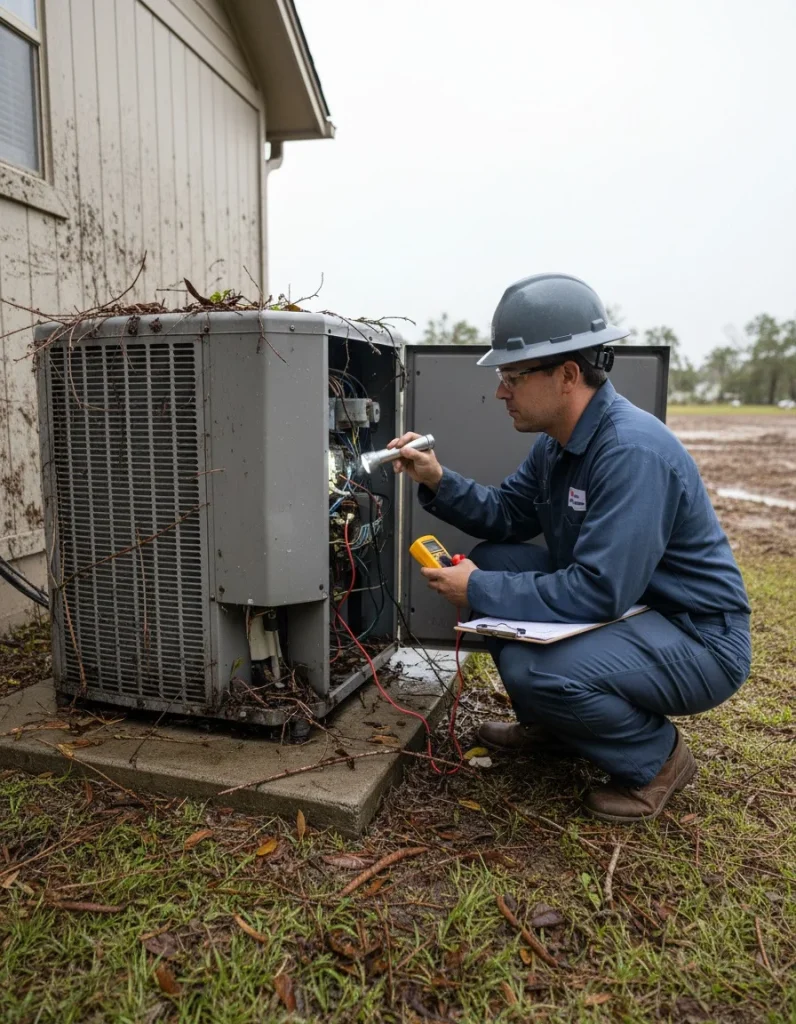
Do not restart your HVAC system immediately after a hurricane, even if power is restored. Wait for professional inspection to confirm safe operation.
Immediate Post-Storm Assessment (First 24-48 Hours)
Outdoor unit inspection:
- Look for visible damage: dents, bent fins, broken fan blades, crushed sections
- Check for water lines or flood marks indicating water intrusion
- Remove leaves, branches, mud, and debris from condenser coils
- Verify refrigerant lines (copper tubing) are intact, not kinked or separated
- Inspect electrical connections for fraying, exposed wires, or corrosion
- Check that unit is still properly secured and hasn't shifted
Ductwork and return air inspection:
- Look for visible gaps, loose connections, or separation at duct joints
- Check for water inside ducts or wet insulation indicating flood intrusion
- Smell for musty or moldy odors (sign of mold growth)
- Check air returns, vents, and grilles for debris or blockage
Electrical connections:
- Visually inspect the HVAC breaker—do not reset tripped breakers without professional inspection
- Check thermostat for signs of water damage or corrosion
Professional Inspection (Before Restarting)
Do not attempt to restart the system yourself. Call a licensed HVAC contractor for post-storm inspection.
Professional inspection includes:
- Checking for refrigerant leaks (may be invisible but critical)
- Testing all electrical connections for proper voltage
- Inspecting compressor for water intrusion or damage
- Evaluating capacitor, control board, and thermostat
- Inspecting ductwork for mold if flooding occurred
- Confirming proper operation before full restart
Cost: Post-hurricane HVAC inspections typically cost $75–$200 and may be partially covered by insurance if the system was damaged.
Professional heating installation contractors provide post-storm inspection services ensuring your system is safe to operate after hurricane events.
Post-Storm System Restart Protocol
Once a professional has cleared your HVAC system for operation:
- Turn on the breaker to your HVAC system at the main electrical panel
- Set thermostat to modest temperature (78-80°F initially to manage load)
- Listen for unusual sounds: humming, grinding, or squealing indicates problems requiring immediate shutdown
- Monitor airflow: Confirm cool air flows from all vents and system cycles normally
- Check for leaks: Monitor outdoor unit and ceiling/wall penetrations for water intrusion during first 24-48 hours
Hurricane Season Preparation Checklist
Complete by May 31
- Outdoor condenser bolted to hurricane pad or hurricane straps installed
- Outdoor unit elevated (if in flood-prone area)
- Surrounding debris removed, trees and branches trimmed
- HVAC surge protector installed
- Spring maintenance and tune-up completed
- System tested for proper operation
- Homeowners insurance reviewed, HVAC coverage confirmed
- Photos and videos of HVAC equipment documented
- Contractor contact information saved
Before Storm Arrival
- Pre-cool home 2-3 days before hurricane
- Turn off HVAC breaker when tropical weather enters Gulf
- Secure loose items in yard that could become projectiles
- Install breathable cover if desired (optional)
- Charge phones and back up important documents
After Storm Passes
- Wait 24-48 hours before attempting restart
- Visually inspect outdoor unit and ducts for damage
- Call licensed HVAC contractor for professional inspection
- Do not restart without professional clearance
- Document any damage for insurance claim
- Monitor system for first 24 hours for unusual sounds or leaks
Key Takeaways
- Secure outdoor condensers with hurricane straps bolted to hurricane-rated pads engineered for 150+ mph winds, and elevate units in flood-prone areas near Buffalo Bayou or Brays Bayou to prevent water intrusion into electrical components
- Install HVAC-specific surge protectors ($150-$300) that intercept voltage spikes from lightning and grid fluctuations before they destroy compressors, circuit boards, and thermostats that can cost $1,500-$10,000+ to replace
- Pre-cool your home 3-5°F before hurricanes arrive to add thermal mass keeping your house cooler longer during power outages, critical in Houston's 90°F+ post-storm heat when grid power may be out for days
- Shut off HVAC breakers before storms make landfall to prevent compressor damage from power surges, overheating from debris blockage, and motor stress from intermittent power cycling during grid instability
- Size generators properly for startup power with 3-ton central AC requiring 8,000-10,000 watt generators due to 7,200 W starting surge, while mini-splits need only 2,500-3,500 watts for emergency cooling
- Never restart HVAC systems after hurricanes without professional inspection verifying no refrigerant leaks, water intrusion, electrical damage, or ductwork contamination that could cause equipment failure or safety hazards
Frequently Asked Questions
How do I protect my AC unit during a hurricane?
Secure the condenser with hurricane straps, clear debris within 5 feet, trim overhanging branches, install surge protection, and shut off the breaker before the storm arrives. Optionally cover with breathable material—never plastic.
Should I turn off my AC before a hurricane?
Yes. Turn off the thermostat and breaker before the hurricane arrives to prevent compressor damage from power surges, overheating from debris blockage, and motor stress from intermittent power cycling.
What size generator do I need to run my AC?
A 3-ton central AC requires an 8,000-10,000 watt generator due to 7,200 W startup surge. Window units need 5,000-6,000 watts. Mini-splits require only 2,500-3,500 watts for emergency cooling.
Can I restart my AC after a hurricane?
Wait for professional inspection before restarting. Technicians check for refrigerant leaks, electrical damage, water intrusion, and debris contamination that could cause equipment failure or safety hazards.
How much does hurricane HVAC preparation cost?
Hurricane straps cost $100-$300 installed. Surge protectors run $150-$300. Spring tune-ups cost $75-$150. Total preparation investment typically ranges $325-$750, preventing thousands in potential damage.
Does homeowners insurance cover hurricane HVAC damage?
Most policies cover wind damage but may cap HVAC replacement or require high deductibles. Flood damage typically requires separate flood insurance. Document your system with photos before hurricane season.
How long can my house stay cool without AC after a hurricane?
Pre-cooling your home 3-5°F before the storm adds thermal mass keeping it cooler for 12-24+ hours depending on insulation quality, outdoor temperatures, and whether you keep doors and windows closed.
Should I cover my outdoor AC unit during a hurricane?
Optional. If covering, use only breathable, manufacturer-approved covers—never plastic which traps moisture. Secure tightly so covers don't blow off. Never cover while the unit is running.
What should I check on my HVAC after a hurricane?
Inspect for visible damage, bent fins, flood marks, debris in coils, kinked refrigerant lines, shifted positioning, and electrical damage. Smell for musty odors indicating mold. Call a professional before restarting.
When does Houston hurricane season start?
The Atlantic hurricane season officially runs June 1 through November 30, with peak activity in August and September. Complete HVAC preparation by May 31 before the season begins.
Conclusion
Houston hurricane season demands proactive HVAC preparation to prevent costly damage and ensure your home remains habitable in post-storm Texas heat. Secure outdoor units with hurricane straps, install surge protection, complete spring maintenance, and document your system for insurance purposes before June 1. Pre-cool your home and shut off breakers before storms arrive, then wait for professional inspection before restarting after hurricanes pass.
These investments in preparation represent among the most cost-effective hurricane mitigation steps homeowners can take, often costing $325-$750 total while preventing thousands in potential damage. Given Houston's vulnerability to tropical systems and the critical role of air conditioning in post-disaster recovery, proper HVAC hurricane preparation is essential.Ready to hurricane-proof your HVAC system? Contact VeriChill for professional preparation assessment, surge protection installation, and maintenance services before the 2026 hurricane season begins.