The single-stage vs two-stage vs variable-speed AC decision comes down to how the compressor modulates output. Single-stage systems run at one fixed output, two-stage systems can run at a low or full output, and variable-speed systems continuously modulate between many speeds to match real-time cooling demand. For Houston homeowners, the buyer's guide lands almost every time on two-stage as the recommended sweet spot for most homes, with variable-speed as the premium option for larger, comfort-critical homes, and single-stage reserved for tight budgets or the smallest, best-insulated properties.
Walk into any HVAC showroom, and you will quickly hit a decision that determines a lot about how comfortable your home feels for the next fifteen years. Single-stage, two-stage, or variable-speed? The salesperson will tell you the higher tier is always better. The internet will tell you it depends. Both are partly right, but neither answer helps a Houston homeowner actually make the call.
Our climate weighs on this decision more than most. Eight to nine months of cooling, 75-percent-plus humidity for weeks at a time, and afternoons that spend more hours in the partial-load 88 to 95 degree range than in the extreme 100-plus range mean the AC staging choice has bigger real-world consequences here than in shorter-season markets.
Let us walk through what each staging tier actually does, how each one performs in Houston conditions, and how our team helps homeowners land on the right tier for their specific house. Consider this an AC technology comparison written for Houston, not a generic national AC system types comparison.
AC Staging Explained: What It Actually Means
Every central air conditioner uses a compressor to move refrigerant through the system. Staging describes how many output levels that compressor has and how smoothly it moves between them.
- Single-stage compressors have exactly one output level: full capacity. When the thermostat calls, they run at 100 percent until the setpoint is satisfied, then shut off completely. Simple, proven, inexpensive to install and repair.
- Two-stage compressors have two output levels: low, typically around 65 to 70 percent capacity, and high, 100 percent capacity. The system runs at low most of the time and stages up to high only when the load demands it. This is the modulation tier most Houston homes benefit from most.
- Variable-speed compressors, sometimes called inverter compressors, have essentially unlimited output levels. They ramp continuously between roughly 20 percent and 100 percent, matching output to real-time demand almost second by second.
The higher the tier, the more precisely the equipment can match your home's cooling load. That precision pays off in comfort, humidity control, and efficiency in a climate like ours. For homeowners working with a shortlist of residential HVAC services in Houston, staging is one of the first specification questions to ask about any quoted system.
How Each Tier Performs in Houston Conditions
Specification sheets tell one story. The way each tier actually behaves in a Houston home tells a different one.
- Single-stage systems produce short, aggressive cycles that cool the setpoint quickly, then shut off. In our climate, the coil often does not stay wet long enough between cycles to remove enough humidity, so the house can hit the temperature and still feel muggy. Bill impact is highest because each hard startup draws significant current.
- Two-stage systems spend most of Houston's cooling season in low stage, running long, gentle cycles that pull steady moisture out of the air. When a hot afternoon pushes the load past what low can handle, high stage kicks in for as long as needed. This matches our climate's typical load pattern remarkably well, which is why the editorial position on two-stage as Houston's sweet spot has held up across thousands of installations.
- Variable-speed systems modulate constantly to whatever the house needs, delivering the tightest temperature control, strongest humidity handling, quietest operation, and lowest seasonal electric consumption of the three tiers. The premium price point becomes easier to justify in homes where comfort inconsistency or comfort priority is high.
| Feature | Single-Stage | Two-Stage | Variable-Speed |
|---|---|---|---|
| Output levels | 1 (full) | 2 (low, high) | Continuous |
| Typical Houston runtime pattern | Short, aggressive | Long, gentle | Continuous, adaptive |
| Humidity control | Modest | Strong | Strongest |
| Sound at partial load | Full compressor noise | Quiet at low stage | Very quiet |
| Best fit efficiency at | Full load | Partial and full | All loads |
Humidity Control: Where Houston's Climate Rewards Higher Tiers
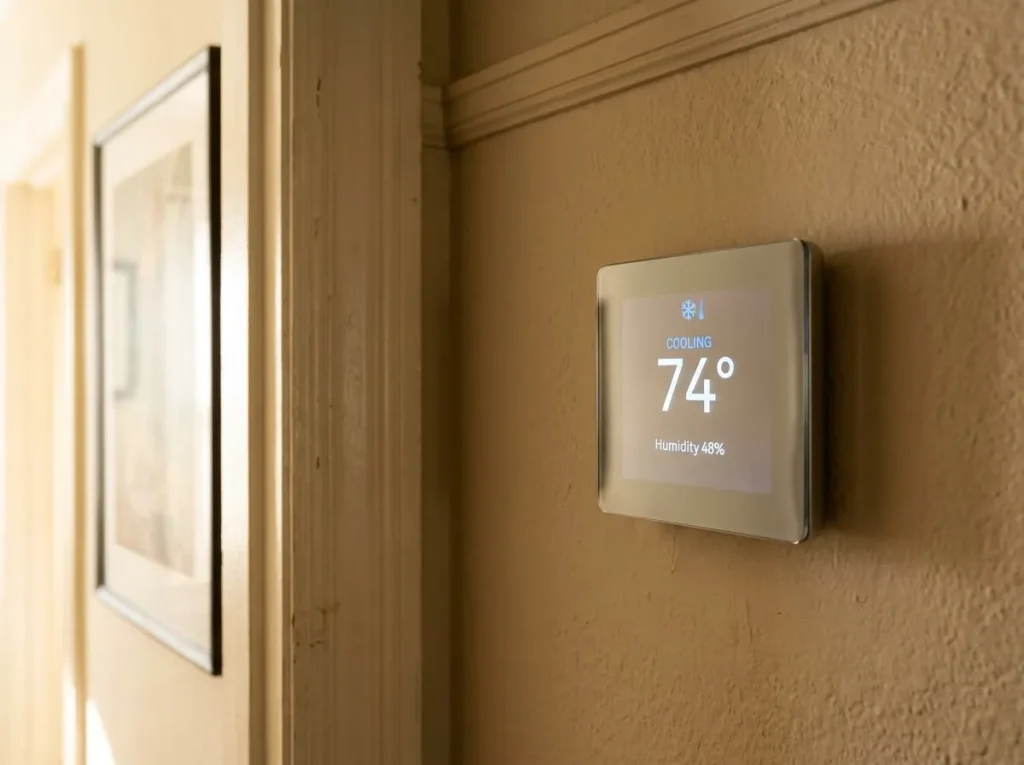
The single biggest reason our team pushes homeowners toward two-stage or variable-speed in Houston is humidity, not temperature.
Cooling and dehumidification are related but different jobs. Cooling means dropping air temperature. Dehumidification means condensing water vapor onto the coil so it drains away as liquid. Both happen when refrigerant is cold and air is moving through the coil, but dehumidification takes time. Long runs at lower output pull far more water out of the air than short runs at full output, even when the two options remove the same amount of heat.
A single-stage system hits the temperature setpoint quickly, then shuts off before enough moisture has left the air. The house is at 74 degrees but 60-plus percent indoor humidity, which feels sticky no matter what the thermostat says. A two-stage or variable-speed system runs longer at lower output, keeps the coil cold and wet longer, and drops the indoor humidity into the more comfortable 45 to 50 percent range where the same 74 degrees feels genuinely cool.
ENERGY STAR's certified product specifications reference is where you can look up the exact efficiency criteria each staging tier of AC equipment has to meet, and the same physics apply in Houston's 75-percent-plus outdoor humidity climate where staging is the primary lever for indoor comfort, not raw BTU output.
What Each Tier Costs and What Actually Recoups the Difference
Because prices are not published in this guide, our team focuses instead on the value logic that determines whether a homeowner should stretch to a higher tier or stay at the entry level.
- Single-stage systems carry the lowest installed cost. The value case works for small, well-insulated homes with modest cooling loads and for owners on a tight budget who need reliable cooling without paying for higher-tier features.
- Two-stage systems carry a modest premium over single-stage and typically recoup it through lower seasonal electric consumption, better humidity control, quieter operation, and longer equipment life due to fewer hard starts. For the majority of Houston homes this is the value sweet spot.
- Variable-speed systems carry the largest premium and recoup it in homes where comfort inconsistency, quietness, or top-tier efficiency matters more than the entry price. Larger homes, comfort-critical homes, and long ownership horizons make the math work.
Financing through Wells Fargo, Synchrony Bank, and Goodleap is available for qualified homeowners who want to spread the investment across the tier they actually want rather than settling for the tier the budget allows day one.
Matching Single Stage vs Two Stage vs Variable Speed AC to Your Home

Rather than starting with a tier and asking whether it fits your home, our team starts with the home and asks which tier fits. The assessment looks at insulation, ductwork condition, ceiling heights, window orientation, and airflow distribution alongside your comfort priorities and how long you plan to stay in the property.
- Small, well-insulated single-story Houston homes with modest cooling loads are often well served by a single-stage system, especially when the ductwork is in good shape and the load is fairly uniform through the day.
- Most standard Houston homes, single-story or two-story, three to five bedrooms, average insulation and typical Gulf Coast ductwork land squarely on two-stage as the recommended pick.
- Larger homes, two-story homes with historically hot upstairs conditions, comfort-critical homes, or homes where the owners plan to stay ten-plus years benefit meaningfully from variable-speed equipment.
- Homes where humidity has been a chronic complaint benefit dramatically from moving up at least to two-stage regardless of size, because that longer run time is what pulls the moisture out.
Whether the answer is single-stage, two-stage, or variable-speed, the equipment tier is only half the recommendation. The other half is the design and installation quality that carries it, which is why an AC installation houston recommendation from our team is grounded in the assessment rather than in a factory brochure.
Common Mistakes Houston Buyers Make
A few patterns come up often enough in the initial conversations that they are worth naming.
- Assuming bigger is better on staging tier. Variable-speed is not automatically the right pick. In a small, tight home, the equipment can spend most of its time at very low output where the value case gets thinner.
- Assuming smaller is fine because the house is small. Single-stage in a home with humidity problems will not fix the humidity problem no matter how well it is installed. Higher tier is usually the answer.
- Oversizing at any tier. Oversizing is the most common HVAC problem we see in Houston, and it hurts all three tiers. A too-big single-stage cycles brutally short. A too-big two-stage never gets out of low. A too-big variable-speed never has to work at any meaningful output. Correct sizing matters more than tier selection.
- Pairing a high-tier compressor with weak ductwork. The best inverter or two-stage compressor in the world cannot fix leaky, restricted, or undersized ducts. Fix the envelope and the ductwork first, and the tier decision gets easier.
- Skipping the compatibility check on indoor coils. Matching outdoor and indoor equipment matters at every tier and matters more as staging complexity increases. A two-stage outdoor unit needs a compatible coil, a compatible blower, and a compatible thermostat to deliver its promised performance.
For homeowners planning a heating upgrade in the same project as an AC decision, considering the tier logic for both the cooling side and the professional heating installation side together often produces the tightest package.
Key Takeaways
- Single-stage AC systems run at one output, two-stage systems have low and high output, and variable-speed systems modulate continuously across many output levels
- Houston's long cooling season and 75-percent-plus humidity make staging a bigger comfort lever here than in shorter-season, drier markets
- Two-stage systems are the recommended sweet spot for most Houston homes because they match our partial-load, high-humidity climate especially well
- Variable-speed systems earn their premium in larger, comfort-critical, or long-ownership homes and where humidity or comfort inconsistency has been a chronic complaint
- Single-stage systems are a legitimate choice for small, well-insulated Houston homes or tight-budget scenarios
- Oversizing hurts every tier and remains the most common HVAC problem in our market, so correct sizing matters as much as tier selection
Frequently Asked Questions
Which ac type is best for a typical Houston home?
For the majority of Houston homes, our team recommends a two-stage system as the sweet spot. It matches our long cooling season and 75-percent-plus humidity better than single-stage because the long, gentle runs at low stage pull far more moisture out of the air. It also carries a modest price premium over single-stage rather than the larger premium of variable-speed. Larger homes, comfort-critical homes, and long ownership horizons often justify moving up to variable-speed, but two-stage is the default recommendation for most standard three-to-five-bedroom Houston homes.
Is variable-speed really quieter than two-stage?
Yes, meaningfully. Variable-speed systems spend most of their runtime at reduced output where the compressor and outdoor fan operate well below the sound levels of a two-stage system in low stage, and dramatically below a single-stage system at full blast. Homeowners with bedroom-adjacent equipment, home offices, or a general dislike of compressor noise notice the difference right away, especially at night when the equipment dials down further to match the lighter overnight load.
Does the SEER2 rating tell me which tier is best?
Not directly. SEER2 measures seasonal efficiency but does not describe staging. In practice, higher SEER2 ratings tend to appear on two-stage and variable-speed equipment because those platforms are where manufacturers put their most efficient components. Southeast minimum is 14.3 SEER2, but for Houston we recommend targeting 16-plus SEER2, which usually means at least two-stage equipment. Ask specifically about the compressor staging, not just the SEER2 number.
Can I upgrade from single-stage to two-stage without replacing the whole system?
Usually not. Staging is not just an outdoor unit choice. It requires compatible indoor equipment, matched airflow, and a compatible thermostat. Trying to bolt a higher-stage outdoor unit onto older indoor gear generally loses most of the benefit and can create control problems. A staging upgrade is almost always a full system replacement, which is why the tier decision happens at the point of purchase rather than as a later add-on.
If two-stage is the sweet spot, when is variable-speed worth the extra cost?
When the home is large, when comfort inconsistency has been a persistent complaint, when quietness is a priority, when the owners plan to stay ten-plus years, or when humidity control needs to be at its absolute best. Two-story homes with historically hot upstairs conditions often see a real day-one difference with variable-speed. Homeowners who see their HVAC as a long-term investment more than a commodity purchase tend to find the premium worthwhile.
Conclusion
Single-stage, two-stage, and variable-speed AC systems all cool a Houston home, but they do it in different ways with different comfort and efficiency profiles. In our climate, the staging choice matters more than most homeowners realize, because our humidity and our long cooling season reward the higher tiers in ways that shorter-season markets never see.
At VeriChill, when our team helps a homeowner land on the right tier, we walk through insulation, ductwork condition, ceiling heights, window orientation, and airflow distribution alongside the home's cooling load and your comfort priorities. Most of the time the answer is two-stage. Sometimes it is variable-speed. Occasionally it is single-stage. The recommendation always follows the home, not a target price point.
Ready to figure out which tier fits your Houston home? Call us at 281-559-6995 or visit verichill.com to schedule a consultation.