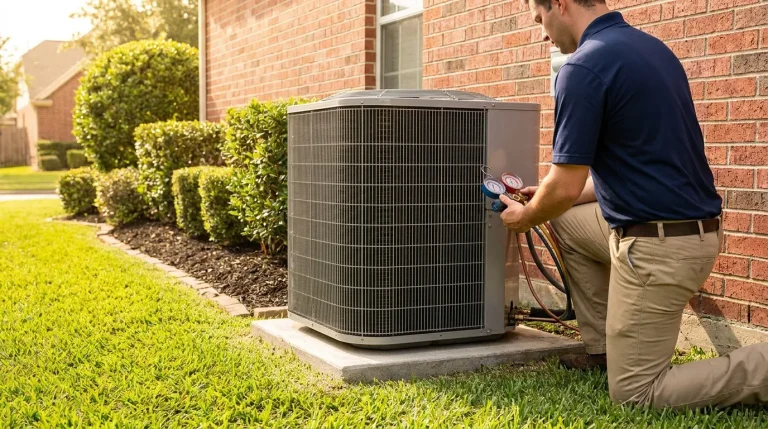
AC condenser unit care in Houston means keeping the outdoor coil clean, maintaining at least two feet of clearance around every side, protecting the unit from flooding and salt-laden Gulf Coast air, and having a qualified technician verify the refrigerant charge and electrical connections once a year. Homeowners who take these steps routinely see their outdoor equipment reach or exceed its full lifespan, while neglected condensers often fail years short of what the manufacturer designed the equipment to deliver.
Your outdoor AC condenser, which Houston homes rely on, is arguably the hardest-working piece of mechanical equipment on your property. It runs eight to nine months of the year, sits in direct sun, gets pounded by Gulf Coast humidity and the occasional flooding rain, and does all of it while an aggressive vegetation environment tries to overtake it. Yet most homeowners think about it exactly twice: the day it is installed, and the day it stops working.
Our team wants to change that. Not because we want to sell you a subscription service, but because a small amount of routine attention to protect your outdoor AC unit is one of the highest-return habits for extending your equipment's life and protecting your investment.
Let us walk through what your condenser actually needs, what the Gulf Coast environment throws at it, and where the line falls between homeowner-friendly care and work that belongs to a qualified technician.
What Your Condenser Unit Actually Does (and Why AC Condenser Unit Care Matters)
The condenser is the outdoor half of your central air conditioning system. Inside its cabinet sit the compressor, the outdoor coil, the outdoor fan, and the electrical controls that coordinate them. When your indoor thermostat calls for cooling, the compressor pressurizes refrigerant, the outdoor coil dumps heat from that refrigerant into the outdoor air, and the fan pulls air across the coil to carry that heat away.
That heat rejection job is the entire reason your indoor space gets cool. If the outdoor coil cannot dump heat effectively, the whole system loses efficiency, the compressor works harder, the electric bill climbs, and the equipment life shortens. Everything that follows in this guide comes back to that one fundamental job.
For homeowners investing in professional HVAC services for the long haul, protecting the condenser is protecting the majority of what makes an AC system work.
Homeowner-Friendly Outdoor AC Unit Maintenance Habits
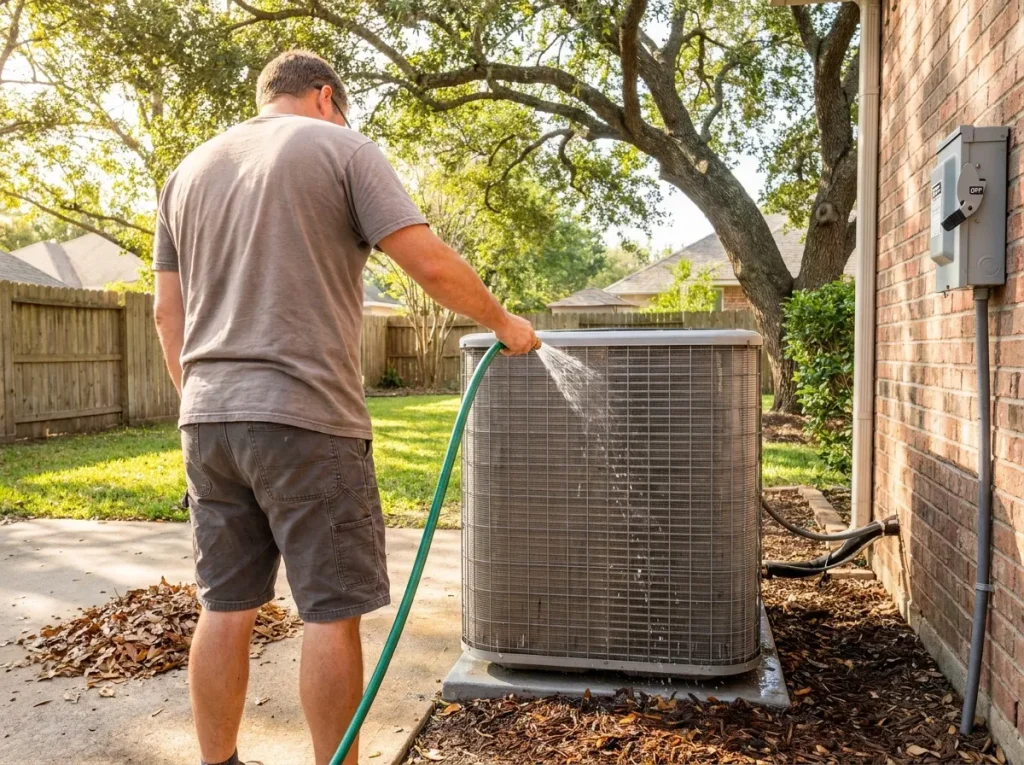
There is a real difference between the care a homeowner can safely handle and the work that requires a licensed technician. Here are the habits that fall squarely in homeowner territory and produce meaningful returns.
- Keep at least two feet of clearance around every side of the unit. Shrubs, fence lines, storage bins, and privacy screens all restrict airflow if they encroach on the equipment. Restricted airflow forces the compressor to work harder against a hotter operating environment, which is why ENERGY STAR's heating and cooling maintenance checklist calls out outdoor unit clearance and coil cleanliness as two of the most impactful homeowner care items.
- Rinse the outdoor coil gently with a garden hose two or three times each cooling season. Grass clippings, cottonwood fluff, lint, and Gulf Coast pollen collect on the coil fins and choke airflow. This light condenser cleaning Houston homeowners can handle themselves clears the majority of that buildup without any specialized tool, with the unit power turned off at the disconnect and a gentle top-to-bottom rinse.
- Trim vegetation back regularly. Houston greenery grows aggressively, and shrubs planted for privacy have a way of engulfing the condenser by mid-summer. A monthly walk-around with pruning shears keeps the two-foot clearance intact.
- Keep debris off the top of the unit. Leaves, seed pods from live oaks and pines, sticks after storms, and pool toys all end up on top of condensers if the yard is not checked. Clearing the top monthly during the cooling season keeps the fan pulling clean air.
- Check for level. Concrete pads settle over years, especially in Houston clay soils. A condenser tilted more than a few degrees can stress refrigerant lines and impair oil return to the compressor. A visual check every year or two is enough to catch settling early.
- Watch for storm damage. After a hurricane, tropical storm, or severe hail event, walk out and inspect the cabinet for dents, bent fins, and debris impact. Cosmetic damage rarely matters. Bent coil fins across a large area or a struck fan blade does matter.
What Houston's Gulf Coast Environment Throws at Your Condenser (and How to Protect Your Outdoor AC Unit)
Houston is a harder environment on outdoor HVAC equipment than most of the country. Understanding why helps you prioritize the care that matters most.
Sustained high humidity accelerates corrosion
The 75-percent-plus humidity our region carries most of the year means metal surfaces stay damp much of the time. That constant moisture accelerates rust and coil degradation, especially on lower-tier cabinets without corrosion-resistant coatings.
Salt-laden air near the coast and bays adds a corrosive layer
Homes in eastern Houston, in Galveston, or along the Ship Channel corridor deal with real salt exposure that eats through coils and cabinet finishes faster than inland areas. Coated coils and periodic freshwater rinsing help significantly.
Flooding risk during heavy rain events
Houston's flat topography, gulf-influenced storm patterns, and dense development create meaningful flooding exposure. A submerged condenser suffers electrical damage, oil contamination, and compressor risk that often makes the unit unrecoverable. Elevating the pad in flood-prone areas is a real consideration.
Aggressive vegetation growth
Our long growing season and humid heat let landscape plants overtake equipment quickly. What was two feet of clearance in April can be four inches of clearance by August without intervention.
Wildlife pressure
Squirrels, roof rats, and lizards find outdoor units interesting. Nesting material inside the cabinet or chewed wiring on the electrical whip is more common than most homeowners realize, and both cause failures.
For homeowners who purchase coastal-area properties or homes near a flood zone, thinking about condenser location and protection during any AC upgrade project is often more valuable than the equipment tier itself. Any new AC system installation our team designs for a coastal-adjacent Houston home factors these environmental risks into the plan.
Flood Protection: A Houston-Specific Priority
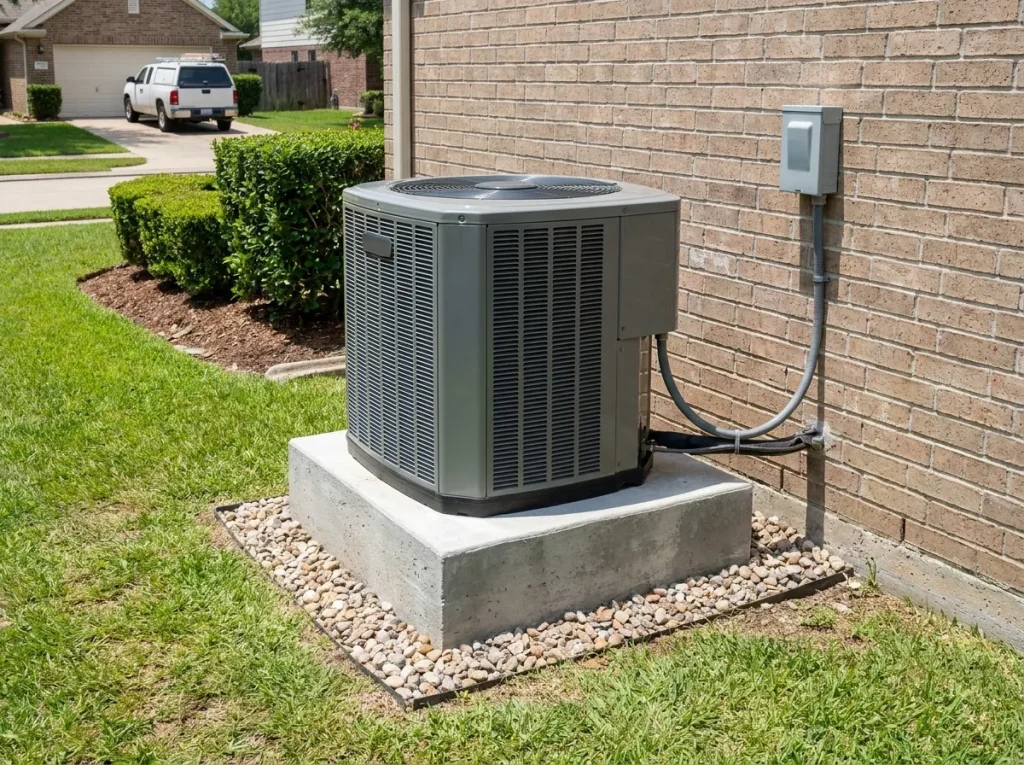
Flooding deserves its own section because it is uniquely serious for Houston condensers and easy to underestimate until it happens.
Elevate the pad above local flood expectations
Homes in known flood zones benefit from pouring the equipment pad six to eighteen inches above natural grade, keeping the electrical connections and cabinet interior above the water line during typical flooding events.
Route condensate and yard drainage away from the pad
Poor grading around the equipment traps water against the cabinet base, accelerating corrosion of the pan and lower coil edge.
Consider a hurricane-rated fan cover for storm season
During major storm events, an approved cover protects the fan blade and coil from wind-driven debris. These are removed for normal operation, since blocking airflow during runtime causes its own problems.
Know what to do after a flood
If your condenser has been submerged, do not power it on. Water inside the electrical compartment and around the compressor makes energizing the unit unsafe. Have a qualified technician inspect it before any attempt to run the system.
Consider flood coverage on your homeowners insurance
HVAC replacement after a flood is a substantial expense, and standard homeowners insurance policies typically do not cover flood damage. Flood insurance, offered separately, is worth exploring for homes in higher-risk zones.
What Requires a Qualified Technician
Some condenser care is homeowner territory. Other work is not. Here is the honest line.
- Refrigerant charge verification. Only a licensed technician can legally add or recover refrigerant. Low charge from a slow leak reduces efficiency and eventually damages the compressor. Annual verification catches problems early.
- Electrical connection inspection. The disconnect box, contactor, capacitor, and terminal connections all degrade over years of heat cycling and humidity. A technician can tighten connections, test capacitor microfarad values, and identify contactors nearing failure before they leave you without cooling.
- Coil cleaning beyond a garden hose rinse. Deep coil cleaning with proper coil cleaner and low-pressure water is a technician task. Aggressive water pressure or the wrong chemicals damage the fins and coating and can void warranty coverage.
- Fin straightening. Bent coil fins from hail or accidental impact restrict airflow. Technicians use a fin comb to straighten larger areas gently without further damage.
- Motor and blade inspection. The outdoor fan motor and blade balance affect both efficiency and equipment life. A yearly professional check catches bearing noise, blade wobble, and motor amp draw issues before they become failures.
- Warranty registration and coverage checks. Our team handles 90-day warranty registration on new installations, and confirming that your equipment warranty coverage is intact during any service visit protects your investment.
For homeowners with an aging system, a professional inspection can also inform whether continued care makes sense or whether replacement planning should start. Combining an AC evaluation with a look at any planned Houston heating installation upgrade often produces the most complete picture.
Signs Your Condenser Needs Professional Attention
Rather than waiting for a total failure, watch for these signals that the outdoor unit needs a technician sooner rather than later.
- Increased runtime for the same cooling result. If the system is running longer to hit the same setpoint, coil condition, refrigerant charge, or airflow is likely off.
- Warm air blowing from indoor registers. This can point to a low charge, a failed capacitor, or a compressor issue at the outdoor unit.
- Unusual noise from the outdoor unit. Loud humming, grinding, buzzing, or rattling all warrant a technician's diagnosis. Normal condenser operation is a steady low hum from the compressor and fan.
- Ice forming on the refrigerant line. Ice on the outdoor line set usually points to a low refrigerant charge or airflow problem and should be diagnosed before more damage occurs.
- Frequent breaker trips at the disconnect or panel. Repeated tripping indicates an electrical fault that will not fix itself and can be dangerous.
- Any burning or overheated electrical smell near the unit. Turn the disconnect off and call a technician. Do not attempt to open the electrical compartment.
Key Takeaways
- Homeowner-friendly condenser care includes maintaining two feet of clearance, rinsing the coil gently a few times per cooling season, trimming vegetation, keeping debris off the top, and watching for storm damage
- Houston's Gulf Coast environment accelerates corrosion, invites flooding risk, drives aggressive vegetation growth, and creates wildlife pressure that all shorten condenser life if ignored
- Flood protection through elevated pads, drainage grading, and post-flood professional inspection is uniquely important in our market
- Refrigerant charge, electrical connections, deep coil cleaning, fin straightening, and motor inspection all require a qualified technician
- Warning signs like increased runtime, warm indoor airflow, unusual outdoor noise, ice on refrigerant lines, breaker trips, or electrical smells all warrant a service call
- Consistent care routinely lets condensers reach or exceed their designed lifespan, while neglect often ends equipment years early
Frequently Asked Questions
How often should I clean my outdoor AC unit?
A gentle garden hose rinse of the outdoor coil two or three times per cooling season is a reasonable homeowner routine in Houston, plus monthly walk-arounds to clear debris off the top and confirm two-foot clearance is intact. Deeper coil cleaning with proper coil cleaner is a technician task best handled during an annual service visit. Homeowners in coastal-adjacent areas dealing with salt exposure benefit from more frequent freshwater rinsing to slow corrosion.
Should I cover my outdoor AC unit in winter or during storms?
For normal Houston winters, no. Central AC condensers are engineered to sit outside year-round, and covering the unit traps moisture, invites rodents, and can promote corrosion. During a specific major storm event with wind-driven debris risk, an approved hurricane-rated fan cover can protect the unit temporarily, but it must be removed before the system runs again. Full cabinet covers used through winter typically cause more problems than they prevent.
How much clearance does my outdoor unit really need?
At least two feet on every side and above is the general rule for airflow and service access. Some manufacturers specify more depending on model, so it is worth checking the installation manual for your specific equipment. Reducing clearance restricts airflow to the coil, forces the compressor to work harder against a hotter operating environment, and shortens equipment life. Houston's aggressive plant growth means this is worth checking monthly during the growing season.
What should I do if my condenser floods?
Do not power it on. Have the electrical disconnect turned off if it is not already, and call a qualified technician to inspect the unit before any attempt to run it. Water inside the electrical compartment and around the compressor makes energizing the unit both unsafe and often the final act that pushes damage from recoverable to unrecoverable. Depending on flood depth and duration, some units can be restored and others cannot, and only an inspection tells you which.
How long should an outdoor AC condenser last in Houston?
With consistent care and correct sizing, a well-installed modern condenser in Houston typically reaches or exceeds its designed lifespan of roughly 12 to 15 years, and premium equipment often runs longer. Neglected units in aggressive coastal-adjacent environments often fail well short of that, sometimes at 8 to 10 years. Correct installation, routine care, professional annual inspection, and correct system sizing are the four biggest determinants of how close to the top end of that range your specific equipment gets.
Conclusion
Your outdoor condenser is doing more work in a harder environment than most of the equipment on your property, and it deserves a small amount of routine attention in exchange. The habits are not complicated. Keep clearance, rinse the coil, clear debris, watch for storm damage, and get a qualified technician to check the refrigerant charge and electrical connections once a year. Do those things and your equipment routinely reaches the long end of its designed lifespan.
At VeriChill, when our team evaluates a home's outdoor equipment, we walk through insulation, ductwork condition, ceiling heights, window orientation, and airflow distribution alongside the condenser location, environment, and condition. Sometimes routine care and a professional tune-up is the whole answer. Sometimes it is time to plan a replacement. The recommendation always follows what we actually see at the property, not a scripted service pitch.
Ready to have your outdoor unit assessed before the next big storm or peak-heat stretch? Call us at 281-559-6995 or visit verichill.com to schedule a consultation.