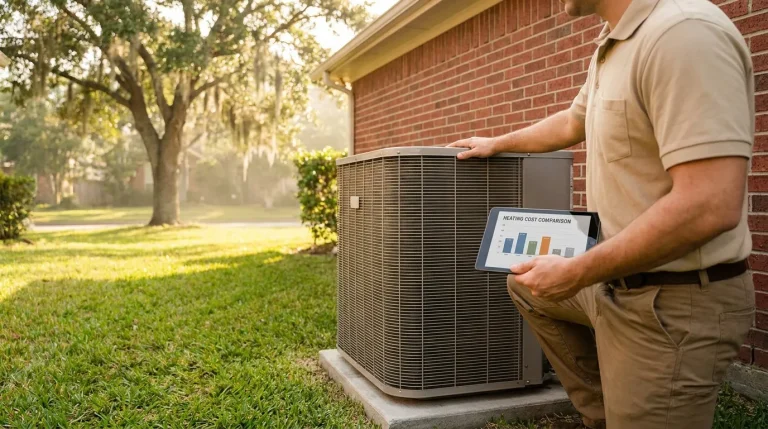
The heat pump vs. furnace cost comparison in Houston lands differently here than in cold climates, and the reason is our mild winters. A heat pump moves heat rather than burning fuel to create it, so it delivers more heating energy than the electricity it consumes, and in Houston's mild conditions it operates in its most efficient range for almost the entire heating season. A gas furnace burns fuel at a fixed efficiency no matter how mild the day. For most Houston homes, that combination makes a heat pump the lower operating-cost choice across our short, mild heating season, which is why our team favors heat pumps for our climate.
Ask ten people whether a heat pump or a gas furnace is cheaper to run and you will get ten confident, contradictory answers. Most of them are borrowed from cold-climate advice, where furnaces often win because heat pumps struggle in deep freezes and gas can be inexpensive. That advice does not transfer to Houston, and applying it here leads people to the wrong conclusion.
Operating cost is not about the equipment in the abstract. It is about how the equipment performs in your actual climate against your actual utility rates. Houston has mild winters and a specific utility rate structure, and both of those facts push the comparison in a direction the national conversation rarely acknowledges.
Let us walk through how each system actually consumes energy, why Houston's mild winters change the math, and how our team helps homeowners land on the lower operating-cost choice for their home rather than a rule of thumb imported from Minnesota.
How Each System Consumes Energy
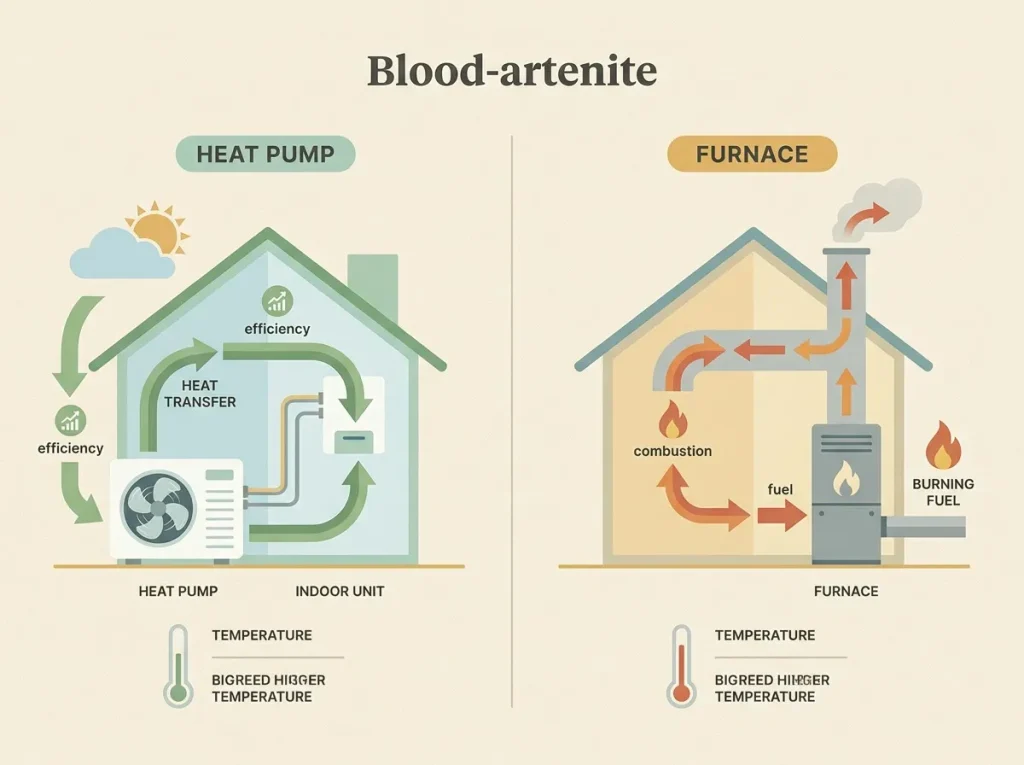
The operating-cost difference starts with a fundamental difference in how the two systems produce heat. Understanding that difference is the key to the whole comparison.
A gas furnace burns fuel
A gas furnace creates heat by burning natural gas. Its efficiency is measured by AFUE, the percentage of fuel energy converted to usable heat. A high-efficiency furnace might convert most of the fuel to heat, but it can never exceed 100 percent, because it is fundamentally limited by combustion. It burns the same way on a barely-cool day as on a genuinely cold one.
A heat pump moves heat
A heat pump does not create heat by burning anything. It moves existing heat from the outdoor air into your home using electricity, the same principle as an air conditioner running in reverse. Because it moves heat rather than generates it, it can deliver several units of heat energy for every unit of electricity it consumes. Its efficiency is measured by HSPF2 for the season and COP at a given moment, and unlike AFUE, that ratio can be well above 100 percent equivalent.
Why the mechanism matters for cost
This is the crux. A furnace is capped by combustion. A heat pump multiplies its energy input, and it multiplies it most effectively when the outdoor temperature is mild, because there is more ambient heat available to move and the temperature lift is small. The milder the winter, the better the heat pump's advantage. Homeowners weighing these mechanisms benefit from talking them through with HVAC replacement service who can translate the ratings into what they mean for a specific home.
Why Houston's Mild Winters Change the Math
Here is where the national advice breaks down and Houston reality takes over. The heat pump's efficiency depends heavily on outdoor temperature, and our outdoor temperatures are exactly what a heat pump likes.
| Factor | Cold climate | Houston |
|---|---|---|
| Heat pump efficiency | Drops in deep freezes | Stays high through mild winters |
| Furnace efficiency | Fixed by AFUE | Fixed by AFUE |
| Supplemental heat needed | Often, during freezes | Rarely |
| Heating season length | Long and severe | Short and mild |
| Cost advantage | Often favors gas | Favors heat pump |
Heat pumps operate in their sweet spot here
A heat pump is most efficient when it only has to raise the temperature a modest amount. Houston winters, which spend most of their time well above freezing, keep the heat pump in that high-efficiency range for nearly the whole season. It rarely faces the deep cold that forces a cold-climate heat pump into inefficient operation or expensive backup heat.
The season is short and forgiving
Because our heating season is brief and mild, the total amount of heating a Houston home needs is small compared with a northern home. That shrinks the absolute cost of heating either way, but it also means the heat pump spends nearly all of its limited runtime in efficient conditions, maximizing its operating-cost edge.
Utility rate structure matters
The comparison also depends on local electricity and natural gas rates, and Houston's rate structure factors into the calculation. Utilities like CenterPoint Energy deliver both, and the relationship between the electric rate and the gas rate, combined with the heat pump's efficiency multiplier, is what determines the real cost gap for a given home. Because that relationship shifts, our team looks at the current picture rather than a stale assumption.
What This Means for the Average Houston Home

Translating the mechanics into a recommendation, the picture for most Houston homes is fairly clear, with some worthwhile nuance.
The heat pump usually wins on operating cost
For the typical Houston home, a heat pump delivers lower heating operating costs than a gas furnace across our mild season, because it multiplies its energy input in exactly the conditions our winters provide. This is the core reason our team favors heat pumps for Houston, and it is reinforced by the fact that the same heat pump also provides your cooling, so one efficient system covers both seasons. For the efficiency ratings behind that advantage, ENERGY STAR heat pump efficiency information is a useful reference.
Dual fuel is the hedge for the coldest snaps
For homeowners who want insurance against the occasional hard freeze, a dual fuel system pairs a heat pump with a gas furnace, letting the heat pump handle the efficient majority of the season and the furnace step in only during the rare deep cold. This captures most of the heat pump's operating-cost advantage while covering the extremes.
Existing infrastructure influences the call
If a home already has gas service and a relatively new furnace, the calculus shifts, and our team weighs that existing infrastructure rather than assuming a clean slate. When a system is due for replacement anyway, that is the natural moment to evaluate a heat pump on its Houston merits. That evaluation fits naturally alongside any heating unit installation planning, and because a heat pump also handles cooling, it connects directly to AC system installation decisions as well.
How Our Team Approaches the Comparison for Your Home
Rather than quoting a generic winner, our team runs the comparison against your specific situation, because the right answer genuinely depends on the home.
Start with the home and the climate
We look at the home's heating load given its insulation, ductwork, ceiling heights, window orientation, and airflow distribution, then consider how a heat pump would perform across a typical Houston winter. Correct sizing matters here as much as anywhere, since oversizing remains the most common HVAC problem we see and it undercuts efficiency in heating just as it does in cooling.
Weigh the full-year picture
Because a heat pump provides both heating and cooling, the operating-cost comparison is not just about winter. A single efficient heat pump covering both seasons often makes more sense for a Houston home than a separate furnace and AC, and we factor that whole-year view into the recommendation.
Give honest tradeoffs, not a sales pitch
Our team explains what you gain and what you give up with each option: the heat pump's operating-cost advantage and dual-season coverage, the furnace's familiarity and performance in extreme cold, and the dual fuel system's balance of both. The goal is the lowest real cost and best comfort for your home, not a one-size-fits-all answer.
Key Takeaways
- A heat pump moves heat rather than burning fuel, so it delivers more heating energy than the electricity it consumes, unlike a furnace capped by combustion
- Houston's mild winters keep a heat pump in its most efficient operating range for nearly the entire heating season
- For most Houston homes, a heat pump is the lower operating-cost heating choice across our short, mild season
- The comparison depends on local electricity and gas rates, so our team looks at the current picture rather than a stale assumption
- Dual fuel systems hedge against rare hard freezes while capturing most of the heat pump's operating-cost advantage
- A heat pump also provides cooling, so one efficient system can cover both Houston seasons, which strengthens its whole-year value
Frequently Asked Questions
Is a heat pump or gas furnace cheaper to run in Houston?
For most Houston homes, a heat pump is the lower operating-cost choice across our heating season. A heat pump moves heat rather than burning fuel, so it delivers more heating energy than the electricity it uses, and Houston's mild winters keep it in that high-efficiency range for nearly the whole season. A gas furnace burns fuel at a fixed efficiency regardless of how mild the day is. The exact gap depends on current electricity and gas rates and your specific home, but the mild-winter advantage consistently favors the heat pump here.
Why does cold-climate advice about furnaces not apply to Houston?
Because cold-climate advice assumes long, severe winters where heat pumps lose efficiency in deep freezes and often need expensive backup heat, which can tip the cost advantage toward gas. Houston has the opposite conditions: short, mild winters that keep a heat pump in its efficient operating range almost the entire season, with deep freezes rare enough that supplemental heat is seldom needed. Applying northern advice here leads homeowners to overvalue gas and undervalue the heat pump that actually fits our climate.
What is a dual fuel system and should I consider one?
A dual fuel system pairs a heat pump with a gas furnace. The heat pump handles the efficient majority of Houston's mild heating season, and the gas furnace steps in only during the rare hard freeze when it may be more effective. This captures most of the heat pump's operating-cost advantage while providing a hedge for the coldest snaps. It is a strong option for homeowners who already have gas service or who want insurance against extreme cold without giving up the heat pump's everyday efficiency.
Does a heat pump save money in summer too?
Yes, indirectly, in the sense that a heat pump is your air conditioner in summer, since it works by moving heat and simply reverses to cool. That means one efficient system covers both seasons rather than maintaining a separate furnace and AC. When our team compares operating costs, we look at the full-year picture, not just winter, because the heat pump's dual-season role is a meaningful part of its value for a Houston home where cooling dominates the calendar.
Do electricity and gas rates change the heat pump vs furnace comparison?
They do, which is why our team looks at the current rate picture rather than relying on an old assumption. The real cost gap depends on the relationship between the local electricity rate and the natural gas rate, combined with the heat pump's efficiency multiplier. Utilities in the Houston area deliver both, and the balance between them shifts over time. The heat pump's efficiency advantage in our mild climate is durable, but the precise dollar gap moves with the rates, so a current comparison is more reliable than a general rule.
Conclusion
The heat pump versus gas furnace debate has a clear regional answer that the national conversation tends to miss. In cold climates, the case for gas is real. In Houston, our mild winters keep a heat pump in its efficient sweet spot for nearly the whole season, and that efficiency multiplier, combined with the fact that the same system handles our long cooling season, makes the heat pump the lower operating-cost choice for most homes here.
At VeriChill, our team runs this comparison against your actual home, your heating load, and the current rate picture rather than a borrowed rule of thumb. Sometimes the answer is a straight heat pump, sometimes a dual fuel system for extra insurance, and occasionally an existing gas setup that still makes sense to keep. The recommendation follows the home and the climate, not a national headline.
Want a heat pump versus furnace comparison run for your specific Houston home? Call us at 281-559-6995 or visit verichill.com to schedule a consultation.