HVAC installation works by setting matched indoor and outdoor equipment, joining them with a sealed refrigerant line set, removing all air and moisture from that line set with a vacuum pump, charging the refrigerant to a measured specification, and then verifying airflow and temperature performance before the crew leaves. Every one of those steps is confirmed with instruments rather than judged by eye, and the measurements are what separate a system that runs from a system that performs the way its rating claims.
Most homeowners watching an installation see equipment come off a truck, go into an attic, and get connected. That version is accurate as far as it goes, but it misses the part that determines whether the system delivers what you paid for. The physical placement of equipment is the visible half of the job. The measured half happens through a set of gauges, a micron gauge, and a manometer, and it is largely invisible once the panels go back on.
This guide walks through the mechanics of the work itself, step by step, and explains what each step is actually accomplishing. If you want the broader definition of what installation covers, or the checklist for clearing your home before the crew arrives, those are separate subjects. What follows is what the crew is doing and why each stage decides how the system behaves for the next fifteen years. Because a great deal of it happens in a Houston attic in August, our conditions change the execution in ways worth understanding before you compare quotes for AC installation in Houston.
What a Correctly Working System Is Measured Against
Before describing the steps, it helps to know what the crew is aiming at, because every stage of the installation exists to hit one of a small number of numbers. A finished system is not judged by whether cold air comes out of the vents. Cold air comes out of badly installed systems too, at least for a while.
The industry standard for a quality installation, defined by the Air Conditioning Contractors of America, centers on a handful of verifiable readings. Airflow across the indoor coil has to fall within the manufacturer's range, usually stated in cubic feet per minute per ton of capacity. Refrigerant charge has to be correct by measurement rather than approximation. Static pressure in the duct system has to sit within what the blower is designed to work against. Temperature drop across the coil has to land in the expected band once the system has run long enough to stabilize.
These four readings are related, which is why a problem in one shows up as a symptom in another. Low airflow produces a temperature split that looks impressive on a thermometer while the coil slowly freezes. An overcharged system produces high head pressure and shortens compressor life without ever tripping an alarm the homeowner would notice.
| What is measured | Typical target range | What a bad reading causes |
|---|---|---|
| Airflow across the coil | Roughly 350 to 400 CFM per ton | Coil freezing, poor dehumidification, short cycling |
| Total external static pressure | At or below the blower's rated maximum | Reduced airflow, blower strain, noise |
| Refrigerant charge | Manufacturer's subcooling or superheat target | Compressor wear, capacity loss, high bills |
| Temperature drop across the coil | Roughly 18 to 22 degrees once stabilized | Indicates airflow or charge is off |
None of these numbers appear on the equipment tag, and none of them can be assessed by touch. That is the practical reason to ask whether commissioning readings will be documented and handed to you, because a contractor who takes them has no reason to withhold them.
Setting the Equipment and Why Placement Decides Service Life
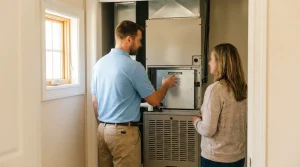
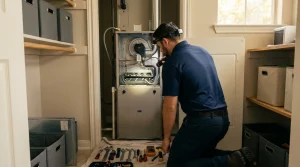
The indoor unit goes first in most jobs. In the majority of Houston homes that means an air handler or furnace in the attic, which is a harder installation than a closet or basement placement and carries consequences that last as long as the equipment does.
The unit has to sit level, because the condensate drain pan relies on gravity to move water toward the drain rather than toward the ceiling below it. It has to be supported on a platform that will not sag or shift. It needs enough clearance on the service side that a technician can actually reach the blower, the coil, and the electrical connections a few years from now, since a unit wedged against a truss makes every future service call longer and more expensive.
Attic placement also brings a safety requirement that matters more here than in drier climates. A secondary drain pan sits beneath the unit with a float switch wired to shut the system down if the primary drain clogs. Houston humidity means an air handler running through a summer afternoon produces a steady stream of condensate, and a blocked drain without a working float switch is how ceilings come down.
| Placement detail | What it requires | Why it matters later |
|---|---|---|
| Indoor unit level | Set true so the drain pan slopes to the outlet | Standing water in the pan reaches the ceiling below |
| Service clearance | Reachable blower, coil, and electrical panel | Every future service call takes longer without it |
| Secondary drain pan | Pan plus a wired float switch beneath the unit | Shuts the system down before a clogged drain floods |
| Condenser pad | Level, with clearance on all sides for airflow | Boxed-in units recirculate hot air and run at high pressure |
Outdoors, the condenser goes on a level pad with clearance on every side for airflow, plus room in front of the service panel. Airflow clearance is not a formality, since the outdoor coil rejects heat by pulling air across it, and a unit boxed in by fencing or shrubs recirculates its own hot discharge air and runs at higher pressures all season.
Joining the Refrigerant Lines Without Contaminating Them
The two units are connected by a line set, a pair of insulated copper lines carrying refrigerant between the outdoor condenser and the indoor coil. On a replacement the existing line set is sometimes reused, and whether that is acceptable depends on its condition, its size relative to the new equipment, and whether the old system had a compressor failure that pushed debris through it.
Joining copper is done by brazing, which means heating the joint until filler metal flows into it and forms a sealed connection. The detail that matters is what is inside the pipe while that happens. Heating copper in the presence of air forms a black scale on the inside wall of the tubing, and that scale flakes loose once refrigerant starts moving. It travels through the system and lands where it does the most damage, which is the compressor and the metering device.
The prevention is straightforward and takes a few extra minutes. A slow flow of nitrogen is run through the line while the joint is heated, displacing the oxygen so no scale can form. It leaves no trace a homeowner could inspect afterward, which is exactly why it is worth asking about beforehand.
Electrical connections follow at both ends, high voltage from the disconnect to the condenser and low voltage control wiring between the thermostat, the indoor unit, and the outdoor unit. The condensate drain is routed with consistent slope, tied into an appropriate termination, and fitted with a cleanout so it can be serviced without cutting the pipe apart.
Evacuation: The Step That Quietly Decides Compressor Life
Once the system is sealed, it contains air and water vapor, and both have to come out before refrigerant goes in. This is the step most likely to be shortened when a crew is behind schedule, and it is close to invisible in the finished result.
Air in a refrigerant circuit is a non-condensable gas. It raises operating pressures and reduces capacity, so the system works harder to deliver less. Moisture is the more serious problem, because water combines with refrigerant oil to form acids that corrode the system from the inside and eventually destroy the compressor windings. A system that fails at year seven instead of year fifteen is often carrying damage that started as moisture nobody removed.
Evacuation uses a vacuum pump to draw the pressure down far enough that any remaining water boils off and gets pulled out as vapor. Depth is measured in microns with a dedicated gauge, not with the pressure gauges on a manifold, which lack the resolution to show anything meaningful in that range. The accepted target is 500 microns or lower.
The verification step is the decay test. The pump is valved off and the system is left to sit. If the reading holds steady, the system is dry and tight. If it climbs slowly, moisture is still boiling off. If it climbs quickly and keeps going, there is a leak, and finding it now is far cheaper than finding it after the refrigerant is in and has to be recovered again.
Charging and Airflow Verification by Measurement
Refrigerant charge is where measurement replaces intuition most clearly. Systems ship with a factory charge sized for a specific line set length, so a longer or shorter run changes what the system needs. Topping off until the suction line feels cold is not a method, though it is a common one.
The correct approach depends on the metering device. Systems using a fixed orifice are charged by superheat, and systems using a thermostatic or electronic expansion valve, which covers most modern equipment, are charged by subcooling. Either way the technician takes pressure and temperature readings, calculates the value, compares it to the manufacturer's target, and adjusts until it matches.
Houston adds a wrinkle here that crews in milder climates rarely think about. Charging accuracy depends partly on outdoor ambient temperature, and a system charged on a 100 degree afternoon behaves differently from one charged at 70 degrees. Experienced local technicians account for this rather than reading the chart as though conditions were standard.
Airflow gets verified in the same spirit. Total external static pressure is measured with a manometer on both sides of the air handler, which tells the technician whether the duct system is letting the blower move the air it was designed to move. High static pressure is common in Houston homes with undersized returns or long flex runs, and it quietly strips capacity from equipment that tests fine on the bench.
| Commissioning step | Instrument used | What passing looks like |
|---|---|---|
| Evacuation depth | Micron gauge | 500 microns or lower, holding on decay test |
| Refrigerant charge | Manifold gauges plus temperature probes | Subcooling or superheat matches the data plate |
| Static pressure | Manometer | At or below the blower's rated maximum |
| Temperature split | Thermometer at supply and return | Roughly 18 to 22 degrees after stabilizing |
| Electrical draw | Clamp meter | Within the amperage listed on the equipment |
| Condensate flow | Visual plus float switch test | Water flows freely, safety switch shuts the system down |
The last item on that list is worth its own mention. Testing a float switch takes about a minute and confirms that the safety actually works, and skipping it means nobody finds out until the day the drain clogs.
What Houston Conditions Change About the Execution
Everything described so far applies wherever a system gets installed. What changes here is how much the margins matter, because our climate removes most of the room for error.
Attic temperatures in a Houston summer routinely pass 130 degrees, which affects both the crew and the work. Brazing, evacuation, and charging all take longer when technicians are cycling in and out of that heat, and rushing any of them is precisely what a homeowner cannot see afterward. Crews commonly schedule attic work for early morning for this reason, which is one practical argument for booking replacement outside peak summer when the timing is yours to choose.
Humidity changes the airflow conversation. Moisture leaves your home only while the system is running and air is passing across a cold coil, so a system moving too much air across the coil cools the house quickly and dehumidifies poorly. That is why airflow gets set toward the lower end of the acceptable range in humid climates rather than the higher end, and it is part of why variable speed systems perform well here. Longer run time at reduced output pulls more water out of the air.
Our cooling season also runs roughly nine months, so equipment here accumulates far more run hours than the same unit would elsewhere. A charge that is slightly off or a static pressure reading slightly high does not produce a dramatic failure. It produces steady extra wear across thousands of additional hours, which is how installation quality turns into service life. Working with an established Houston HVAC company means the measurements get taken and documented rather than assumed, and homeowners comparing bids can request a system evaluation to see what their home actually requires before the numbers start moving.
Key Takeaways
- HVAC installation works through a measured sequence: set the equipment, braze a sealed line set, evacuate air and moisture, charge refrigerant to specification, then verify airflow and temperature performance with instruments.
- A finished system is judged against four readings, which are airflow across the coil, total external static pressure, refrigerant charge by subcooling or superheat, and temperature drop across the coil.
- Brazing without a nitrogen purge leaves scale inside the copper that later travels to the compressor and metering device, and it leaves no evidence a homeowner could inspect.
- Evacuation to 500 microns with a holding decay test is what removes the moisture that forms acids and shortens compressor life, and it is the step most often cut short under schedule pressure.
- Refrigerant charge is calculated from pressure and temperature readings against the manufacturer's target, not judged by how cold the suction line feels, and Houston's outdoor temperatures affect the calculation.
- Airflow in a humid climate is set toward the lower end of the acceptable range, because moisture removal only happens while air passes slowly enough across a cold coil.
- Houston's nine-month cooling season means small installation errors do not fail dramatically, they accumulate as extra wear across thousands of additional run hours.
Frequently Asked Questions
How does HVAC installation work?
Matched indoor and outdoor equipment is set in place, joined by a sealed refrigerant line set, evacuated to remove air and moisture, charged with refrigerant to a measured specification, then tested for airflow, static pressure, and temperature performance before completion.
What is a nitrogen purge and why does it matter?
A slow flow of nitrogen through the copper line while joints are brazed, which displaces oxygen so no scale forms inside the pipe. Without it, that scale flakes loose later and damages the compressor and metering device.
What does evacuation do?
It uses a vacuum pump to pull air and water vapor out of the sealed refrigerant lines before charging. Moisture left inside combines with refrigerant oil to form acids that corrode the system and shorten compressor life.
What is 500 microns?
The accepted vacuum depth for a properly evacuated system, measured with a micron gauge. After reaching it the pump is valved off and the reading should hold steady, which confirms the system is both dry and leak-free.
How is refrigerant charge determined?
By calculation, not by feel. Technicians take pressure and temperature readings, then compute subcooling or superheat depending on the metering device and adjust until the value matches the manufacturer's target on the data plate.
What is static pressure and why is it checked?
The resistance the duct system creates against the blower, measured with a manometer. High static pressure reduces airflow and strips capacity from equipment that would otherwise perform to its rating.
What temperature drop should a working system produce?
Roughly 18 to 22 degrees between return and supply air once the system has run long enough to stabilize. A reading outside that band usually points to an airflow or charge problem rather than a broken component.
Why does airflow get set lower in Houston?
Because moisture removal only happens while air moves across a cold coil. Air moving too quickly cools the house before enough water condenses out, leaving the home cool but damp.
Does a float switch really need testing?
Yes. It takes about a minute and confirms the safety will shut the system down if the condensate drain clogs. Untested, nobody discovers a failed switch until water is already coming through the ceiling.
Can I see the commissioning readings?
You can and you should ask. A contractor who measures airflow, static pressure, charge, and electrical draw has documentation available, and receiving it gives you a baseline for comparison years later.
Final Thoughts
The mechanics of HVAC installation come down to a sealed system, a dry system, a correctly charged system, and verified airflow. Each of those is achieved with an instrument and confirmed with a number, which is why two crews installing identical equipment in identical homes can produce systems that perform very differently. The equipment sets the ceiling. The execution decides how close you get to it.
In Houston that gap widens, because our nine-month cooling season converts small errors into thousands of extra run hours under load, and our humidity punishes airflow decisions that would go unnoticed in a dry climate. The useful takeaway for a homeowner is not that you need to understand micron gauges. It is that these steps produce documentation, and asking to see it before you sign tells you a great deal about how the work will be done.
Ask for commissioning numbers on your Houston AC installation quote.
Schedule a system evaluation before comparing installation bids.