AFUE and HSPF2 are two different efficiency ratings that measure two different kinds of heating equipment. AFUE measures how much of a gas furnace's fuel is converted into usable heat, expressed as a percentage from roughly 80% to 98%. HSPF2 measures a heat pump's heating-season efficiency. The two numbers are not directly comparable because they describe different fuel types, and in Houston's mild winters, the heat pump number usually matters most.
When Houston homeowners start shopping for heating equipment, they run into a wall of acronyms almost immediately. AFUE, HSPF2, SEER2, COP. The numbers look comparable, so people assume a 95% furnace must be better than a heat pump rated at 8.1. After more than a decade of designing and installing heating systems across the Houston metro, our team can tell you that assumption steers homeowners toward the wrong equipment more often than any other single misunderstanding.
The problem is that these two ratings measure different things. One describes combustion. The other describes electric heat transfer. Putting them side by side and picking the bigger number is like comparing a car's miles per gallon to an electric vehicle's miles per kilowatt-hour and declaring a winner. They answer different questions.
Let us walk through what each rating measures, where the minimums are set, why heat pumps tend to win in our climate, and how to compare across fuel types as you decide what to put in your home.
What AFUE Measures
AFUE stands for annual fuel utilization efficiency, and it is the rating standard for gas furnaces and boilers. The number answers one focused question about combustion heating equipment:
- What it tracks: Of all the fuel your furnace burns over a heating season, AFUE tells you what percentage actually becomes heat inside your home. An 80% AFUE furnace converts 80% of its fuel into usable heat, with the remaining 20% escaping as exhaust through the flue, while a 96% AFUE furnace wastes only 4%.
- Why the label exists: The U.S. Department of Energy requires that new furnaces display this rating so buyers can compare gas furnace efficiency directly against other gas units. It gives you an apples-to-apples view across combustion models.
- What it does not cover: AFUE only applies to combustion equipment, so it tells you nothing about a heat pump, because a heat pump does not burn fuel. When you see an AFUE figure on a spec sheet, you are always looking at a furnace or boiler.
AFUE rating explained by tier
Furnaces fall into a few broad efficiency bands. Standard-efficiency units sit near the federal minimum. Condensing furnaces use a second heat exchanger to extract additional heat from the exhaust, pushing them into the higher range.
| AFUE Range | Furnace Type | What It Means |
|---|---|---|
| 80% to 83% | Standard efficiency | Single heat exchanger, vents through a flue |
| 90% to 95% | High efficiency | Condensing design, recovers exhaust heat |
| 95% to 98% | Premium condensing | Maximum fuel conversion available |
Two practical points shape how these tiers play out in a Houston home:
- The southern minimum is already efficient: The federal efficiency minimum for new gas furnaces in southern states sits at 80% AFUE, so even an entry-level furnace converts most of its fuel into usable heat.
- Condensing units carry a tradeoff: Stepping up to a condensing model improves the furnace efficiency rating but adds venting requirements that not every Houston home can accommodate easily.
What HSPF2 Measures
HSPF2 stands for heating seasonal performance factor, version 2, and it is the heat pump efficiency rating for the heating season. The metric works on a completely different principle than AFUE:
- How it generates warmth: A heat pump does not create heat by burning anything, but instead moves existing heat from the outdoor air into your home using electricity. Because it moves heat rather than generates it, a heat pump can deliver more heating energy than the electrical energy it consumes, which is why the HSPF2 scale uses a different unit and an entirely different set of numbers.
- Why it is the current standard: HSPF2 replaced the older HSPF metric in 2023 when the Department of Energy updated its testing procedures to reflect more realistic operating conditions. An HSPF2 number is typically lower than the old HSPF figure for the same equipment, so a heat pump rated 7.5 HSPF2 today is not less efficient than a unit that showed 8.8 HSPF a few years ago.
- What the savings look like: The U.S. Department of Energy notes that modern heat pumps can substantially reduce heating electricity use compared to an electric resistance baseline. That efficiency edge is what makes the heat pump number worth watching closely.
Heat pump COP and what HSPF2 reflects
You may also see heat pump COP, or coefficient of performance, on technical documentation, and it relates to HSPF2 in a straightforward way:
- COP is a snapshot: the instantaneous ratio of heat delivered to electricity consumed at a given outdoor temperature, capturing performance at a specific moment and condition.
- HSPF2 is the season-long average: it essentially bundles many COP measurements across a range of outdoor conditions into a single performance benchmark, so a higher HSPF2 means better average heating-season efficiency.
Why You Cannot Compare AFUE and HSPF2 Directly
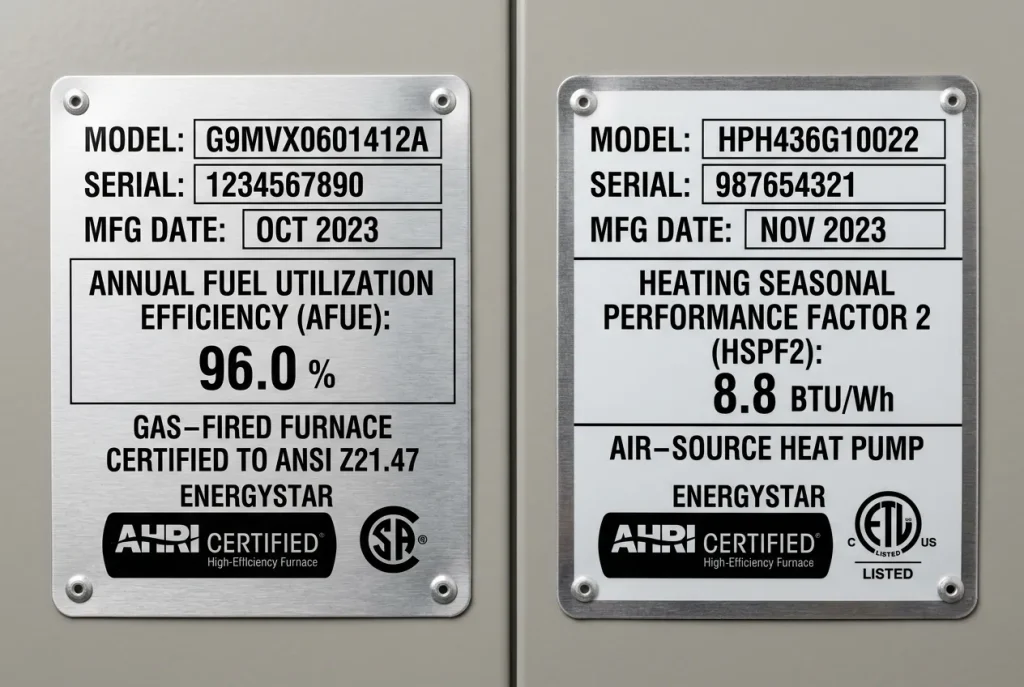
This is where most homeowners get tripped up, so we want to be direct about it. You cannot put an AFUE number next to an HSPF2 number and decide which is better, because the two are measured on different scales, for different fuels, using different math. The table below shows why the two ratings live in separate worlds.
| Factor | AFUE (Gas Furnace) | HSPF2 (Heat Pump) |
|---|---|---|
| Energy source | Burns natural gas or propane | Moves heat using electricity |
| Efficiency ceiling | Caps at 100% by definition | Effectively exceeds 100% |
| What the number means | Percent of fuel converted to heat | Seasonal heating efficiency factor |
A few points explain why the raw numbers are not interchangeable:
- AFUE has a hard ceiling: AFUE caps out at 100% by definition, because a furnace can never produce more heat than the fuel contains. The rating measures how completely the unit burns what you feed it.
- Heat pumps can clear 100%: A heat pump routinely operates at what appears to be more than 100% efficiency because it moves heat rather than makes it. A unit delivering three units of heat for every unit of electricity is operating at an effective 300%, which no furnace can match on a pure energy-conversion basis.
- Running cost is a separate question: That higher effective efficiency does not automatically make heat pumps cheaper to run, because electricity and natural gas are priced differently, and the comparison depends on local utility rates.
How to actually compare across fuel types
To make a real efficiency comparison between a gas furnace and a heat pump, you have to convert both to a common basis. That means looking at the cost to deliver the same amount of heat using your actual local energy rates, not just reading the ratings off the box.
The process works in a few steps. You convert the furnace's AFUE and gas rate into a cost per unit of delivered heat, then do the same for the heat pump by pairing its HSPF2 with your electric rate. From there, you factor in how many true cold hours your home actually experiences in a season, and you account for your home's insulation, ductwork, and proper sizing. Only when all of those pieces sit on the same basis does a real comparison emerge.
A qualified contractor providing heating installation in Houston runs this comparison for your specific home using your real utility rates, which is the only way to get a meaningful answer to the AFUE vs HSPF2 rating question.
Why HSPF2 Usually Matters More in Houston
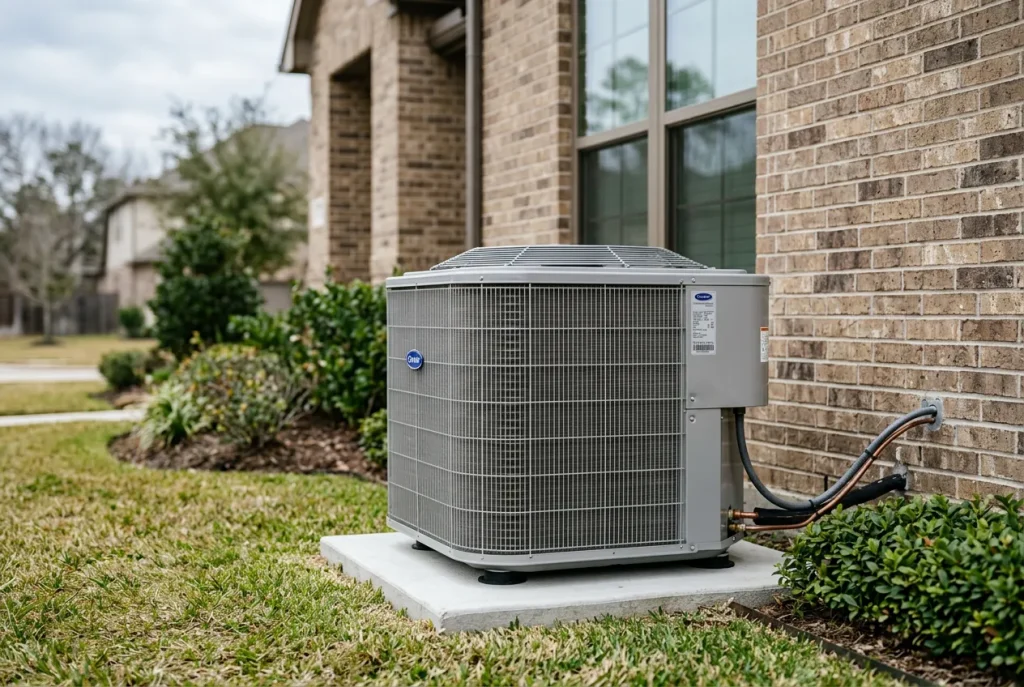
Houston's mild winters reshape the conversation about ratings. A typical Houston winter sits in the 40s and 50s, with occasional cold snaps that dip into the 30s, and we rarely see the sustained deep cold that makes a high-AFUE furnace the obvious choice in northern states. That gentle heating season works in a heat pump's favor, because a heat pump operates at its highest efficiency when outdoor temperatures are moderate, and there is more ambient heat to pull from. In the 40s and 50s, a Houston heat pump runs at a high COP for most of the season.
The energy math rewards it, too. Across most of our season, a heat pump delivers efficient warmth at a fraction of the energy an electric resistance comparison would require, so the HSPF2 figure translates into real savings rather than a number on a box.
Heat pumps handle our cold snaps fine
The old worry about heat pumps was that they struggled in cold weather, but in Houston, that concern barely applies:
- Our cold snaps are brief: Houston cold snaps pass quickly, and modern heat pumps hold their performance well into the 30s, which covers the vast majority of our winter hours.
- Backup heat covers the extremes: For the rare hours when temperatures drop further, systems include backup heat that fills the gap so the home stays comfortable.
One system, two seasons
A heat pump also cools, which means a single unit handles both your summer and winter needs. For a market like ours where cooling dominates the year, that efficiency carries weight. When homeowners ask us about ac installation houston and heating in the same conversation, a heat pump is frequently the answer to both at once.
Reading the Ratings and Regional Standards
Efficiency minimums are not the same everywhere. The Department of Energy sets regional standards that account for climate, which is why southern furnace minimums differ from northern ones and why heat pump efficiency requirements have their own benchmarks.
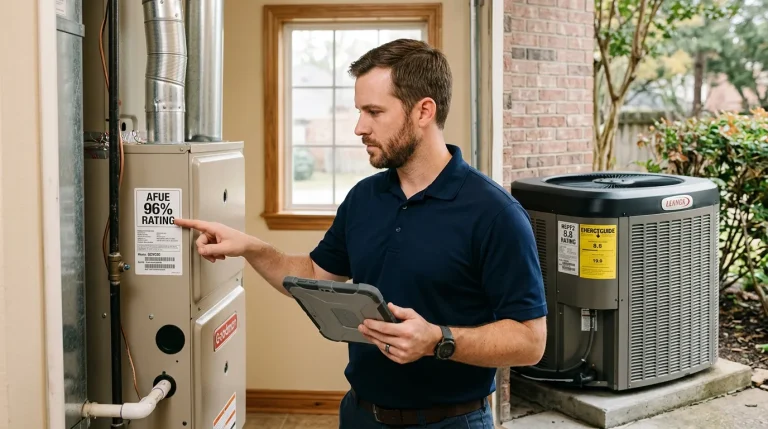
When you look at equipment, you will see two key labels that each tell you something different about the rating on the sticker:
- AHRI certification: AHRI, the Air-Conditioning, Heating, and Refrigeration Institute, certifies the rated performance of matched system combinations, so the HSPF2 or AFUE on the sticker reflects tested results rather than marketing claims.
- ENERGY STAR certification: ENERGY STAR adds a separate certification that flags equipment exceeding the baseline efficiency minimums, pointing you toward units that perform notably better than the federal floor.
What to verify before you buy
- Confirm the AFUE or HSPF2 rating is AHRI-certified for the specific matched combination
- Check whether the equipment carries an ENERGY STAR label for above-minimum performance
- Make sure indoor and outdoor components are matched, since a mismatch voids the rated number
- Ask whether the unit meets current regional standards for your area
A trustworthy hvac service houston contractor confirms these details as part of the proposal rather than leaving you to decode spec sheets on your own.
Matching the Rating to Your Home
The right rating to prioritize depends on what kind of system fits your home, and a couple of common scenarios point in different directions:
- Existing gas and furnace ductwork: A home with established gas service and ductwork sized for a furnace may lean toward keeping a combustion system, which makes AFUE the rating to watch.
- All-electric or cooling-upgrade homes: A home built for all-electric operation, or one already getting a cooling upgrade, often leans toward a heat pump where HSPF2 becomes the number that matters most.
Proper sizing matters more than chasing the highest rating on the shelf, because the rating only pays off when the equipment is matched to your home's actual heating demand:
- Oversizing wastes a high AFUE: An oversized furnace short-cycles, turning on and off too quickly to ever settle into the efficient operation its high AFUE rating promises.
- Undersizing erases the HSPF2 edge: An undersized heat pump leans on backup heat during demand, which gives up the HSPF2 advantage you paid for in the first place.
For most Houston homes our team evaluates, the conversation starts with the heat pump because our climate rewards it, but our installers run the numbers both ways and let the cost-to-heat comparison point to the answer.
Key Takeaways
- AFUE measures gas furnace combustion efficiency as a percentage of fuel converted to heat, ranging from about 80% to 98%
- HSPF2 measures heat pump heating-season efficiency and is the current rating standard that replaced the older HSPF metric
- The two ratings are not directly comparable because they measure different fuel types on different scales
- Heat pumps can deliver more heat energy than the electricity they consume, which no furnace can match on a pure conversion basis
- Houston's mild 40s-to-50s winters make HSPF2 and heat pumps the more relevant choice for most homes here
- Always verify ratings are AHRI-certified for matched equipment and confirm proper sizing before purchase
Frequently Asked Questions
Is a higher AFUE always better than a heat pump's HSPF2 rating?
No, and this is the most common mistake we see. A higher AFUE number does not beat an HSPF2 number, because they measure different equipment on different scales. AFUE describes how completely a gas furnace burns its fuel, while HSPF2 describes how efficiently a heat pump moves heat using electricity. A heat pump can operate at an effective efficiency well above 100%, which no furnace can do. The right way to compare them is to calculate the actual cost to deliver heat to your home using your local utility rates, rather than reading the two ratings side by side.
What is the difference between HSPF and HSPF2?
HSPF2 is the updated version of the older HSPF rating, and it became the standard in 2023 when the Department of Energy revised its testing procedures. The new test reflects more realistic operating conditions, including external static pressure that better mirrors how equipment performs in a real home. Because the test is more demanding, an HSPF2 number is typically lower than the old HSPF figure for the same unit. A heat pump rated 7.5 HSPF2 today is not less efficient than one that showed 8.8 HSPF a few years ago. It is simply measured under tougher, more honest conditions.
Do heat pumps work in Houston's winter?
Yes, heat pumps are well suited to Houston's climate. Our winters mostly sit in the 40s and 50s, which is precisely the temperature range where heat pumps operate most efficiently because there is plenty of ambient heat to pull from outdoor air. During the occasional cold snap that drops into the 30s, modern heat pumps hold their performance, and built-in backup heat covers the rare hours when temperatures fall further. For a market where cooling dominates the year, a heat pump also handles both seasons with one system, which is part of why we recommend them so often here.
What AFUE or HSPF2 rating should I look for?
There is no universal answer, because the right rating depends on your fuel type, your home, and your local energy rates. For a gas furnace, the federal minimum in southern states is 80% AFUE, and condensing models reach the low-to-mid 90s. For a heat pump, look for an HSPF2 that meets current regional standards, and consider an ENERGY STAR label for above-minimum performance. More important than chasing the highest number is making sure the equipment is properly sized and AHRI-certified for the matched combination, because a high rating on a poorly sized system never delivers its promised efficiency.
Why does ENERGY STAR matter if AHRI already certifies the rating?
The two certifications do different jobs. AHRI certifies that the AFUE or HSPF2 number on the sticker is accurate for that specific matched combination of indoor and outdoor equipment, so you know the rating reflects real tested performance rather than marketing. ENERGY STAR goes a step further by flagging equipment that exceeds the baseline efficiency minimums. An AHRI-certified rating tells you the number is true, and an ENERGY STAR label tells you the number is notably better than the federal baseline. Looking for both gives you confidence in both the accuracy and the strength of the efficiency rating.
Conclusion
The acronyms can feel like noise, but the underlying idea is simple. AFUE tells you how well a gas furnace burns fuel, HSPF2 tells you how efficiently a heat pump moves heat, and the two are not meant to be stacked against each other. The number that matters for your home depends on the fuel, the equipment, and the actual cost of delivering heat through a Houston winter.
At VeriChill, when our team evaluates a Houston home for heating, we consider your fuel options, existing ductwork, insulation, and how mild our season actually is. That picture, combined with a true cost-to-heat comparison, determines whether a high-AFUE furnace or a strong-HSPF2 heat pump is the right call. The goal is to match the right rating to the right home, not to chase the biggest number on a spec sheet.
Ready to find out which heating system fits your Houston home? Call us at 281-559-6995 or visit verichill.com to schedule a consultation.