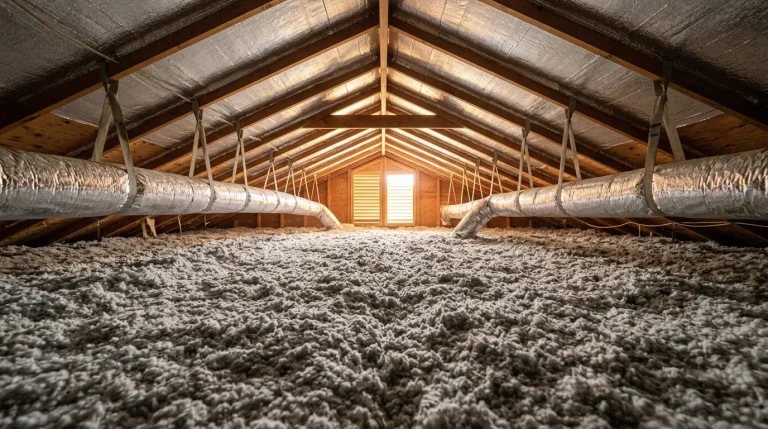
Attic insulation is the hidden efficiency factor behind nearly every Houston HVAC complaint our team investigates. When insulation is thin, settled, or degraded, a Houston attic that reaches 150 degrees pushes enormous heat load through your ceilings and ductwork, forcing your system to run almost constantly while upstairs rooms stay hot. Bringing your attic up to the recommended R-38 to R-49 range lets even a properly sized system finally perform the way it was designed to.
When a Houston homeowner calls our team about an air conditioner that runs all day and still cannot cool the upstairs, the equipment is usually not the first thing we suspect. After years of designing and installing HVAC systems across the Houston metro, our installers have learned that the attic above the ceiling tells the real story. A perfectly sized, high-efficiency system installed under a poorly insulated attic will struggle no matter how good the equipment is.
This is the part of the conversation most homeowners have never had. They focus on the SEER2 rating, the brand, and the tonnage, which all matter. But the thermal envelope around the equipment determines how hard that equipment has to work. In our climate, the attic is the single largest source of heat gain in most homes, and it quietly defines what your system can and cannot do.
Let us walk you through how attic insulation affects HVAC performance in Houston, what R-value the Gulf Coast climate actually calls for, and the signs that tell our team an attic is undermining an otherwise capable system.
Why Houston Attics Punish Under-Insulated Homes
Our climate is brutal on attics specifically. With an 8 to 9 month cooling season and relative humidity that sits above 75 percent for months, the sun bears down on Houston rooftops relentlessly. A dark asphalt shingle roof transfers that solar energy straight into the attic below.
On a typical summer afternoon, a Houston attic can reach roughly 150 degrees. That superheated air sits directly above your living space, separated only by your ceiling and whatever insulation rests on the attic floor. When that insulation is thin or compressed, the heat has an easy path down into your rooms.
This is where the relationship between attic insulation and HVAC performance becomes obvious. Every degree of attic heat that crosses your ceiling becomes an additional cooling load your system has to fight. Insulation is the buffer that slows that ceiling heat transfer, and when the buffer is inadequate, your equipment never catches up. The two patterns below are how that deficit shows up in real Houston homes.
The constant-running problem
An under-insulated attic creates a continuous heat gain that your AC has to offset minute by minute. The symptoms our team sees follow a predictable pattern.
- The system never cycles off. Instead of cooling the home and resting, the equipment runs in long, near-permanent cycles trying to overcome heat that keeps pouring through the ceiling.
- Homeowners blame the equipment. This constant runtime reads as a weak or undersized system, when the real culprit is the inadequate insulation sitting directly overhead.
Hot upstairs rooms
Heat rises, and the upper floor sits closest to that 150-degree attic, which is why insulation deficits surface there first.
- The upstairs heats up before anywhere else. In two-story Houston homes, the upper level is almost always the first place an insulation deficit becomes noticeable to the people living there.
- A temperature gap points to the attic. When the bedrooms upstairs run several degrees warmer than the thermostat downstairs, degraded or insufficient attic insulation is usually the reason.
R-Value Requirements for the Houston Climate Zone
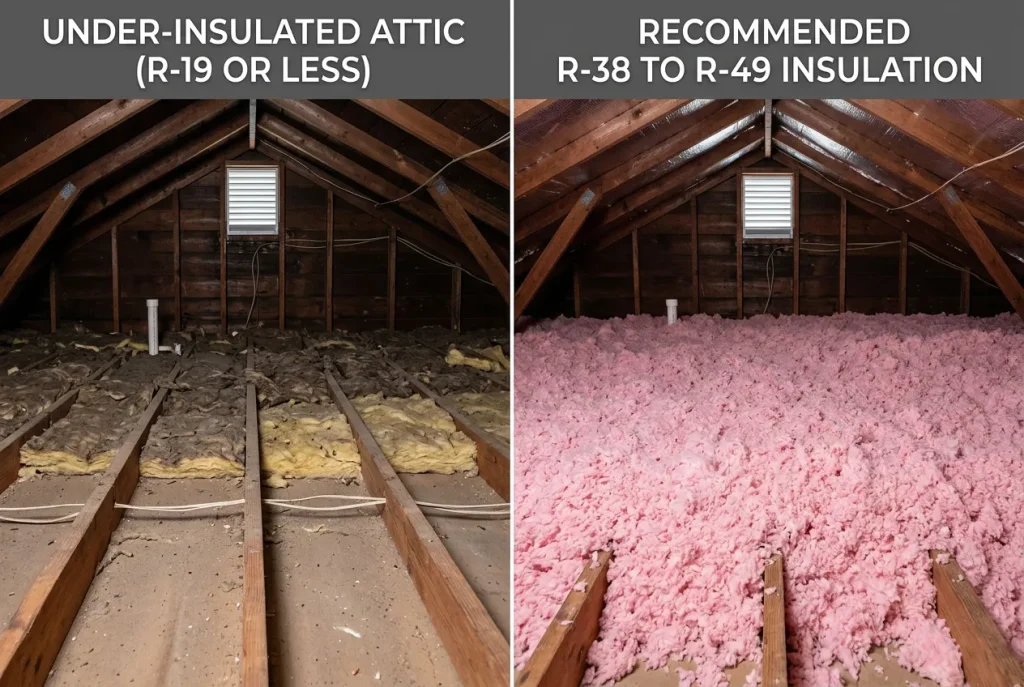
R-value measures how well insulation resists heat flow, so the higher the number, the more the material slows heat gain. Houston sits in a hot, humid Gulf Coast climate zone, and a few points frame what that means for your attic.
- Warm climates call for higher R-values. The U.S. Department of Energy and the International Energy Conservation Code both point toward higher attic insulation levels in warm climates than many older Houston homes actually have.
- The Gulf Coast target is R-38 to R-49. For our region, the recommended attic insulation level generally falls in that range, which reflects the long cooling season and intense rooftop heat we deal with.
| Climate Factor | Houston Reality | Recommended Attic R-Value |
|---|---|---|
| Cooling season length | 8 to 9 months | Higher attic R-value priority |
| Peak attic temperature | ~150 degrees | R-38 minimum |
| Older home insulation | Often R-19 to R-30 | Upgrade toward R-38 to R-49 |
| New construction target | Built to current code | R-38 to R-49 |
Many homes built in earlier decades were insulated to standards well below today's R-value requirements. If your attic was last addressed when the home was built and that was 20 or more years ago, there is a strong chance it falls short of what current guidance recommends for the Gulf Coast.
Blown-In vs. Batt Insulation in Houston Attics
When homeowners ask how to bring an attic up to standard, the conversation usually comes down to two common material approaches: blown-in insulation and batt insulation. Both can reach the recommended R-value, but they behave differently in a Houston attic.
Blown-in insulation
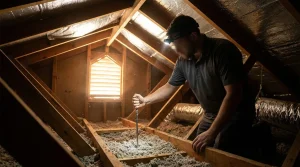
Blown-in insulation, whether fiberglass or cellulose, is installed as loose fill that settles into an even blanket across the attic floor. The traits below explain why our team often reaches for it in Houston retrofits.
- Coverage is its biggest advantage. The loose fill flows around framing, wiring, and the irregular gaps that batts tend to leave open, so it blankets the attic floor without the seams a rigid product creates.
- It suits retrofits well. When the goal is to add depth to existing material rather than start from bare joists, blown-in insulation is often the practical choice because it layers cleanly over what is already there.
Batt insulation
Batt insulation comes in pre-cut rolls or panels fitted between framing members. It has clear strengths and one recurring weakness that homeowners should understand.
- It performs well in open, regular cavities. Batt is straightforward to install in newer construction where the joist spacing is consistent, and the cavities are easy to fill cleanly.
- Gaps are its main weakness. When batts are cut imprecisely or compressed, they create thermal bridges where heat can slip through, lowering the real-world R-value below what the label promises.
What our team looks for
The right approach depends on the attic, and what matters more than the material is the quality of the installation. Our installers check for the points below before calling the attic finished.
- Full, consistent coverage. The blanket should span the entire attic floor, with no compressed sections that would quietly reduce the effective R-value.
- No gaps around penetrations. Wiring, vents, and framing should be insulated carefully, since open gaps are where heat finds its easiest path down.
- Correctly installed depth. The material has to reach the depth that hits the target R-value, because a well-installed blanket of either type beats a poorly installed run of the other.
Radiant Barriers and Heat Gain Reduction
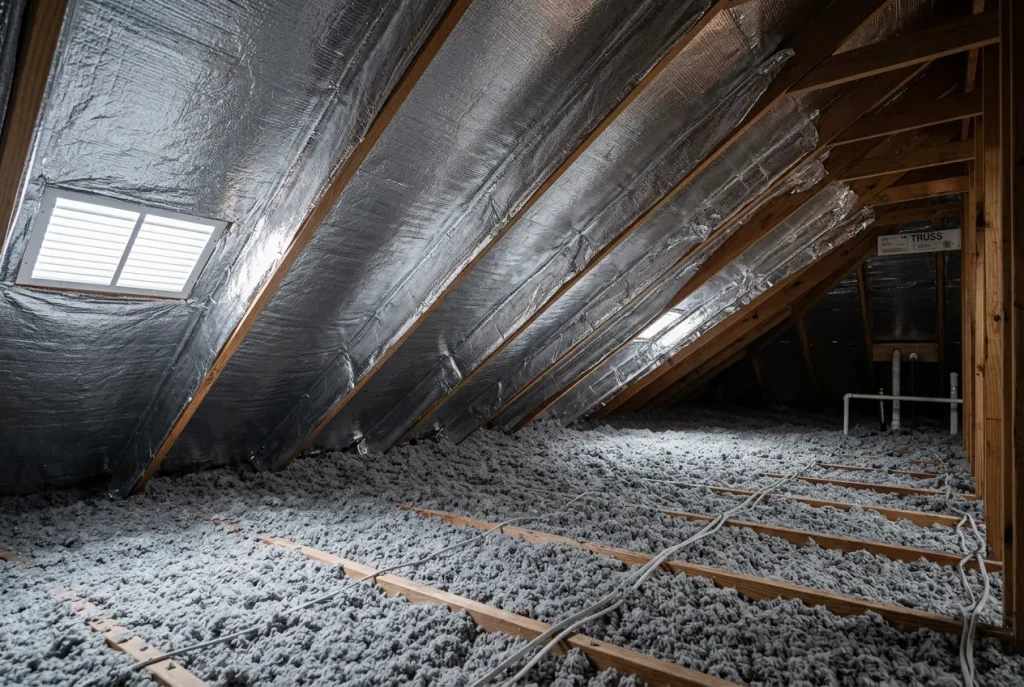
Insulation on the attic floor slows the heat already in the attic. A radiant barrier works earlier in the process by reflecting radiant heat before it builds up. In a climate like ours, that distinction matters.
A radiant barrier is a reflective material, usually a foil layer, installed along the underside of the roof decking. Its job in a Houston attic breaks down into a few clear effects.
- It reflects solar energy outward. The foil reflects much of the sun's radiant heat back outward rather than letting it soak into the attic in the first place.
- It lowers attic temperature. Reflecting that radiant energy produces a meaningful reduction in attic temperature, which directly lowers the heat load reaching your ceiling.
Radiant barriers do not replace insulation. They work alongside it, and understanding how the two layers divide the work makes the value clear.
- The barrier handles the roofline. It reduces radiant heat gain at the top of the attic before that energy builds up in the space.
- The floor insulation handles the rest. Together, the two layers reduce how much of that 150-degree attic environment reaches your conditioned space, taking real strain off the HVAC system and making the pairing one of the more effective heat-gain-reduction strategies available for Houston homes.
Signs Your Attic Insulation Is Degrading
Insulation does not last forever, and its degradation is gradual enough that most homeowners never notice it. Here are the signs our team watches for when an aging attic is quietly dragging down system performance.
- Uneven temperatures between floors or rooms that were not there a few years ago
- Visibly thin or settled insulation where you can see the tops of ceiling joists across the attic floor
- Rising runtime with the system cycling far longer than it used to in similar weather
- Moisture staining or matting in the insulation, which can signal vapor barrier issues or roof leaks
- Pest disturbance or debris that has displaced or contaminated sections of the material
Insulation degradation can be traced to a handful of common causes that our team accounts for when assessing an aging attic.
- Compression and settling. Over the years, insulation compacts and settles, which reduces its depth and therefore its R-value, even when the material itself looks intact.
- Moisture intrusion. When moisture is allowed to migrate into insulation, it loses effectiveness, and in our humid climate, it can stay damp long enough to accelerate the decline, which is where vapor barriers matter most.
Energy loss you can feel
The clearest signal is comfort. When a home that used to cool evenly starts developing hot zones and the system works harder to deliver the same result, you are feeling energy loss through the thermal envelope. The attic is the first place our team looks, because it is where Houston homes lose the most.
How Insulation Quality Shapes HVAC Performance
The connection between insulation and AC efficiency comes down to load, and a few linked facts explain why the attic carries so much weight in that equation.
- Equipment is sized to a specific load. Your HVAC system is selected to handle a specific cooling load for your home, and that calculation assumes a reasonable thermal envelope around it.
- A weak attic raises the real load. When the attic underperforms, the actual cooling load climbs past what the equipment was chosen to handle, so the system falls behind no matter how good it is.
This is why our team always considers the attic during a proper sizing and cooling load assessment for any AC installation in a Houston project. Installing capable equipment under a leaky thermal envelope wastes much of that capability, and a right-sized system in a well-insulated home outperforms an oversized system fighting a 150-degree attic every single time.
The same principle applies to heating installation during our milder winters. A tight thermal envelope holds conditioned air, cooled or heated, where it belongs. ENERGY STAR notes that sealing and insulating a home is one of the most reliable ways to improve comfort and reduce energy use, and you can review their guidance on sealing and insulating. When our team evaluates a home for any HVAC service in Houston, the condition of the attic is part of the picture because it determines whether the equipment our installers install can actually perform.
Key Takeaways
- Houston attics can reach roughly 150 degrees, making attic insulation one of the largest factors in HVAC performance and comfort
- Under-insulated attics push constant heat load through ceilings, causing systems to run continuously and leaving upstairs rooms hot
- The recommended attic R-value for the Houston Gulf Coast climate zone generally falls in the R-38 to R-49 range
- Blown-in and batt insulation can both reach target R-values, but full, consistent coverage matters more than the material choice
- Radiant barriers reduce attic heat gain at the roofline and work alongside floor insulation to lower the load on your system
- Insulation degrades through compression, moisture, and settling, and a proper cooling load assessment accounts for the real thermal envelope
Frequently Asked Questions
How does attic insulation actually affect my air conditioner's performance?
Your air conditioner is sized to offset a specific cooling load, and attic insulation directly determines how much of that load comes from heat gain through the ceiling. In Houston, where an attic can reach roughly 150 degrees, thin or degraded insulation lets that heat pour into your living space, forcing the system to run almost constantly. Better insulation slows ceiling heat transfer, reduces the load, and lets even a properly sized system cool the home with shorter, more effective cycles instead of running endlessly.
What R-value should my attic have in the Houston area?
For the Houston Gulf Coast climate zone, the recommended attic insulation level generally falls in the R-38 to R-49 range, in line with U.S. Department of Energy guidance and the International Energy Conservation Code for warm, humid climates. Many older Houston homes were insulated to lower standards, often in the R-19 to R-30 range, which falls short of current recommendations. If your attic insulation is thin enough that you can see the tops of the ceiling joists, it almost certainly sits below the target R-value for our region.
Is a radiant barrier worth it in Houston, or do I just need more insulation?
Both serve different roles, and in our climate, they work best together. A radiant barrier reflects the sun's radiant heat at the roofline before it builds up in the attic, while floor insulation slows the heat that does get through. Because Houston attics get so hot, reducing that radiant heat gain at the source produces a meaningful drop in attic temperature and the load reaching your ceiling. A radiant barrier does not replace insulation, but when paired with adequate R-value, it is one of the more effective strategies for reducing heat gain in our region.
How do I know if my attic insulation has degraded over time?
Insulation degradation is gradual, so watch for changes rather than a single dramatic sign. Rooms that used to cool evenly but now develop hot zones, a system that runs noticeably longer than it once did in similar weather, and visibly thin or settled insulation where joists show through are all common indicators. Moisture staining or matting can point to vapor barrier problems in our humid climate. When comfort declines and energy loss becomes noticeable, the attic is usually the first place worth inspecting.
Should I improve my attic insulation before installing a new HVAC system?
Addressing the thermal envelope before or alongside a new installation almost always pays off. When our team performs a cooling load assessment and proper sizing for a home, the condition of the attic shapes the result. A tighter, better-insulated attic reduces the load, which means the equipment our installers install can be matched to the home's actual needs and perform as designed. Installing capable equipment under a degraded attic wastes much of that capability, so insulation quality is part of the conversation from the start.
Conclusion
Attic insulation is the quiet variable behind so many Houston comfort problems. The equipment gets the attention, but the thermal envelope above your ceiling determines how hard that equipment has to work and whether it can keep up with a 150-degree attic overhead. When the insulation is right, a well-chosen system finally gets to do its job.
At VeriChill, when our team evaluates a Houston home for a new system, we consider the full picture, including how the attic and thermal envelope affect the cooling load. That perspective is what allows us to recommend equipment that will actually perform in your home rather than equipment that will spend its life fighting heat it was never meant to overcome. Matching the right system to the right home, attic included, is the goal.
Ready to find out how your home's thermal envelope is affecting your comfort? Call us at 281-559-6995 or visit verichill.com to schedule a consultation.