For the vast majority of Houston homes, a cold climate heat pump is not necessary. Cold-climate heat pumps use enhanced technology like vapor injection to maintain heating capacity in sub-freezing and even sub-zero temperatures, which is genuinely valuable in northern climates. Houston's mild winters rarely test a standard heat pump's limits, so a well-chosen standard heat pump handles our heating season comfortably while a cold-climate model's premium features mostly go unused. The honest answer to the cold climate heat pump Houston question is that a standard heat pump is the right match for most homes here, and the premium technology is worth it only in narrow situations.
Heat pump marketing has gotten very good at selling cold-climate performance. You will see impressive claims about maintaining full heating capacity at 5 degrees, or even below zero, powered by enhanced vapor injection and other engineering advances. It is legitimately impressive technology, and for a homeowner in a genuinely cold climate, it can be the difference between a heat pump that works all winter and one that leans on expensive backup heat.
Then that same marketing reaches Houston, where our winters look nothing like the conditions this technology was built for. A homeowner reads about sub-zero performance, worries their standard heat pump will not cut it, and considers paying a premium for capability our climate will almost never call on.
This is exactly the kind of situation where honest guidance matters more than a sales pitch. Let us walk through what cold-climate heat pumps actually do, whether Houston's climate needs those features, and how our team helps homeowners avoid overspending on capability they will not use, while flagging the narrow cases where the premium genuinely makes sense.
What a Cold Climate Heat Pump Actually Does
To decide whether you need the technology, you first have to understand what problem it solves. Cold-climate heat pumps are engineered to overcome the one real weakness of standard heat pumps.
The standard heat pump limitation
A heat pump works by moving heat from outdoor air into your home. As the outdoor temperature falls, there is less ambient heat to move and the job gets harder, so a standard heat pump gradually loses heating capacity in deep cold. In a severe climate, that decline can leave the system unable to keep up, forcing reliance on supplemental electric heat strips that are expensive to run.
The cold-climate solution
Cold-climate heat pumps address this with enhanced technology, most notably enhanced vapor injection, larger compressors, and refined controls that maintain much more of their heating capacity at low ambient temperatures. Models meeting the ENERGY STAR cold climate heat pump criteria can hold strong output at 5 degrees and continue operating well below that, dramatically reducing or eliminating the need for supplemental heat in a cold climate.
Where this genuinely matters
In the upper Midwest or the mountain states, this capability is transformative. It lets a homeowner rely on an efficient heat pump through a real winter instead of an expensive furnace or resistance heat. The technology is not marketing fluff; it is a real solution to a real problem, in the climates that have that problem. Understanding that distinction is the whole key, and it is where a conversation with an HVAC system installation can save a homeowner from paying for a solution to a problem they do not have.
Does Houston's Climate Actually Need It?
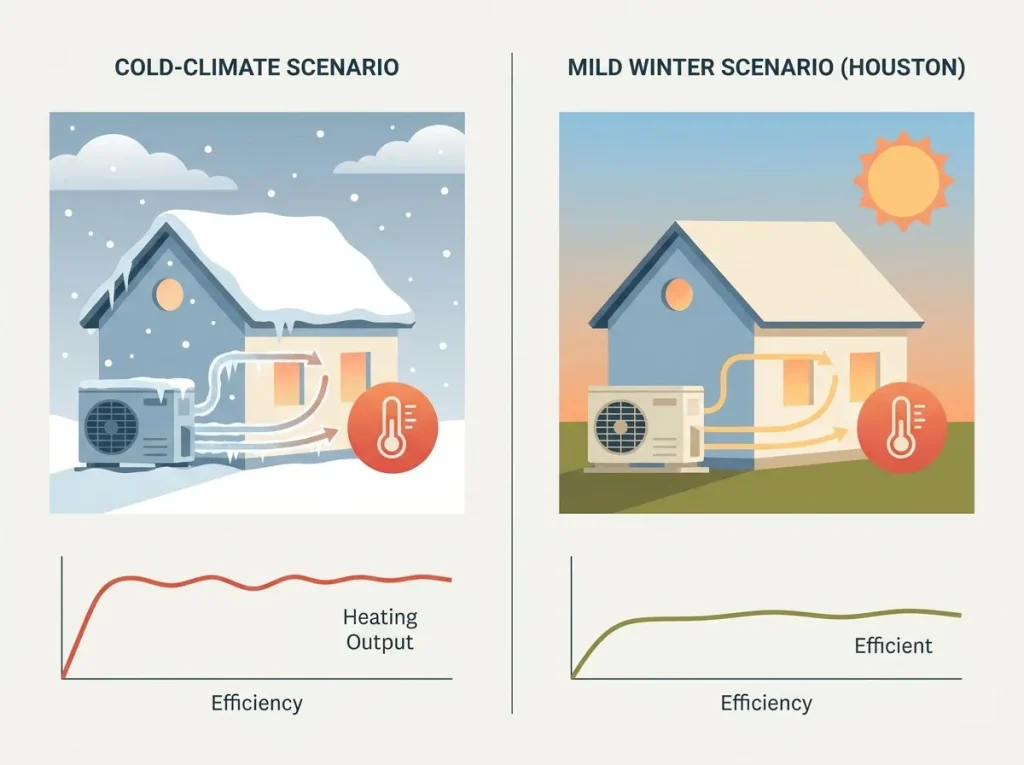
Here is where the analysis turns local, and the answer becomes clear. The technology solves a problem Houston barely has.
| Consideration | Cold climate | Houston |
|---|---|---|
| Typical winter lows | Frequently sub-freezing to sub-zero | Mostly above freezing |
| Standard heat pump performance | Declines significantly | Stays strong most of the season |
| Supplemental heat reliance | Common without cold-climate tech | Rare |
| Value of cold-climate features | High | Low for most homes |
| Cost premium justified | Usually | Seldom |
Our winters rarely reach the technology's territory
Houston winters spend most of their time above freezing. The deep-cold conditions where cold-climate features earn their keep, sustained temperatures in the teens, single digits, or below, are rare and brief here. A standard heat pump operates comfortably across the conditions our winters actually deliver, staying in an efficient range for nearly the whole season.
Standard heat pumps already suit Houston
Our team's editorial position, grounded in how these systems perform across Houston winters, is that a well-chosen standard heat pump is strongly favorable for our climate. It handles our mild season efficiently, it doubles as your air conditioner for the long cooling season, and it does not carry the premium of technology built for conditions we rarely see. Paying for cold-climate capability in Houston is, for most homes, paying for a feature that will sit idle.
The overspending trap
The risk is spending a meaningful premium on sub-zero performance that a Houston home may go years without ever needing. That money is often better directed toward correct sizing, better ductwork, or a higher-staging standard system that improves comfort every single day, rather than toward extreme-cold capability that waits for a freeze that seldom comes.
The Narrow Cases Where the Premium Makes Sense
Honesty cuts both ways. There are specific situations where a cold-climate heat pump can be a reasonable choice even in Houston, and our team names them rather than pretending the technology is never worth it.
All-electric homes wanting freeze insurance
A homeowner with no gas service who wants a single all-electric system and maximum peace of mind during the occasional hard freeze might value the extra low-temperature headroom. For them, the cold-climate model reduces any reliance on supplemental electric heat during those rare events.
Comfort-critical or risk-averse households
Some homeowners simply prioritize never feeling a dip in heating performance, even during a rare cold snap, and are willing to pay for that assurance. That is a legitimate personal preference, and our team respects it while making sure the homeowner understands they are buying insurance against an uncommon event.
When the price gap is small
Occasionally the premium for a cold-climate model over a comparable high-end standard heat pump is modest. When the gap is small, the extra headroom can be worth it as low-cost insurance. When the gap is large, it rarely is for a Houston home. Weighing that gap is part of a sound heating installation contractor decision, and because the heat pump also handles cooling, it ties directly into aircon installation planning as well.
How Our Team Matches the Technology to the Home

Rather than pushing the most advanced equipment, our team matches the technology to what the home and climate actually require.
Right-size and right-stage first
The fundamentals come before the features. Correct sizing based on an assessment of insulation, ductwork, ceiling heights, window orientation, and airflow distribution matters more than cold-climate capability, since oversizing remains the most common HVAC problem we see. A correctly sized, well-staged standard heat pump outperforms an oversized cold-climate model every day of a Houston winter.
Consider dual fuel as an alternative hedge
For homeowners with gas service who want freeze insurance, a dual fuel system pairing a standard heat pump with a gas furnace is often a more sensible hedge than a cold-climate heat pump, because the furnace covers the rare deep cold while the efficient heat pump handles the mild majority of the season. It is worth comparing that path against the cold-climate option.
Give the honest recommendation
Our team explains the tradeoff plainly: what cold-climate technology does, why Houston rarely needs it, and the narrow cases where it makes sense. The goal is the right match for your home and budget, not the biggest spec sheet. For most Houston homes, that means a standard heat pump, and we will say so even when a premium model would be an easier sale.
Key Takeaways
- Cold-climate heat pumps use enhanced technology to maintain heating capacity in sub-freezing and sub-zero temperatures, which is valuable in northern climates
- Houston winters rarely reach the deep-cold conditions where those features earn their keep, so most homes do not need them
- A well-chosen standard heat pump handles Houston's mild season efficiently and doubles as the home's air conditioner
- Paying a large premium for cold-climate capability in Houston usually means paying for a feature that sits idle
- The premium can make sense for all-electric homes wanting freeze insurance, comfort-critical households, or when the price gap is small
- Correct sizing and staging matter more than cold-climate features, and a dual fuel system is often a better freeze hedge for homes with gas service
Frequently Asked Questions
Do I need a cold climate heat pump in Houston?
For the vast majority of Houston homes, no. Cold-climate heat pumps are engineered to maintain heating capacity in sustained sub-freezing and sub-zero temperatures, conditions that are rare and brief in Houston. Our winters spend most of their time above freezing, where a standard heat pump operates efficiently and comfortably. A standard heat pump is the right match for most homes here, and it also serves as your air conditioner across the long cooling season. The cold-climate premium generally buys capability our climate seldom calls on.
What makes a cold climate heat pump different from a standard one?
Cold-climate heat pumps use enhanced technology such as enhanced vapor injection, larger compressors, and refined controls to hold much more of their heating capacity as outdoor temperatures fall. A standard heat pump gradually loses capacity in deep cold because there is less ambient heat to move, which in a severe climate can force reliance on expensive supplemental heat. The cold-climate design maintains strong output at 5 degrees and below, largely eliminating that supplemental reliance in a truly cold climate.
Will a standard heat pump keep my Houston home warm in winter?
Yes, for nearly all Houston homes. A correctly sized standard heat pump handles our mild winter conditions efficiently and comfortably, because our temperatures rarely drop into the deep cold where a standard unit struggles. During the occasional hard freeze, a properly designed system manages, and homeowners who want extra insurance can consider a dual fuel setup rather than a cold-climate model. Correct sizing and staging matter far more to your winter comfort than cold-climate capability does.
When is a cold climate heat pump worth it in Houston?
In narrow cases. An all-electric home with no gas service that wants maximum peace of mind during rare hard freezes, a comfort-critical or risk-averse household that will pay for assurance against any performance dip, or a situation where the price premium over a comparable high-end standard heat pump happens to be small. When the price gap is large, it rarely pays off for a Houston home. Our team helps weigh that gap honestly rather than defaulting to the most advanced equipment.
Is a dual fuel system better than a cold climate heat pump for Houston?
For homeowners with gas service, often yes. A dual fuel system pairs a standard heat pump with a gas furnace, letting the efficient heat pump handle the mild majority of Houston's heating season while the furnace covers the rare deep cold. This provides freeze insurance without paying the premium for cold-climate technology built for conditions we seldom see. Whether dual fuel or a straight standard heat pump is best depends on your home, your existing infrastructure, and your comfort priorities, which our team evaluates together.
Conclusion
Cold-climate heat pumps are a genuine engineering achievement, and in the climates they were built for, they change what a heat pump can do. Houston is simply not one of those climates. Our mild winters keep a standard heat pump in its comfortable, efficient range for nearly the whole season, which means the cold-climate premium mostly buys capability our weather rarely tests.
At VeriChill, our team would rather steer a homeowner toward a correctly sized, well-staged standard heat pump than sell a premium feature that will sit idle through Houston winters. When the narrow cases apply, an all-electric home wanting freeze insurance, a comfort-critical household, or a small price gap, we will say so. And when gas service is available and freeze insurance is the goal, we will put dual fuel on the table as the often-smarter hedge. The recommendation follows your home and our climate, not the spec sheet.
Trying to decide whether a standard or cold-climate heat pump fits your Houston home? Call us at 281-559-6995 or visit verichill.com to schedule a consultation.