A mini split AC houston installation is not a replacement for central air in most homes, and it is not supposed to be. A ductless mini split is a targeted tool: it cools a specific space that your existing ductwork cannot reach or was never designed to serve. Garage conversions, room additions, sunrooms, detached offices, and that one bedroom that has never been comfortable are where mini-splits genuinely outperform the alternatives. Understanding the mini split vs central AC question correctly means recognizing that they usually are not competing at all, and the right answer for most Houston homes is a properly sized central system plus a mini-split where it solves a real problem.
Mini-splits have a marketing problem in both directions. Some homeowners have been told they are the efficient future of cooling and should replace everything. Others have written them off as window units with better styling. Neither view is accurate, and both lead people to the wrong decision.
Here is the practical reality in Houston. Most homes here already have central ducted air conditioning, and for whole-house cooling across a long, humid season, a well-matched central system remains the right approach. But nearly every Houston home also seems to have at least one space that central air handles badly or not at all. A garage converted into a gym or office. A sunroom that becomes unusable from May through September. A bonus room over the garage that runs ten degrees warmer than the rest of the house. An addition someone tied into the existing ducts without adding capacity.
Those spaces are the mini-split conversation. Let us walk through how ductless systems actually work, the Houston situations where they are clearly the right call, where they are not, and how to tell which category your problem space falls into.
How a Ductless Mini Split Actually Works
The mechanics matter here, because they explain both the strengths and the limits.
The basic configuration
A ductless mini split pairs an outdoor compressor unit with one or more indoor air handlers, connected by a narrow conduit carrying refrigerant lines, power, and a condensate drain. That conduit needs only a small wall penetration, which is why installation does not require the structural work that extending ductwork does. Indoor units mount on a wall, sit on the floor, or recess into a ceiling as a cassette.
Inverter-driven capacity modulation
Nearly all modern mini-splits use inverter-driven compressors that continuously vary output rather than cycling fully on and off. That matters enormously in Houston. A system that runs at a low, steady output for long stretches removes far more moisture than one that blasts cold air briefly and shuts down. In a climate averaging above 75 percent humidity, continuous modulation is the difference between a space that feels cool and dry and one that feels cool and clammy.
Single-zone and multi-zone configurations
A single-zone system pairs one outdoor unit with one indoor head, which is the typical solution for a garage conversion or an addition. A multi-zone system connects several indoor heads to one outdoor unit, letting you condition three or four problem spaces independently. Multi-zone gives each area its own setpoint, which is genuinely useful when the spaces have different uses and different heat loads.
They heat as well as cool
Most mini-splits sold today are heat pumps, meaning the same equipment reverses to provide heating. In Houston's mild winters, that is a strong advantage. A garage office conditioned by a mini-split is comfortable year round from one piece of equipment, and heat pump operation is well suited to the winter conditions we actually get. Efficiency figures for certified equipment are published through the ENERGY STAR ductless heating and cooling program, which is a reasonable starting point for comparing models.
Where Mini-Splits Genuinely Make Sense in Houston
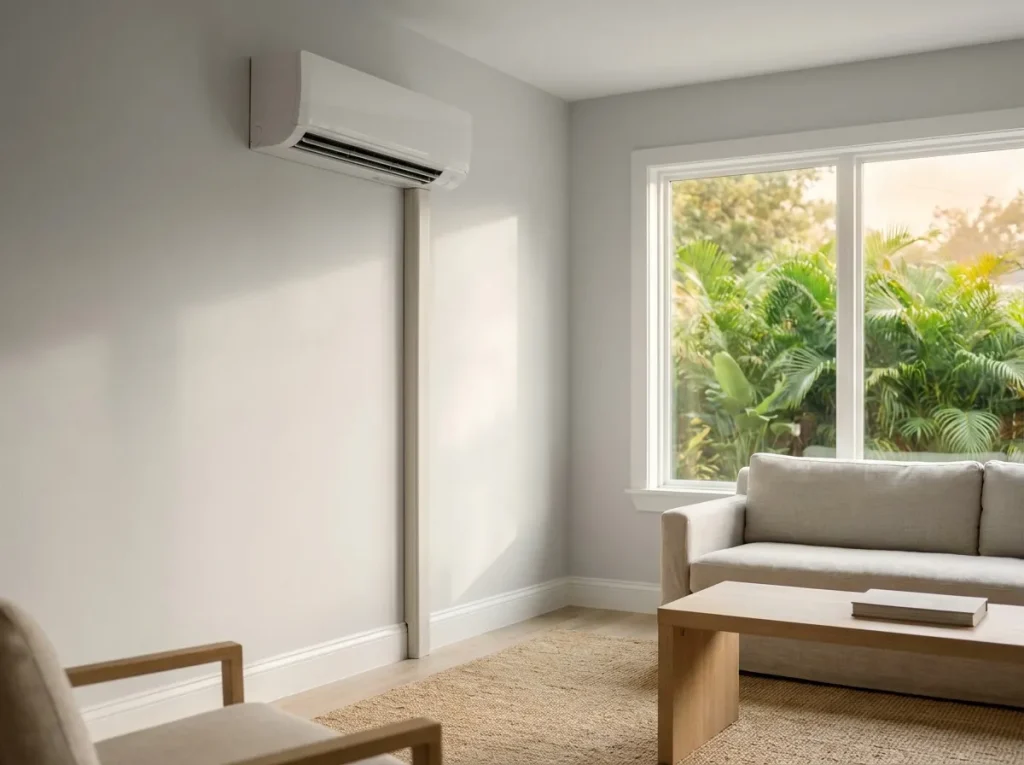
These are the situations where a ductless system is not a compromise but the best available answer.
Garage conversions
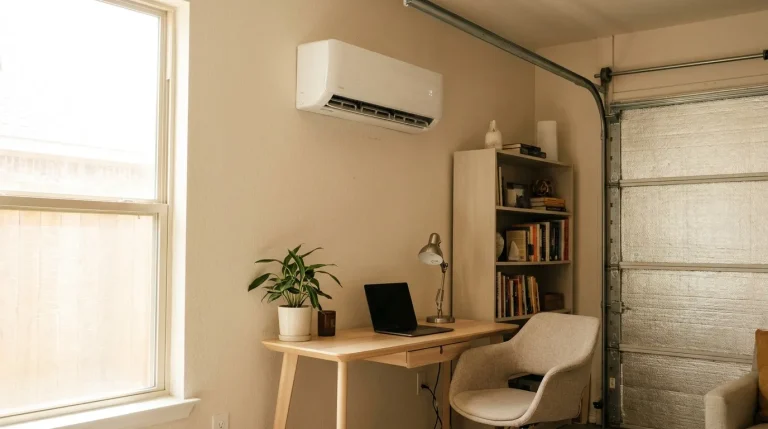
This is the most common mini-split application we see in Houston, and the fit is close to perfect. Garages were never ducted, extending trunk ductwork to reach them is disruptive and often impractical, and the space has a heat load unlike anything else in the house because of the uninsulated door and the west-facing wall. A dedicated mini-split sizes to that specific load and conditions the space independently without stealing capacity from the rest of the home.
Room additions
When a Houston home gets an addition, the tempting shortcut is to branch off the existing ductwork. That almost always underperforms, because the original system was sized for the original house. The result is an addition that never quite keeps up and a main house that got slightly worse. A mini-split adds capacity where the new load is, leaving the original system to do the job it was sized for.
Sunrooms and enclosed porches
Glass-heavy rooms in Houston are brutal cooling loads. A sunroom can pull in more solar heat gain than several regular rooms combined, and tying it into central ductwork means the whole system fights that load all afternoon. A dedicated mini-split handles the extreme load locally and only when the room is in use.
Detached structures
Workshops, studios, pool houses, and detached offices cannot practically be reached by the main system at all. A mini-split is the straightforward answer.
The one room that has never been right
Many Houston homes have a single chronically uncomfortable room, usually a bonus room over the garage, a back bedroom at the end of a long duct run, or an upstairs room with heavy west exposure. Sometimes this is a duct design problem worth fixing properly. Sometimes the duct geometry simply cannot deliver enough air to that location, and a mini-split resolves in a day what duct modification cannot resolve at all. Figuring out which situation you have is worth a conversation with an AC installation services team before committing either way.
Where a Mini-Split Is Not the Right Answer
Being honest about the limits is what makes the recommendation trustworthy.
| Situation | Better approach | Why |
|---|---|---|
| Whole-home cooling in an already-ducted house | Central system, correctly sized | Ducted distribution is more practical and cost effective for whole-house load |
| Masking an undersized or failing central system | Address the central system | A mini-split treats the symptom while the real problem continues |
| A comfort problem caused by duct leakage or bad design | Repair the ductwork | Adding equipment around a fixable distribution flaw is the expensive path |
| Rooms where visible indoor units are unacceptable | Ducted solutions or concealed cassettes | Wall-mounted heads are visible by design |
| An insulation or air sealing deficit | Improve the envelope first | Conditioning a leaky space with new equipment wastes the capacity |
The whole-home replacement question
Occasionally a homeowner asks whether a multi-zone mini-split system could replace central air entirely. It is technically possible, and in a home with no existing ductwork it can make real sense. But in a typical Houston home that already has functioning ducts, converting to a fully ductless system means an indoor head in every conditioned space, more equipment to maintain, and a higher total investment than a properly matched central system. For most homes here, a correctly sized two-stage central system remains the better foundation, with mini-splits added where the ducts genuinely cannot reach.
Do not let a mini-split cover for a sizing problem
If the whole house struggles in July, adding a mini-split to the worst room does not fix the house. It adds a second system to compensate for a first system that is not doing its job, usually because it was oversized and short cycles, or because it is reaching the end of its capacity. Oversizing is the most common HVAC problem we see in Houston homes, and patching around it with ductless equipment is an expensive way to avoid addressing it.
How Our Team Decides Whether a Mini-Split Fits

The evaluation is about the space and the cause, not the product.
Diagnose why the space is uncomfortable
Before recommending equipment, we determine why the room is a problem. Is it unducted, underducted, poorly insulated, heavily glazed, or at the far end of a run that cannot deliver enough air? A room that is uncomfortable because of a crushed flex duct needs a duct repair, not a mini-split, and we would rather say that than sell equipment that papers over it.
Size to the actual space
Mini-splits can be oversized just as easily as central systems, and the consequences are the same: short cycling, poor moisture removal, and a space that feels cool but damp. Sizing means looking at the real conditions in that space, including insulation levels, ceiling height, window area and orientation, and how the space connects to the rest of the house. In a Houston garage conversion with an uninsulated overhead door, those factors change the answer substantially.
Plan placement thoughtfully
Where the indoor head goes affects both performance and how much you notice it. Where the outdoor unit goes affects noise, service access, and how well it holds up to Gulf Coast weather. Getting both right at the planning stage avoids the common regret of a correctly performing system installed somewhere inconvenient.
Consider it alongside your main system
A mini-split decision rarely stands entirely alone. If your central system is in its later years, it is worth understanding the whole picture before adding equipment, because a coordinated plan usually beats two disconnected decisions. That is also the moment to think about whether your heating side is on the same timeline, since heating and air installation choices interact with cooling equipment more than most homeowners expect. For homeowners weighing several moving parts at once, talking it through with a residential HVAC services team early tends to save money later.
Key Takeaways
- Mini-splits and central air usually are not competing options; the right setup for most Houston homes is a correctly sized central system plus ductless where ducts cannot reach
- Garage conversions, room additions, sunrooms, detached structures, and chronically uncomfortable rooms are the strongest Houston use cases
- Inverter-driven modulation gives mini-splits excellent moisture removal, which matters in a climate averaging above 75 percent humidity
- Most mini-splits are heat pumps, making them well suited to year-round comfort in Houston's mild winters
- A mini-split is the wrong answer for whole-home comfort problems caused by an oversized central system, duct leakage, or insulation deficits
- Correct sizing matters as much for ductless equipment as for central systems, since an oversized head short cycles and leaves the space damp
Frequently Asked Questions
Are mini-split AC systems a good idea for Houston homes?
They are an excellent solution for specific spaces and a poor substitute for whole-home central air in a house that already has ductwork. The strongest Houston applications are garage conversions, room additions, sunrooms, detached structures, and rooms the existing ducts cannot adequately serve. In those situations a mini-split outperforms the alternatives clearly. For cooling an entire ducted home, a properly sized central system remains more practical and cost effective, with mini-splits added where they solve a problem the ducts cannot.
Can a mini-split replace central air conditioning entirely?
Technically yes, and in a home with no existing ductwork it can be a sensible approach. In a typical Houston home with functioning ducts, though, going fully ductless means an indoor head in every conditioned room, more equipment to maintain, and generally a larger total investment than a well-matched central system. Most homes here are better served by a correctly sized two-stage central system as the foundation, using ductless units selectively for spaces the ductwork genuinely cannot reach.
Do mini-splits handle Houston humidity well?
Yes, and this is one of their real strengths. Inverter-driven compressors let a mini-split run at low, steady output for long periods instead of cycling hard on and off, and long run times are what remove moisture from the air. In a climate where humidity averages above 75 percent, that continuous operation produces noticeably drier comfort than a short-cycling system. The caveat is sizing: an oversized mini-split head loses that advantage because it satisfies the thermostat too quickly to dehumidify properly.
Will a mini-split heat my space in winter too?
Most mini-splits sold today are heat pumps, so the same equipment reverses to provide heating. For Houston that works well, because our winters are mild and stay comfortably within the range where heat pump heating is efficient and effective. A garage conversion or addition conditioned by a mini-split heat pump is comfortable year round from a single piece of equipment, which is part of why they suit our climate so well.
How many rooms can one mini-split system cool?
A single-zone system serves one space through one indoor head. A multi-zone system connects several indoor heads, commonly three or four, to a single outdoor unit, with each head controlled independently. Multi-zone is well suited to a home with a few distinct problem areas, such as a garage conversion plus a sunroom plus a bonus room, since each space gets its own setpoint. The practical limit depends on the combined load of the spaces and the capacity of the outdoor unit, which is part of what sizing determines.
Conclusion
The most useful thing to understand about mini-splits is that the question is almost never whether they are better than central air. The question is whether you have a space that central air was never going to serve properly, and whether a ductless system is the right way to solve it or a way to avoid solving something else.
At VeriChill, our team starts with why the space is uncomfortable rather than with the equipment. Sometimes the answer is a duct repair, and we will tell you that even though it is a smaller job. Sometimes the answer is that the main system is undersized or aging and the mini-split would just be covering for it. And often the answer is that you have a garage conversion or an addition or a sunroom that genuinely needs its own capacity, in which case a correctly sized ductless system is a clean, efficient, year-round solution that we are glad to recommend.
Have a space in your Houston home that has never been comfortable? Call us at 281-559-6995 or visit verichill.com to schedule a consultation.