A modulating furnace adjusts its heat output in small increments, from as low as 40% capacity to 100%, maintaining temperatures within 1 to 2 degrees of your thermostat setting. Conventional single-stage furnaces operate at full capacity only, cycling on and off repeatedly. For Houston homeowners considering a furnace upgrade, the question is whether modulating technology offers enough benefit in our mild winter climate to justify the higher upfront cost.
When Houston homeowners start shopping for a new furnace, they encounter three tiers of technology: single-stage, two-stage, and modulating. Single-stage is the entry point. Modulating is the top of the line. And two-stage sits in between, which is where I recommend most Houston homeowners focus their attention.
That recommendation may surprise you, coming from someone who installs all three types. Modulating furnaces are genuinely excellent equipment. They deliver the most precise comfort, the quietest operation, and the highest efficiency ratings in the furnace category. But whether that excellence translates to proportional value in Houston's specific climate depends on factors that most furnace marketing does not address.
After 14 years of installing heating systems across the Houston metro area, let me give you an honest comparison of what each technology offers, where modulating furnaces genuinely shine, and how to determine whether the upgrade makes sense for your home.
How Modulating Furnaces Work
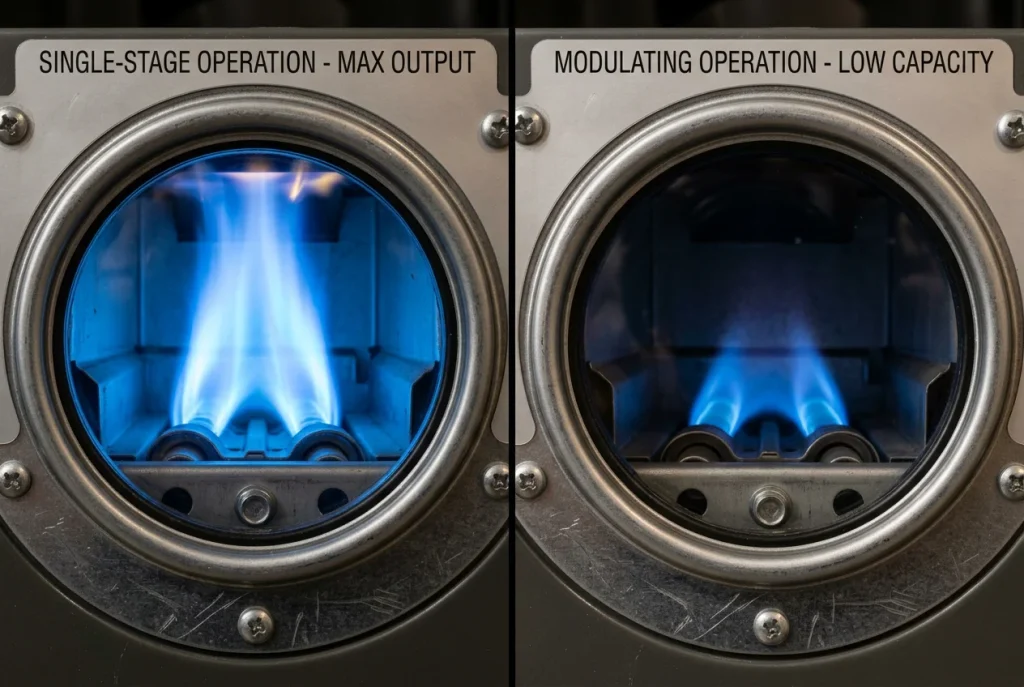
A modulating furnace uses a variable-output gas valve and a variable-speed blower motor to adjust heat production in small increments. Rather than operating at a single fixed output or switching between two stages, a modulating furnace can run at 40%, 55%, 73%, or any output level the system's controls determine is appropriate for current conditions.
This continuous adjustment means the furnace essentially matches its output to your home's real-time heating demand. On a mild 50-degree evening in Houston, it might run at 45% capacity. During a 30-degree cold snap, it ramps up toward full capacity. The system reads conditions and responds precisely, rather than cycling between fixed output levels.
| Feature | Single-Stage | Two-Stage | Modulating |
| Output levels | 1 (100% only) | 2 (65% and 100%) | Continuous (40-100%) |
| Temperature consistency | 3-4 degree swings | 1-2 degree swings | Less than 1 degree |
| Noise level | Loudest | Moderate | Quietest |
| AFUE range | 80-96% | 95-97% | 97-98.5% |
| Blower type | Fixed-speed | Multi-speed | Variable-speed |
The variable-speed blower motor is a significant part of the modulating furnace advantage. It adjusts airflow precisely to match the burner output, delivering consistent air distribution at every operating point. This eliminates the blast-of-hot-air experience that single-stage furnaces produce and provides even, gentle warmth throughout your home.
Where Modulating Furnaces Excel
The benefits of modulating technology are real and measurable. Understanding where they matter most helps frame the value decision.
Temperature precision
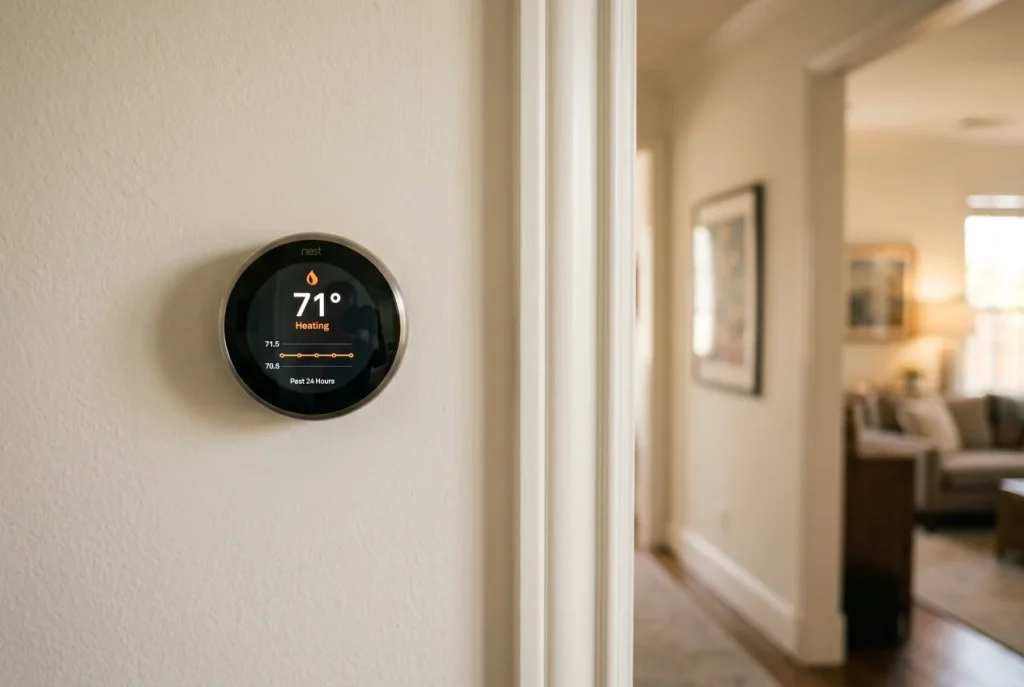
Modulating furnaces maintain indoor temperatures within approximately one degree of the thermostat setting. Single-stage systems typically allow 3 to 4 degree swings between cycles. For homeowners who notice and are bothered by temperature fluctuations, modulating technology eliminates this discomfort entirely.
Noise reduction
A furnace running at 45% capacity is dramatically quieter than one operating at 100%. For Houston homes where the furnace is located near living spaces, bedrooms, or home offices, the noise difference is substantial. Modulating furnaces at low capacity are often nearly inaudible from adjacent rooms.
Maximum efficiency
Modulating furnaces achieve AFUE ratings up to 98.5%, meaning virtually all the natural gas consumed converts to usable heat. Over the life of the equipment, this efficiency translates to measurably lower gas bills during heating season. The efficiency advantage is most pronounced during mild conditions, where the furnace runs at low capacity for extended periods.
Airflow quality
The variable-speed blower in a modulating furnace operates continuously at low speed when the thermostat is satisfied, providing constant air circulation and filtration even when the burner is off. This continuous circulation improves air quality, supports more even temperatures between rooms, and enhances the performance of your air filtration system.
The Houston-Specific Calculation
Here is where the honest assessment begins. Houston's heating season is short and mild compared to the markets where modulating furnaces deliver their maximum value.
Limited heating hours
Houston homeowners run their heating systems approximately 600 to 900 hours per year, compared to 3,000 to 4,000 hours in northern markets. The efficiency advantage of a modulating furnace compounds over operating hours. Fewer operating hours mean less total energy saved, which extends the payback period on the higher upfront investment.
Mild temperatures dominate
The vast majority of Houston's heating hours occur between 40 and 55 degrees Fahrenheit. At these mild temperatures, even a two-stage furnace running on its low stage provides efficient, comfortable heating. The incremental comfort and efficiency improvements of modulating technology over a two-stage system are real but relatively small under mild conditions.
The premium is significant
Modulating furnaces carry a meaningful cost premium over two-stage equipment. That premium buys genuine performance advantages, but in Houston's short heating season, the energy savings take longer to offset the additional investment than they would for a homeowner in Chicago or Minneapolis.
The two-stage captures most of the benefit
This is the key insight for Houston homeowners. A two-stage furnace operating at 65% capacity on its low stage for most of Houston's heating hours delivers most of the comfort, noise, and efficiency improvements over single-stage equipment. Modulating technology refines those benefits further, but the incremental improvement over the two-stage is smaller than the improvement from the single-stage to two-stage.
When Modulating Makes Sense in Houston
Despite the climate-adjusted analysis, there are specific situations where modulating furnaces are the right choice for Houston homes.
Noise-sensitive locations
If your furnace is located in a utility closet adjacent to a master bedroom, home office, or media room, the near-silent operation of a modulating furnace at low capacity provides comfort that no other technology matches. For homeowners for whom furnace noise is a daily quality-of-life issue, the premium is justified by noise elimination alone.
Maximum efficiency priority
Homeowners who prioritize the highest possible efficiency, regardless of the payback period, benefit from modulating technology. A 98% AFUE modulating furnace wastes virtually no energy. If environmental efficiency is a personal value rather than strictly a financial calculation, modulating delivers the highest performance available.
Long-term ownership plans
If you plan to stay in your home for 15 or more years, the extended ownership period allows the efficiency savings to accumulate across more heating seasons. The longer you own the equipment, the more the efficiency advantage compounds, and the closer the payback period approaches.
Large or complex homes
Homes with multiple floors, long duct runs, or rooms that are difficult to heat consistently benefit from the precise output matching and continuous airflow that modulating furnaces provide. The variable-speed blower distributes heat more effectively through challenging ductwork configurations.
The Two-Stage Sweet Spot for Houston
For most Houston homes, I recommend two-stage furnaces as the optimal balance of performance and value. Here is why.
Two-stage furnaces capture roughly 80% of the comfort improvement over single-stage at roughly 60% of the modulating furnace premium. They run quietly on low stage during normal conditions, maintain tighter temperature ranges than single-stage equipment, and achieve AFUE ratings of 95 to 97%.
The two-stage design also pairs effectively with two-stage AC installation Houston equipment, creating a matched system that delivers staged performance for both heating and cooling seasons. This whole-system approach often provides more overall comfort value than investing the premium in heating-only modulating technology while pairing it with single-stage cooling.
When evaluating your heating installation options, the choice between two-stage and modulating should start with an honest assessment of your specific priorities: is the additional comfort and efficiency refinement worth the premium in your situation?
What to Ask Your HVAC Contractor
When discussing furnace options with your hvac service Houston contractor, these questions help frame the decision.
Ask for a specific comparison of annual operating costs between two-stage and modulating equipment for your home's heating load. Generic efficiency comparisons do not account for Houston's specific heating hours and temperature profile.
Ask about warranty differences. Modulating furnaces often include longer or more comprehensive warranties on the heat exchanger and variable-speed components, which can factor into the long-term value calculation.
Ask about matched system options. Your furnace works as part of a complete HVAC system. The AHRI maintains a directory of certified equipment combinations. The best value often comes from matching your furnace technology level to your cooling equipment rather than over-investing in one side of the system.
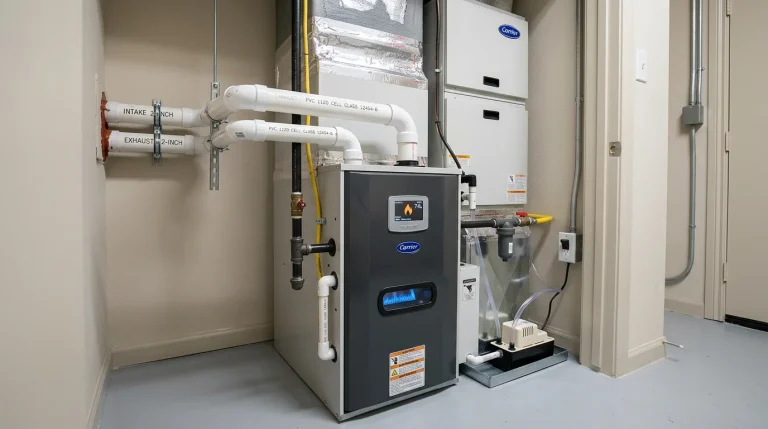
Ask about installation requirements. Modulating furnaces require specific venting configurations (typically PVC direct vent for 96%+ AFUE models) and compatible thermostats. Verify that your home can accommodate these requirements without extensive modification.
Key Takeaways
- Modulating furnaces adjust output continuously from 40% to 100% capacity, providing the most precise temperature control and quietest operation available
- Houston's short heating season (600 to 900 hours) extends the payback period on modulating furnace premiums compared to northern markets
- Two-stage furnaces capture roughly 80% of the comfort improvement over single-stage at a significantly lower cost premium than modulating equipment
- Modulating furnaces make the most sense in Houston for noise-sensitive locations, maximum efficiency priority, long-term ownership, and large or complex homes
- The incremental improvement from two-stage to modulating is smaller than the improvement from single-stage to two-stage
- Matching furnace technology level to your cooling equipment provides better overall system value than over-investing in the heating side alone
Frequently Asked Questions
Is a modulating furnace worth the extra cost in Houston?
For most Houston homeowners, a two-stage furnace provides the best balance of comfort improvement and value. Modulating furnaces deliver genuine performance advantages, but Houston's short, mild heating season means the energy savings take longer to offset the higher equipment cost. Modulating makes the most sense for homeowners who prioritize noise elimination, maximum efficiency as a personal value, or who plan to stay in their home for 15 or more years.
How much quieter is a modulating furnace than a conventional furnace?
The difference is substantial. A single-stage furnace operates at full capacity every time it runs, producing its maximum noise level with every cycle. A modulating furnace running at 40 to 50% capacity, which is its normal operating range during Houston's typical winter temperatures, produces dramatically less noise. Many homeowners describe the difference as going from clearly audible to nearly inaudible from adjacent rooms.
Does a modulating furnace need special maintenance?
Modulating furnaces require the same fundamental maintenance as any gas furnace: annual professional inspection, filter replacement, combustion analysis, and heat exchanger examination. The variable gas valve and variable-speed blower motor do not add maintenance requirements but do require a technician familiar with modulating equipment for accurate diagnosis if service is needed.
Can I pair a modulating furnace with my existing AC system?
Technically yes, but the value diminishes if the systems are mismatched. A modulating furnace paired with a single-stage AC means you get premium heating performance but basic cooling performance. For the best overall system value, match your furnace technology tier to your cooling equipment. A two-stage furnace with a two-stage AC often delivers more balanced comfort improvement across both seasons than a modulating furnace paired with a single-stage condenser.
What AFUE rating should I look for in Houston?
For Houston's climate, a minimum of 95% AFUE is recommended for any new furnace installation. Two-stage furnaces typically achieve 95 to 97% AFUE, while modulating furnaces reach 97 to 98.5% AFUE. The difference between 96% and 98% AFUE saves a small amount of gas per heating season, but that savings compound over the equipment's lifespan. Any furnace rated 90% AFUE or higher requires condensing operation and PVC venting.
Conclusion
Modulating furnaces are not overhyped. They are genuinely the best-performing furnace technology available. But best-performing and best-value are not always the same thing, and in Houston's mild heating climate, the distinction matters.
At VeriChill, I present all three furnace tiers honestly. I explain what each technology delivers, what it costs, and how that equation plays out specifically in Houston's climate and your home's conditions. For most Houston homeowners, two-stage represents the sweet spot. For specific situations, modulating is the right answer. The evaluation process determines which applies to you.
Ready to compare furnace options for your Houston home? Call us at 281-559-6995 or visit verichill.com to schedule a consultation.