A variable-speed AC system uses an inverter compressor that continuously modulates output from roughly 25% to 100%, matching its cooling to exactly what your home needs at any moment. For Houston homes, where the cooling season runs eight to nine months, and humidity sits above 75% for much of the year, that continuous modulation delivers exceptional dehumidification, quieter operation, and strong partial-load efficiency. Whether it is worth the premium depends on your home, and for many families, a two-stage system offers better value.
Almost every Houston homeowner our team meets eventually asks the same thing: Is a variable-speed air conditioner actually worth it, or is it just an expensive badge? After years of designing and installing cooling systems across the Houston metro, our team has learned the honest answer is "it depends," and we would rather walk you through the real trade-offs than push the priciest unit available.
Variable-speed technology is genuinely impressive. An inverter ac system does not slam on and off the way older equipment does. It ramps up gently, settles into a low hum, and holds your home steady with very little drama. In our climate, that long, low-and-slow runtime is exactly what pulls clammy moisture out of the air.
But impressive does not always mean right for your house. Below we will explain how it works, where Houston's long cooling season tilts the math in its favor, and where a well-installed two-stage system gives you most of the comfort for less money.
How a Variable-Speed AC System Works
A variable-speed air conditioner is built around an inverter compressor. Instead of a fixed-speed motor that runs flat out or not at all, the inverter spins the compressor at thousands of incremental speeds, ramping output up or down in tiny steps. This is continuous modulation, and it is the heart of the technology.
When your thermostat calls for cooling, the system sizes its response to the demand. On a mild morning, it may run at 30% and barely whisper. On a brutal August afternoon, it climbs toward 100%. The variable-speed compressor is constantly adjusting, which is what installers mean by energy matching: the unit produces only as much cooling as is required at that moment.
| System Type | Capacity Behavior | Typical Run Pattern | Houston Fit |
|---|---|---|---|
| Single-stage | 100% or off | Frequent short cycles | Weakest humidity control |
| Two-stage | ~65% and 100% | Longer low-stage cycles | Strong value choice |
| Variable-speed | ~25% to 100% | Long, near-continuous low runs | Best comfort and dehumidification |
Compared against the older approaches, the difference in how each compressor behaves is what sets variable-speed apart:
- A single-stage unit only knows full blast or off, so it slams to 100% every time the thermostat calls and then shuts down, with nothing in between.
- A two-stage unit adds a middle gear, running a low stage near 65% and a high stage at 100%, and selects whichever the moment calls for.
- A variable-speed unit simply has far more in-between settings to work with, sliding through thousands of speeds so output tracks demand almost exactly.
Why Houston's Climate Maximizes the Payoff

Here is the part that matters most for our region. The value of variable-speed technology scales with the number of hours the system actually runs. In a market with a short three or four-month cooling season, the premium is hard to recoup. Houston is the opposite case.
A long cooling season earns the premium back
Our cooling season stretches eight to nine months, which is a tremendous number of operating hours, and partial load efficiency rewards every one of them:
- A variable-speed unit spends most of that time loafing along at low output, sipping energy instead of gulping it the way a fixed-speed unit does on every cycle.
- The longer your season runs, the more those small hourly savings stack up, so a market with only three or four cooling months never gives the premium the same chance to pay you back.
Dehumidification excellence in 75%-plus humidity
Houston's humidity routinely sits above 75%, and that is where this technology shines. Moisture removal depends on runtime, and a variable-speed system runs long, gentle cycles that keep air moving across the cold coil for hours. The result is dehumidification excellence: air that feels genuinely dry and comfortable, not just cold and clammy.
Precise cooling and comfort consistency
Because the inverter holds a near-constant output, indoor temperatures barely drift, and that steadiness pays off in a few ways:
- You get precise cooling that keeps the whole house within a tight band rather than swinging a few degrees above and below the setpoint between cycles.
- You also get comfort consistency from room to room, because steady airflow evens out the hot and cold pockets a cycling system tends to leave behind.
- Homes with two stories or rooms over a garage notice this evenness immediately, since those are the spaces a fixed-speed system struggles hardest to keep comfortable.
The Real Benefits, Honestly Assessed
We want to give you the genuine upsides without overselling them, because the daily experience is where variable-speed earns its reputation.
Noise reduction you actually notice
A compressor easing in at low speed is dramatically quieter than one starting at full power, and that quietness shows up in two distinct ways:
- This noise reduction is one of the first things homeowners mention after an upgrade, especially when the condenser sits near a bedroom or patio where a fixed-speed unit would be intrusive.
- There is also startup surge elimination because the inverter ramps up smoothly rather than jolting to full load, which reduces both noise and the electrical stress that comes with every hard start.
Strong efficiency ratings
Variable-speed equipment carries some of the highest SEER2 premium ratings on the market, precisely because it spends so many hours at efficient partial load. The Department of Energy notes that properly sized, high-efficiency cooling systems deliver meaningful energy savings in hot, humid climates like ours. For a long Houston season, those efficiency gains have real time to add up.
Certified, matched equipment
To hit its rated numbers, a variable-speed condenser must be paired with the correct indoor coil and air handler, and there are clear ways to confirm the match is legitimate:
- ENERGY STAR and AHRI both maintain certification programs, so you can confirm a specific combination is verified to perform as advertised rather than taking the label on faith.
- Any hvac service houston company you hire should specify AHRI-matched, certified components on the proposal, never a mismatched pairing that quietly falls short of the rated numbers.
Where Two-Stage Is the Smarter Value
This is the conversation our team has most often, and it is where our honesty earns its keep. Variable-speed is the top of the line, but top of the line is not the right answer for every home.
A well-installed two-stage system captures most of the comfort and humidity benefits at a noticeably lower entry point. It's low stage near 65% already runs long, dehumidifying cycles, and for many Houston homes, that is more than enough all summer.
| Home Scenario | Two-Stage Fit | Variable-Speed Fit |
|---|---|---|
| Modest single-story, sound ductwork | Smarter value, plenty of comfort | More than the home needs |
| Larger or multi-story home | Good, with some unevenness | Best evenness across floors |
| Complex ducts or heavy solar gain | Workable | Worth the premium |
| Top priority on quiet, precise comfort | Very good | The clear winner |
Variable-speed tends to earn its premium in specific situations, while a two-stage system is usually the smarter dollar when those conditions are absent:
- Variable-speed pays off in a larger or multi-story home, where its fine modulation can hold even temperatures across floors that a simpler system struggles to balance.
- It also justifies the premium with complex ductwork or heavy solar gain on one exposure, since those loads shift constantly and reward a system that adjusts in fine increments.
- It is worth it when you place a strong priority on the quietest, most precise comfort possible and want the system to disappear into the background.
- If your home is modest, has sound ductwork, and you simply want reliable cooling, two-stage is usually the smarter dollar, and we would rather steer you there than sell you capacity you will not use.
What a Proper Variable-Speed Installation Requires
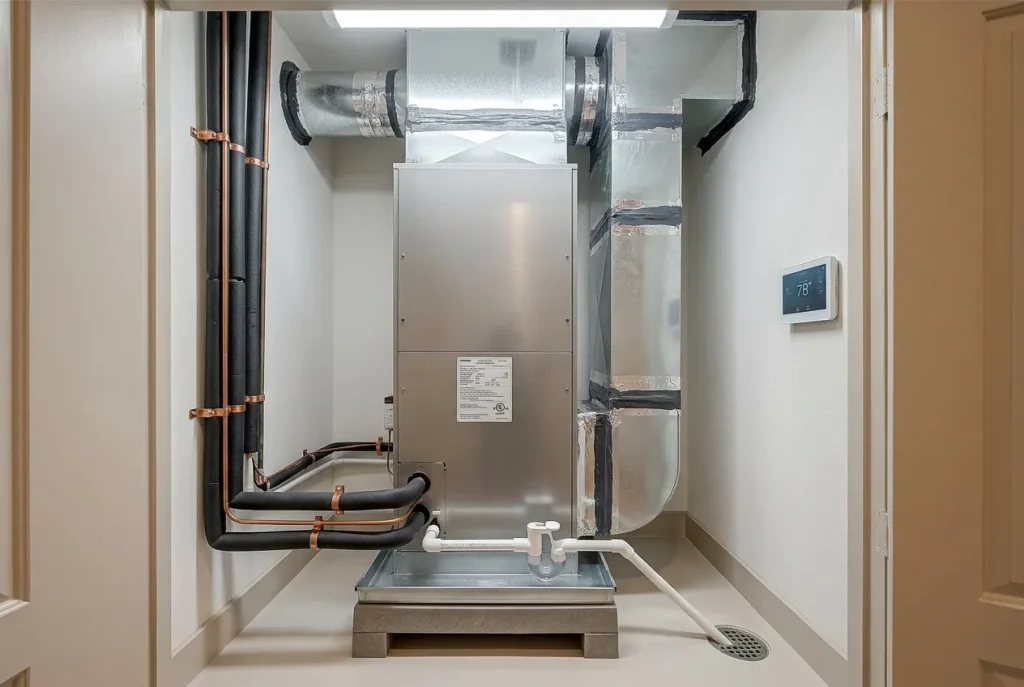
The equipment is only as good as the installation behind it. A premium AC installation Houston lives or dies on a few fundamentals, and a variable speed AC system is less forgiving of shortcuts than basic equipment.
Correct sizing comes first
An oversized variable-speed unit loses much of its advantage because it rarely needs its low end, so accurate sizing has to come before anything else. A proper cooling load assessment is the foundation, and it weighs several factors together:
- Insulation levels and window orientation, since both shape how much heat actually enters the home across the day.
- Ceiling heights and the volume of conditioned space, which change how much air the system has to move and cool.
- The existing ductwork limits the system because it can only deliver what the ducts allow. Get this assessment wrong, and you pay for modulation you never use.
Ductwork has to keep up
Variable-speed systems move air at many different volumes, so the duct system has to keep pace at every speed rather than just at full blast:
- Leaky ducts bleed off conditioned air before it reaches the rooms, quietly erasing the efficiency you paid a premium for.
- Restricted or undersized ducts choke airflow at the higher modulation levels, so the system cannot deliver its full capacity when an August afternoon demands it. Sealing and sizing the duct system is not optional on a premium install.
Thermostat and controls compatibility
These systems rely on communicating thermostats and matched controls to modulate correctly, so the control package deserves its own check before the install:
- The control package is what lets the inverter compressor read demand and respond in fine increments, which is the entire reason the equipment can modulate at all.
- Compatibility needs to be confirmed before installation, not after, since a mismatched thermostat can leave a capable system locked out of the very modulation you paid for.
Variable-Speed and Houston Heating
Variable-speed technology is not limited to cooling. Inverter-driven heat pump versions modulate for both seasons, which suits Houston's mild winters well. For homeowners pairing a system with heating installation, a variable-speed heat pump delivers gentle, steady warmth during our typical 40s and 50s, then ramps up for the occasional cold snap.
Because our heating demand is moderate, the same modulation that excels in our long cooling season carries over to comfortable, even heating without the blast-of-hot-air feel of fixed-speed equipment.
Key Takeaways
- A variable-speed AC system uses an inverter compressor to modulate continuously from roughly 25% to 100%, matching output to real-time demand
- Houston's eight-to-nine-month cooling season and 75%-plus humidity maximize the return on continuous modulation and partial load efficiency
- Standout benefits include dehumidification excellence, precise cooling, comfort consistency, noise reduction, and startup surge elimination
- Variable-speed carries the highest SEER2 premium ratings because it spends most hours at efficient low output
- For many Houston homes, a well-installed two-stage system delivers most of the comfort at a smarter price point
- Correct sizing, sealed ductwork, and compatible communicating controls are non-negotiable for a variable-speed installation to perform
Frequently Asked Questions
Is a variable-speed AC really worth the extra cost in Houston?
For many Houston homes, it can be, and the reason is our climate. The longer your cooling season runs, the more hours a variable speed compressor spends at efficient partial load, which is where the savings and comfort accumulate. With eight to nine months of cooling and humidity above 75%, our region gives variable-speed more chances to pay you back than a short-season market would. That said, it is not automatically the right call. A modest home with good ductwork may be perfectly happy, and better served financially, with a two-stage system.
How is variable-speed different from a two-stage AC system?
The difference is the number of operating settings. A two-stage system has essentially two gears, a low stage near 65% and a high stage at 100%, and it picks between them. A variable speed ac system uses an inverter compressor that ramps through thousands of speeds from about 25% up to 100%, adjusting continuously. That finer control gives variable-speed an edge in temperature precision, humidity removal, and quietness. Two-stage still runs long, dehumidifying low-stage cycles, so it captures most of the comfort for a lower investment.
Does a variable-speed air conditioner remove more humidity?
Yes, and that matters a great deal in Houston. Moisture removal depends on how long air keeps moving across the cold coil, and an inverter ac system runs long, gentle, near-continuous cycles at low output rather than short blasts. Those extended runtimes pull more moisture out of your indoor air, which is the dehumidification excellence homeowners feel as air that is genuinely dry rather than merely cold. In our 75%-plus humidity, that steady moisture control is one of the strongest practical reasons to consider the technology.
Are variable-speed systems quieter than standard AC units?
They are noticeably quieter, and it comes down to how they start and run. A standard single-stage unit jolts to full power each time it cycles, creating both noise and a startup surge. A variable-speed inverter compressor starts at low speed and maintains a soft, steady hum, delivering real noise reduction and eliminating startup surge. If your outdoor unit sits near a bedroom window, a patio, or an outdoor living area, this difference is one homeowners tend to appreciate every single day.
Will a variable-speed AC lower my energy bills?
It can, especially over a long Houston cooling season. Variable-speed equipment carries high SEER2 premium ratings because it spends most of its hours at efficient partial load instead of cycling at full power. The more your system runs, the more those partial-load savings add up, which is why our eight to nine month season favors the technology. Actual results depend on your home's insulation, ductwork, sizing, and how you use the space, so correct installation matters as much as the rated efficiency on the label.
Conclusion
Variable-speed AC technology is the most refined cooling option on the market, and in a climate like ours it has real room to prove its worth. The long Houston season, the relentless humidity, and the appeal of quiet, precise, evenly distributed comfort all line up in its favor. For the right home, it is a genuinely excellent investment.
At VeriChill, our job is to tell you honestly which side of that line your home falls on. For some families, variable-speed is the clear winner. For others, a well-installed two-stage system delivers nearly the same comfort for a smarter price, and we will say so. The goal is to match the right system to your home and priorities, not to sell the most expensive box on the shelf.
Ready to find out whether variable-speed is worth it for your home? Call us at 281-559-6995 or visit verichill.com to schedule a consultation.