You set the thermostat to 74°F. The AC runs. The house feels cold, but also slightly clammy. Your skin feels damp when you sit down. The floors feel a little sticky. The main bathroom has a faint musty smell you can't quite locate. Everything looks fine. It doesn't feel fine.
That's humidity. And in a Houston home, your AC is not guaranteed to handle it on its own. For half the year, the outdoor dew point is high enough that your air conditioner either can't keep up or shuts off before it's pulled enough moisture out of the air. The fix is a whole-home dehumidifier, one of the most underinstalled pieces of HVAC equipment in this market, and one of the highest-impact upgrades we recommend for comfort, air quality, and energy bills.
Why Houston's Climate Breaks the "AC Does It All" Assumption
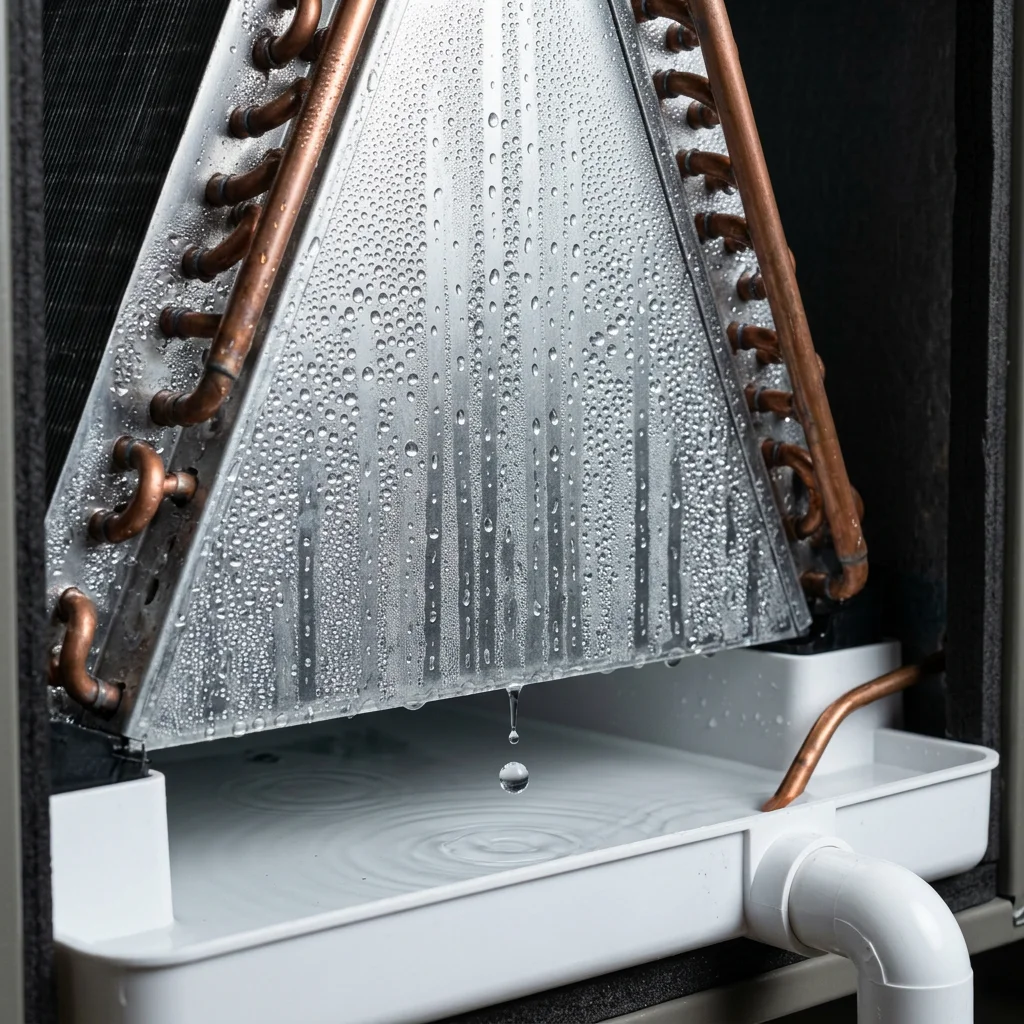
Air conditioning cools air by pulling it across a cold evaporator coil. As the air cools, water vapor condenses on the coil and drains out. Dehumidification occurs only as a byproduct and only while the compressor is running.
Houston creates two failure modes for that design.
The first is mild, humid weather. Think April mornings and October afternoons. Outdoor temperatures hover in the upper 70s, but the dew point is 68-72°F. Your thermostat isn't calling for much cooling, so the AC cycles off quickly. The house stays at 74°F, but indoor humidity creeps to 60%, 65%, sometimes 70%. Everything feels heavy.
The second is oversized systems in any weather. When the AC is sized larger than the home actually needs, which happens in the majority of Houston homes we evaluate, the compressor reaches the target temperature too quickly, shuts off, and never runs long enough for moisture to condense out meaningfully. You get cold, wet air. The symptoms: a clammy 72°F that somehow feels worse than 76°F with balanced humidity, condensation on windows, mildew in closets, and wood floors that start to cup over time.
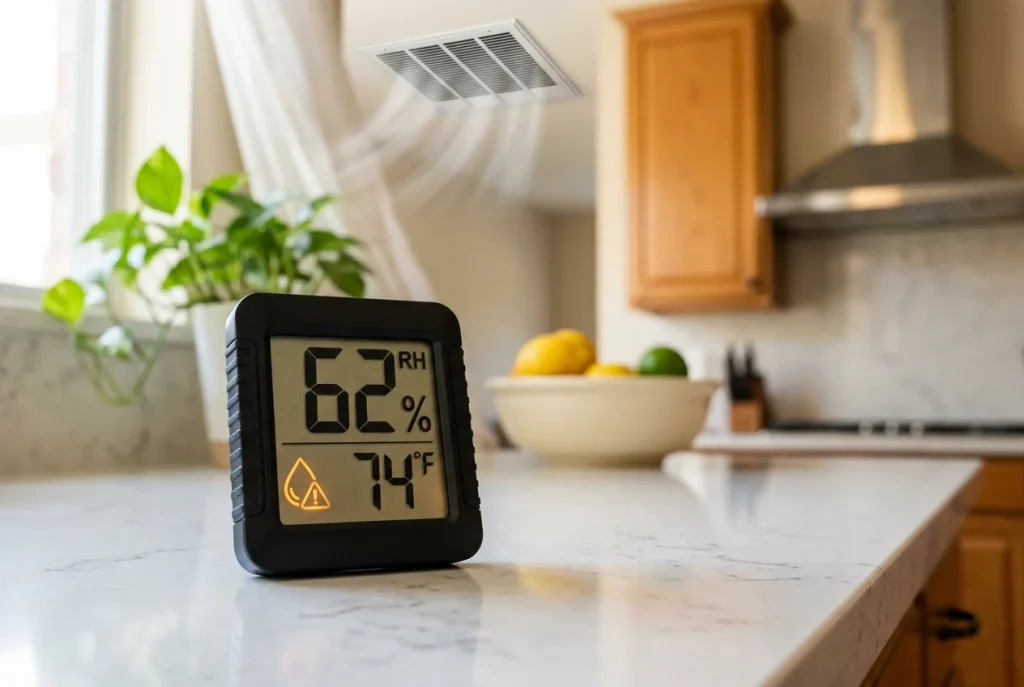
The target for comfortable indoor humidity is 45-55%. If you've never measured it, buy a $20 hygrometer and place it in a central room. Most Houston homeowners are shocked by the number.
What a Whole-Home Dehumidifier Actually Does
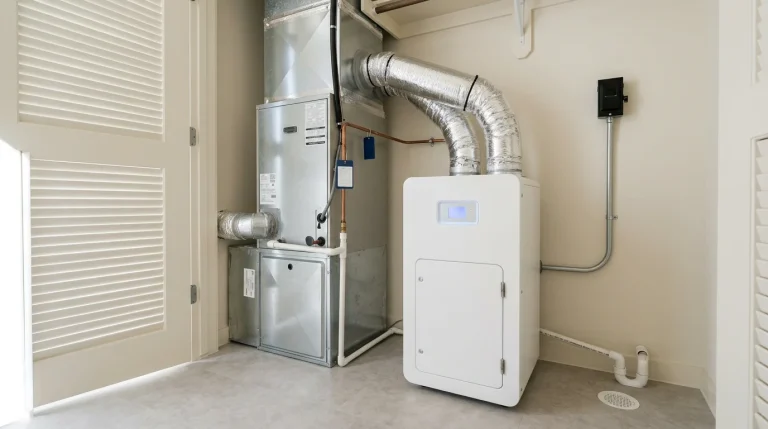
A whole-home dehumidifier is a sealed appliance that ties into your HVAC ductwork (or a dedicated return run). It has its own compressor and coil, independent of the AC, and it runs based on a humidistat rather than a thermostat. When indoor humidity rises above your setpoint (typically 50%), it turns on, draws moisture from the air, and routes the condensate to a drain line. It runs whether the AC is running or not.
Capacity is measured in pints per day. A typical Houston home requires 70-90 pints of dehumidification capacity per day. Compact standalone models handle smaller zones; ducted whole-home units handle the entire conditioned volume.
What changes when one is installed correctly:
Your AC can now be set a few degrees higher and still feel cooler. Air at 76°F and 50% humidity is more comfortable than air at 72°F and 65% humidity. That's thermodynamics, not marketing. Most homeowners drop their thermostat setpoint by 2-4°F within a month of installation, which offsets a meaningful portion of the dehumidifier's energy draw.
Mold growth slows or stops. Dust mite populations crash at relative humidity below 50%. Musty smells disappear. Wood floors, cabinetry, and instruments stop expanding and contracting.
The equipment itself lasts longer. High indoor humidity accelerates corrosion on coils, blower components, and electronics. A drier interior is gentler on every part of the system.
Allergies and asthma symptoms improve. This isn't a cure; indoor air quality is a multi-lever problem, but humidity control is the lever most Houston homes are missing.
When a Whole-Home Dehumidifier Is Worth It
Not every Houston home needs one. If your indoor humidity stays in the 45-55% range year-round with only the AC running, the system is doing its job. That's the exception, not the rule.
Add dehumidification when you see any of these:
- A hygrometer that regularly reads above 55% with the AC running
- Visible condensation on windows, toilet tanks, or cold-water pipes
- Musty smells that return after cleaning
- Mold spots on bathroom ceilings, closet walls, or around window frames
- A home that feels "cold and clammy" rather than "cool and dry."
- A variable-speed AC that still can't pull humidity down during shoulder seasons
- Tightly built new construction in Katy, Cypress, or The Woodlands, where the house is sealed but not actively dehumidified
- Allergy symptoms that worsen indoors
If two or more apply, the equipment pays for itself in comfort alone, before you count the durability or IAQ benefits.
What Goes Wrong When Dehumidifiers Are Installed Poorly
A whole-home dehumidifier is only as good as the integration. We see three common installation failures in Houston:
Undersized capacity
A 50-pint unit in a 3,000-square-foot home will run constantly and still lose the battle. Capacity should be calculated based on home size, envelope tightness, and typical moisture load, not picked off the shelf.
Wrong integration point
Ducted dehumidifiers can dump into the supply side, the return side, or have a dedicated duct. Each has tradeoffs. A supply-side install can fight the AC; a return-side install can short-circuit the system. The right answer depends on your specific air handler and ductwork.
No condensate management
The unit makes water. That water has to go somewhere: a gravity drain, a condensate pump, or a dedicated line. We've seen dehumidifiers installed with a drain line that back-pitches into a pan, creating mold in the very system it's supposed to prevent.
A proper dehumidifier installation takes a day and includes capacity calculation, duct integration, electrical work, humidistat placement, and condensate routing. It is not a drop-in appliance.
How Dehumidifiers Fit Into the Bigger IAQ Picture
Humidity control is one of four levers in indoor air quality, alongside filtration, ventilation, and purification. (Our article on Houston indoor air quality walks through all four.) Dehumidification is the one most Houston homes neglect, and it delivers the most noticeable comfort improvement.
It also enables the other levers. A MERV 13 filter works better when humidity is controlled because it stays drier and captures particulate matter more consistently. An ERV ventilation system works better because the dehumidifier can handle the moisture load from the fresh outdoor air it brings in. UV purification works better because the coil stays cleaner.
Skip dehumidification, and the rest of the IAQ stack runs at half capacity.
How VeriChill Sizes and Installs Dehumidification
Every VeriChill dehumidifier installation starts with two numbers: the home's square footage and the measured existing humidity level under AC operation. From there, we calculate the pints/day requirement, evaluate the existing ductwork, and specify either a ducted whole-home unit or a dedicated-return system, depending on which option yields cleaner airflow. We integrate the humidistat in a central location (not near a supply register or a kitchen) and confirm the condensate path before powering on the unit.
Installation usually takes four to six hours. You'll feel the difference within a week. The hygrometer reading will tell the story before your body does.
Frequently Asked Questions
How much does a whole-home dehumidifier cost in Houston?
Equipment plus installation typically runs $2,800-$4,500 for a standard ducted system in a single-family home. High-capacity or complex retrofits run higher. Compact portable units are $300-$800 but don't cover an entire home and aren't a replacement for whole-home capacity.
Can't I just run my AC longer instead?
You can try. Running the AC at a lower setpoint forces longer cycles, which pulls more moisture. The tradeoffs are higher energy bills and overcooling. For shoulder seasons, it doesn't work at all because the AC simply isn't triggered by temperature.
Will a whole-home dehumidifier raise my electric bill?
It adds load, but in most Houston homes, the net change is small or negative. Homeowners set the thermostat higher once humidity is controlled, and the AC runs less. Energy use is often a wash or slightly lower overall.
Does a variable-speed AC eliminate the need for a dehumidifier?
Partially. Variable-speed (inverter) compressors run longer at low capacity, which pulls more moisture than a single-stage system. In a right-sized variable-speed setup, you may not need a separate dehumidifier. In an oversized or poorly ducted variable-speed system, you still will.
Where should the humidistat be installed?
In a central interior location, away from supply registers, kitchens, and bathrooms, at roughly the height of a thermostat. Placement near a humidity source will cause the unit to short-cycle. Placement in a dry spot will leave the rest of the house humid.
How often does a whole-home dehumidifier need maintenance?
Annually. Coil inspection, condensate line flush, and humidistat calibration. It's the same visit profile as your AC, easiest to roll into the spring service call.
If your Houston home still feels heavy with the AC running, the likely cause is humidity, and dehumidification is the likely fix. A proper evaluation takes about an hour and tells you whether the equipment you already have can be tuned up or whether adding a dehumidifier is the right call. That's the call to make before June.