Houston doesn't really have a spring. We have a brief window in March and April when the AC starts running in earnest, and then June arrives, and the system is at full load for the next five months. Every year, during the first real week of 95°F heat, we get the same kind of calls: condensate floods, capacitors fail, refrigerant problems become emergencies, and homeowners wait days for appointment slots in a market that's suddenly overbooked.
Almost every one of those calls was preventable in April. A proper pre-summer AC checkup catches the issues before they become crises. Here's what that checkup should actually cover, what you can verify on your own this month, and why the contractor who does it in 20 minutes isn't actually doing it.
Why Spring Is the Right Window
Houston AC systems sit idle or lightly loaded for maybe 10 weeks out of the year — usually late December through early March. During that time, a few things happen quietly:
- Condensate drain lines develop algae or dry out and crack
- Capacitors that were borderline in fall drift further out of spec
- Refrigerant leaks that were minor in summer accumulate over the off-season
- Rodents and insects move into outdoor condensers for the warmth
- Cottonwood fluff and pollen pile up on coils when the system starts running
- Thermostat batteries die, float switches stick, contactors pit
If you don't know the system is sick, you find out in mid-June when it fails. Spring service catches all of this while service calendars are open and the weather isn't punishing you for waiting 48 hours on a part.
The right window is mid-March through mid-May. After May, you're competing for appointment slots with everyone whose system already failed.
What a Real Pre-Summer AC Checkup Includes
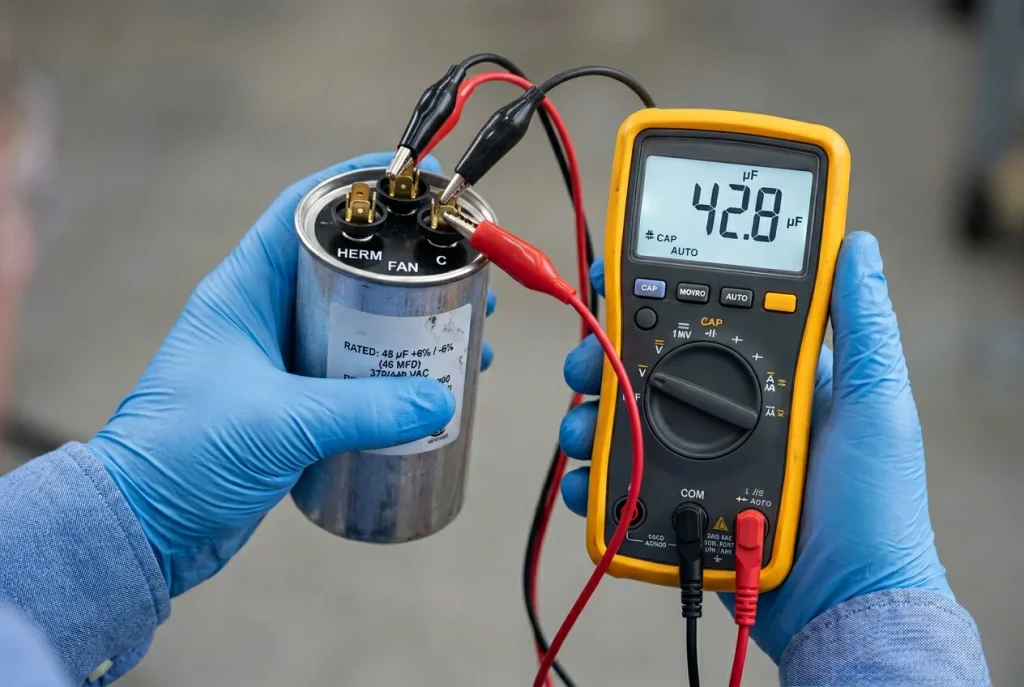
This is the list we run on every pre-summer service visit. If your contractor isn't doing most of these, you're buying a service call, not maintenance.
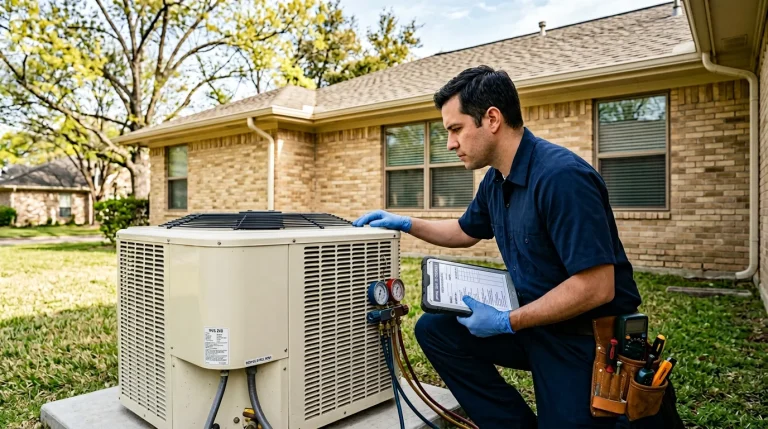
Outdoor Condenser
- Coil cleaning with coil-safe cleaner, rinsed with water (not just hosed off). Cottonwood, pollen, and dust insulate the coil and reduce heat rejection.
- Fan motor amp draw measured against nameplate spec. A motor drawing high amps is failing.
- Fan capacitor microfarads measured. Capacitors are the #1 cause of first-cycle-of-summer failures. Replace anything more than 6% out of spec — they don't get better.
- Contactor inspection for pitting, burn marks, or stuck operation. Burned contactors can cause compressor hard-starts.
- Compressor inrush current measured on startup.
- Refrigerant pressures verified with digital gauges; subcooling and superheat calculated against the manufacturer's target. Pressures alone don't tell you if the charge is correct — the math does.
- Electrical connections torqued to spec. Loose connections heat up, oxidize, and eventually fail.
Indoor Air Handler
- Evaporator coil inspection (actually pulled open and looked at, not assumed clean)
- Blower motor amp draw and capacitor verified
- Drain pan cleaned, float switch tested
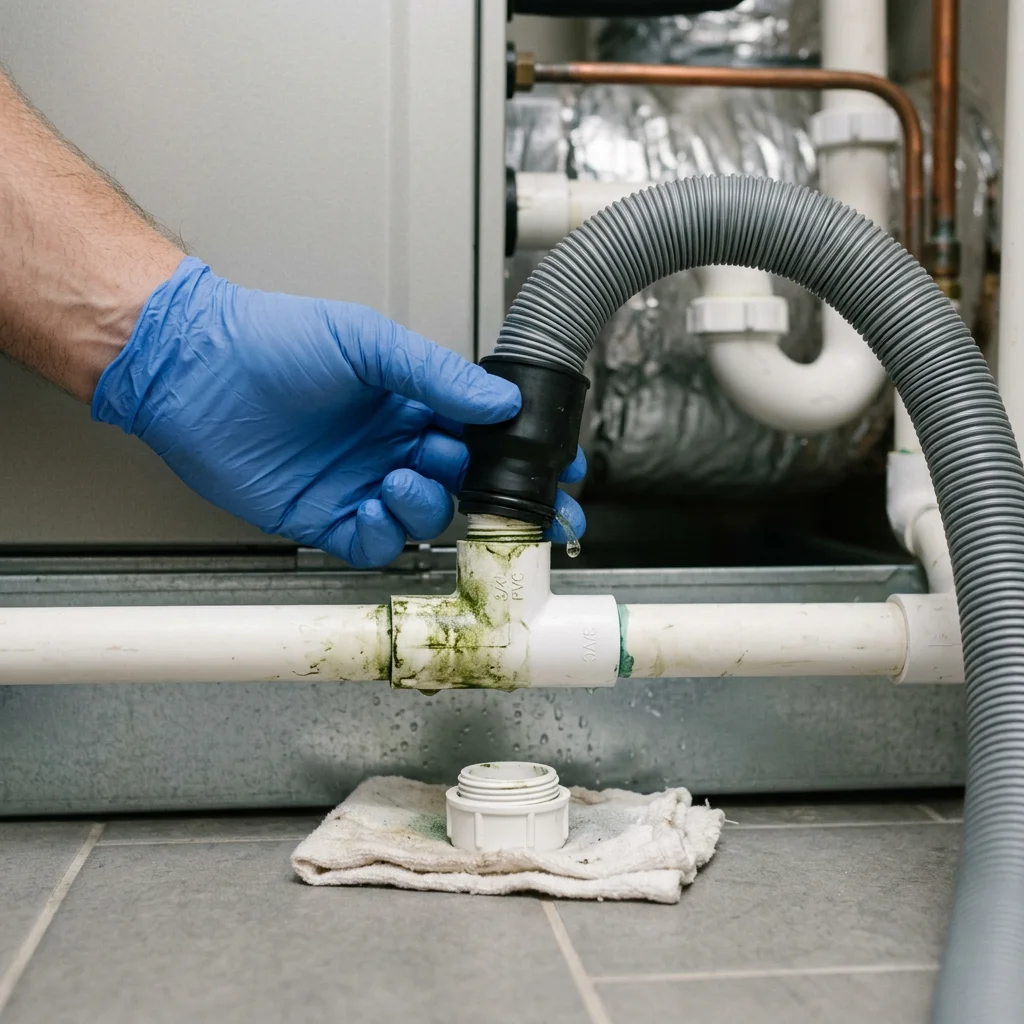
- Condensate line flushed with compressed air or wet-vac, and treated with an algae tablet
- Filter inspected and correctly sized for the slot (not just "replaced")
- Static pressure measured at the return and supply — a one-number health check for the entire airflow side of the system
Thermostat & Controls
- Thermostat calibration against a calibrated reference thermometer
- Cycle test: verify the system turns on, runs at full capacity, and cycles off cleanly at setpoint
- Smart thermostat firmware updated if applicable
- Setpoint and schedule review with the homeowner — including humidity control if the system has a humidistat
Overall System
- Delta-T measurement (temperature drop across the evaporator coil) — should be 16-22°F in a healthy system
- Airflow verification at a representative register or two
- Ductwork visual for anything gone wrong over the winter (rodents, disconnects, crushed runs visible from accessible areas)
That's a 60-90 minute visit per system done correctly. Two-system homes take longer. Anything under 30 minutes is cursory.
What You Can Check Yourself This Month
You don't need a technician for every part of pre-summer readiness. These are homeowner-level checks that catch the most common problems:
Swap the filter. Fresh MERV 11 or 13 filter, correctly oriented (arrow pointing toward the blower), seated properly in its slot. If the filter is loose in the slot, that gap is bypassing the filter and pulling unfiltered return air through. Shim with cardboard or have the slot sized correctly.
Run the system for 30 minutes on a warm day. Set the thermostat 4°F below the current indoor temperature. Let it run. Listen and feel. It should sound normal (no banging, clicking, or whining), cool air should be coming strongly out of registers, and the outdoor unit should be running smoothly. Any unusual noise, weak airflow, or a unit that won't start is a service call.
Check the outdoor condenser. Clear 18-24 inches of space on all sides. Pull mulch away from the base. Rinse the fins gently with a garden hose, top-down, without a pressure washer. If the fins are bent, the coil is dirty, or you see any obvious damage, schedule service.
Watch the condensate drain. Find the PVC drain line outside (usually near the outdoor condenser or at a wall). Within 20 minutes of cool-mode operation, you should see water dripping or a small stream. No water means the drain is clogged, which leads to the air handler pan overflowing and shutting down the system.
Walk the thermostat. If it's older than 7-8 years or uses a mechanical mercury switch, replace it. Modern programmable or smart thermostats are $30-$300 and worth the upgrade in both comfort and equipment control.
Put a hygrometer in the house. $15 at any hardware store. Run the AC for a few hours and check. If humidity reads above 55% with the AC running, the system isn't pulling moisture well, and that's a conversation to have before the heavy humidity of June arrives.
The Most Common Pre-Summer Problems We Find in Houston
Across thousands of spring service visits, a few issues come up repeatedly:
Capacitor drift. Capacitors are rated at a specific microfarad value (e.g., 45 uF). They drift over time with heat exposure. By year 4-5, many are 5-10% below rating. By year 7-8, they're failing in earnest. A capacitor that tests at 38 uF on a 45 uF rating is a time bomb. Replacing capacitors during pre-summer service is the single highest-value maintenance task we perform.
Low refrigerant charge. Refrigerant is a sealed, fixed charge. If the system is low, there's a leak — possibly tiny, possibly not. Finding and fixing the leak in April is the right move. Topping off refrigerant without addressing the leak is a service-call business model, not maintenance.
Clogged condensate drains. The single most common cause of mid-summer water damage and shutdowns. Algae, biofilm, and slime accumulate all winter. A 10-minute flush in April prevents the ceiling damage call in July.
Failed contactors. Pitted, welded, or partially stuck contactors can cause compressor hard-starts, tripped breakers, or silent failures. Visible inspection plus a voltage-drop test catches these before they take out the compressor.
Loose electrical connections. The highest-risk hidden failure mode. A loose lug heats up, arcs, eventually fails, and can trigger equipment damage or a fire. Torque-checking electrical connections is unglamorous maintenance that prevents expensive failures.
Why Timing Matters
The same pre-summer checkup in March costs less than it does in June — not because the prices go up, but because in June you're paying emergency rates to get someone out on a Saturday. The same service that runs $149 with a normal appointment in March becomes a $350 after-hours call in July when the system has already failed.
Also, parts availability shifts in peak summer. Specific capacitor sizes, TXVs, or contactors that are in stock April 10 are on a 3-day backorder by mid-July. We've watched homeowners sit without AC for four days waiting for a $40 part that would have been on the truck if the service had happened eight weeks earlier.
How a Pre-Summer Checkup Fits With the Rest of the System
The full framework for maximizing AC performance and lifespan in Houston ties all three together. Maintenance alone can't fix an oversized system on bad ducts, but it's the single highest-leverage annual investment for a system that was installed well to begin with.
FAQ: Pre-Summer AC Checkup in Houston
When should I schedule my pre-summer AC service in Houston?
Mid-March through mid-May. The earlier in that window, the better your scheduling options and the less likely you'll be competing with emergency calls.
How much does a pre-summer AC checkup cost?
$129-$189 per system for a thorough service with documented measurements. Package deals or maintenance memberships often bring that to $99-$149 per visit, with two visits per year included.
Can I skip the checkup if my system is new?
Even new systems benefit from annual checkups — refrigerant pressures, capacitor values, and electrical connections should all be verified on the first anniversary, and warranty coverage often requires documented annual maintenance. Skipping year-one service can void portions of the warranty.
What happens if I don't do a pre-summer checkup?
You're rolling the dice on the system, making it through summer without a failure. Most years, most systems make it. But the 20-30% that don't tend to fail in mid-July when service availability is worst, and repair costs are highest.
Can I do the full checkup myself?
No. You can handle the homeowner-level checks (filter, outdoor unit clearance, thermostat function, condensate drain observation), but refrigerant verification, capacitor testing, static pressure measurement, and amp draws require tools and training. The DIY checks catch maybe 40% of what a professional visit catches.
Is a maintenance membership worth it in Houston?
For most homeowners, yes. Two visits per year (spring and fall) plus priority scheduling and a modest parts discount typically run $150-$250/year and pays back through the first prevented emergency.
If your AC hasn't been serviced since last summer, April is the time. A proper pre-summer checkup catches the quiet problems before Houston's climate turns them into expensive ones. That single call — done right — is the difference between a system that breezes through July and one that doesn't.