A correctly running residential AC system is designed to hold your home roughly 20 to 22 degrees cooler than the outdoor temperature, not to deliver any setpoint you choose. On a 100-degree Houston afternoon, that means a healthy system keeps the house in the upper 70s, not 68. Understanding this design limit is the difference between a normal hot-day struggle and a real equipment problem that needs attention.
Every July, our team fields the same worried message: "My AC is running nonstop, and it still won't get down to 72." Drawing on more than a decade of our installers installing residential cooling systems across the Houston metro, we can usually tell within a minute whether a homeowner has a broken system or a perfectly healthy one, by bumping into the laws of physics.
Here is the part nobody tells you when you buy a house in Cypress, Katy, or Sugar Land. Air conditioners are not magic boxes that produce any temperature on demand. They are sized to maintain a specific temperature differential below whatever the outdoor air is doing. When the outdoor air hits 100, the math changes, and the expectations many homeowners carry from a milder climate simply do not hold up here.
Let us walk you through what is actually normal on a 100-degree day, what signals a genuine problem, and the practical steps that help your system keep up when Houston turns the heat all the way up.
The 20-Degree Rule: What Your AC Is Actually Designed To Do
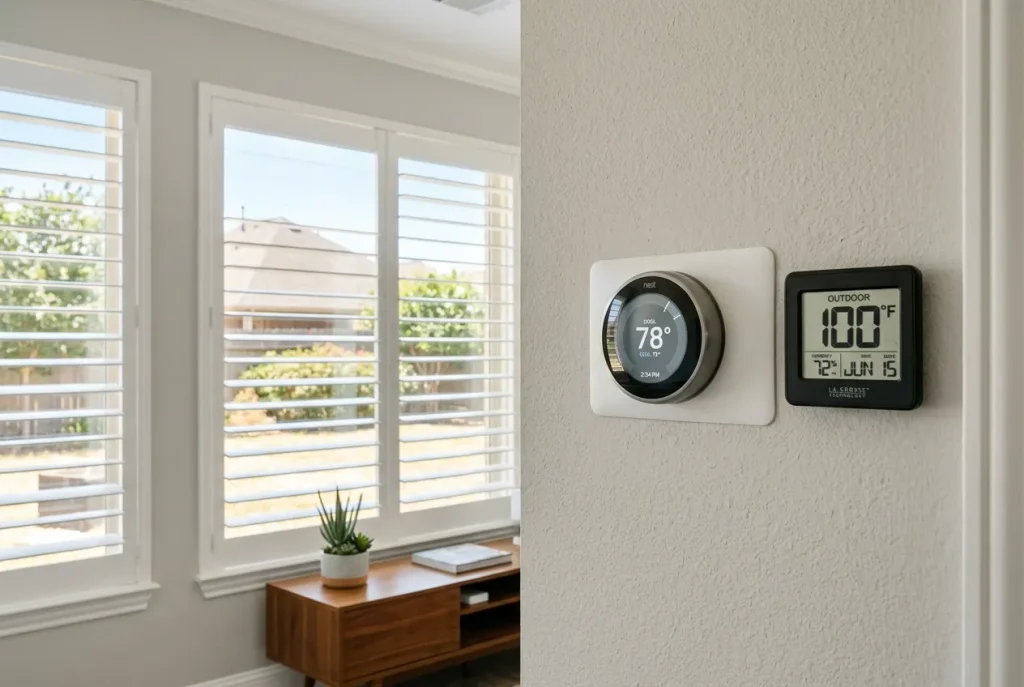
Residential air conditioners are engineered around a target temperature differential, the gap between outdoor temperature and the indoor temperature that the system can sustain. For a properly sized, properly running system, that gap lands at roughly 20 to 22 degrees on the hottest part of the day.
This is not a flaw. It is how the equipment is rated. Organizations like ACCA and ASHRAE establish design temperature limits that manufacturers and installers use to size equipment. In our region, design temperatures sit near 96 to 99 degrees, and systems are matched to maintain comfort against that benchmark, not against record-breaking extremes.
So when the outdoor air reads 100, here is a realistic picture of what a healthy system looks like indoors.
| Outdoor Temperature | Expected Indoor Temperature (Healthy System) | What This Feels Like |
|---|---|---|
| 90 degrees | 70 to 72 degrees | Comfortable, easy to maintain |
| 95 degrees | 73 to 75 degrees | Comfortable, system working steadily |
| 100 degrees | 78 to 80 degrees | Cooler than outside, but warmer than your setpoint |
| 105 degrees | 83 to 85 degrees | Noticeably warm indoors, system at its ceiling |
If your thermostat is set to 72 and the house sits at 78 during a 100-degree afternoon, your system is most likely doing exactly what it was built to do. The disappointment is real, but the equipment is not broken.
Cooling Capacity vs. Demand: Why Peak Heat Changes Everything
Every home has a thermal load, the total amount of heat the system must remove to maintain a target temperature. That load is not fixed. It climbs as the outdoor temperature climbs, as the sun beats on west-facing walls, and as humidity loads the air with moisture your system also has to wring out.
Your AC has a fixed cooling capacity, and its behavior depends on how that fixed capacity compares to the day's demand.
| Condition | Capacity vs. Demand | What The System Does |
|---|---|---|
| Mild day | Capacity comfortably exceeds demand | Cycles on and off with room to spare |
| 100-degree afternoon | Demand meets or exceeds capacity | Can no longer get ahead, simply holds the line as best it can |
This is why the same AC that cruises through a 90-degree morning seems to fall behind by 4 p.m. Nothing changed inside the equipment. The demand side of the equation grew until it pressed right up against what the system can deliver. That is normal, expected behavior during Houston's peak demand hours.
Outdoor Unit Performance in Extreme Heat
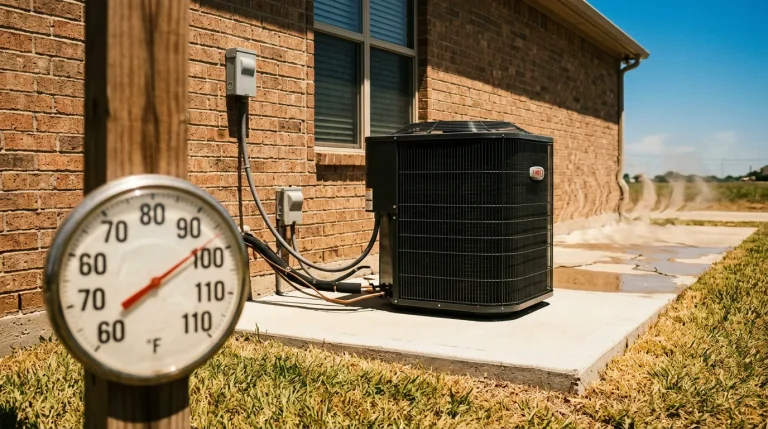
Your outdoor unit, the condenser, rejects the heat your system pulls out of the house into the outdoor air. That job gets harder as the surrounding air gets hotter. When the ambient air is already 100 degrees, condenser efficiency drops because there is a smaller temperature difference to drive heat transfer. Two factors in particular can rob the condenser of the margin it needs on the hottest days.
- Condenser airflow is everything. A condenser smothered by overgrown shrubs, cottonwood fluff, lawn clippings, or a dryer vent blowing lint into its fins cannot breathe. Restricted airflow forces the system to work harder for less cooling, and in peak heat that lost margin is exactly what you cannot spare. Keeping two feet of clear space on every side is one of the simplest things a homeowner controls.
- Heat soak is real. By late afternoon, the concrete pad, the surrounding pavement, and the unit itself have absorbed hours of direct sun. This heat soak raises the local temperature around the condenser above the official air temperature, which is measured in the shade. Your unit may effectively be operating against 105 or 110 degrees even when the forecast says 100.
Compressor Runtime and Recovery Time
On a 100-degree day, two behaviors that look alarming are actually signs of a healthy system, not symptoms of failure.
- Long compressor runtime is expected. A healthy system may run nearly continuously through the hottest hours because continuous operation during peak heat is how it maintains the differential it was designed to hold. Short, frequent cycling in extreme heat would actually be the more concerning behavior.
- Recovery time stretches out. If you let the house warm up while you are away and then drop the thermostat setpoint, expecting a fast cooldown, you will be waiting a long time. The system has to overcome both accumulated heat and ongoing peak load simultaneously, so recovery that takes 20 minutes on a mild day can take hours during peak demand.
This is why we always tell homeowners to avoid big setpoint swings in summer. Setting the thermostat back 10 degrees while you are out, then asking the system to claw all of it back at 5 p.m., stacks the recovery against the day's worst conditions.
When It Is Actually a Problem: Normal vs. Real Trouble
The hard part is telling a healthy struggle apart from a failing system. Here is the framework our team uses on every call.
| Symptom | Probably Normal | Likely a Real Problem |
|---|---|---|
| House sits 6 to 8 degrees above setpoint at 100 outside | Yes | No |
| Indoor temperature climbs higher every day, even on milder days | No | Yes |
| System runs continuously during peak afternoon heat | Yes | No |
| Warm or room-temperature air from the vents | No | Yes |
| House gets warm only between 3 and 6 p.m. | Yes | No |
| Weak airflow, ice on the lines, or water around the indoor unit | No | Yes |
If your home tracks the 20-degree rule and only feels warm at the peak of the afternoon, your system is healthy. If the differential keeps shrinking day after day, the air from the vents is not cold, or you see ice or water, that points to a genuine issue worth a professional look. A reliable hvac service houston provider can diagnose whether you are facing a refrigerant, airflow, or capacity problem.
How To Help Your System Keep Up
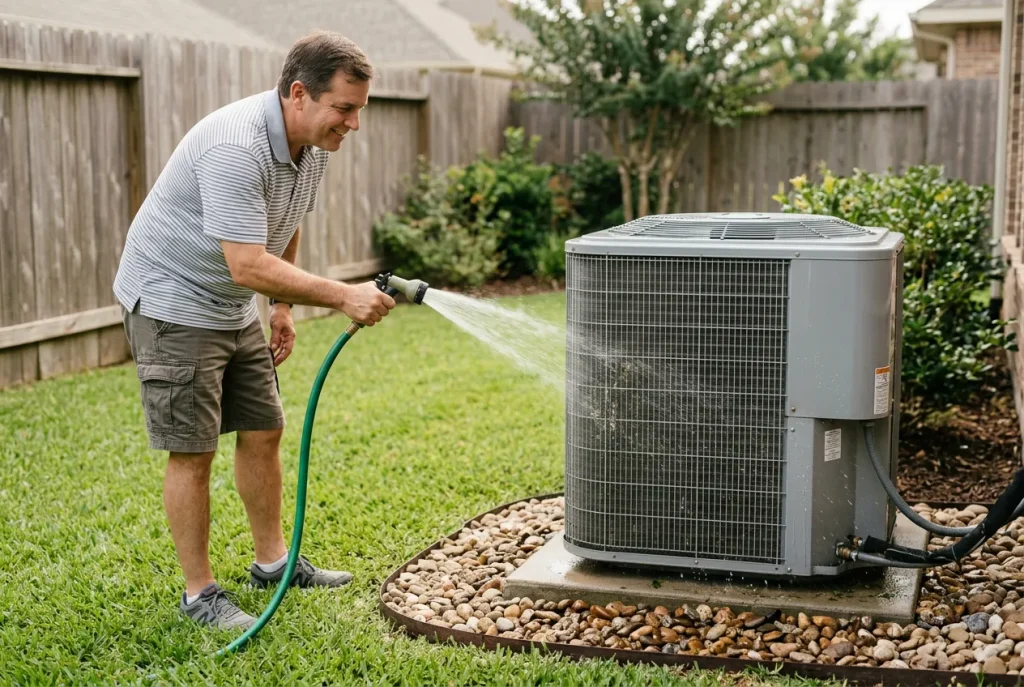
You cannot change the laws of thermodynamics, but you can give your system every advantage during peak heat. The measures below make a measurable difference, and most are well within a homeowner's control.
- Keep the condenser clean and clear. Rinse the outdoor coil gently with a garden hose a few times each summer and pull back any vegetation crowding the unit. A clean condenser maintains its efficiency even when the outside temperature differential is already working against it.
- Set realistic, steady setpoints. The Department of Energy notes that smaller, steadier temperature adjustments are easier on your system than dramatic swings. Pick a setpoint you can live with, in the mid-to-upper 70s on extreme days, and let the system hold it rather than chasing a number it cannot reach. Realistic thermostat setpoint expectations matter as much as the equipment itself.
- Block the sun and seal the leaks. Close blinds on west and south windows during the afternoon, and make sure sealed ducts are not dumping conditioned air into a 130-degree attic. Leaky ducts can quietly erase a large share of your cooling capacity right when you need it most.
- Make sure the system was sized correctly. An undersized system never had a chance against Houston's peak load, so a genuine cooling load assessment that accounts for square footage, insulation, window orientation, and ductwork is the foundation of a system that keeps up. When homeowners ask our team about ac installation houston, proper sizing is the first conversation, because the right capacity is what lets a system hold its differential on the worst day of the year.
- Mind the heat and your health. When indoor temperatures run warm during a heat wave, follow basic heat safety guidance. Stay hydrated, limit strenuous activity during peak hours, and check on older neighbors and family members.
Key Takeaways
- A healthy residential AC maintains roughly a 20 to 22 degree differential below the outdoor temperature, so 78 indoors on a 100-degree day is normal, not broken.
- Cooling capacity is fixed while thermal load rises with the heat, which is why systems fall behind during peak demand hours.
- Long, continuous compressor runtime in extreme heat is expected behavior, not a malfunction.
- Outdoor unit performance suffers when the condenser is dirty, crowded, or heat-soaked by afternoon sun.
- Real trouble shows up as a shrinking differential over time, warm air from the vents, or ice and water around the equipment.
- Clean condensers, steady setpoints, shaded windows, sealed ducts, and proper sizing all help the system keep up.
Frequently Asked Questions
Why won't my AC cool below 78 degrees on a 100-degree day?
This is almost always normal physics rather than a broken system. Residential air conditioners are designed to maintain roughly a 20 to 22 degree differential below the outdoor temperature, so when it is 100 outside, a healthy system holds the house in the upper 70s to around 80. The equipment is matched to design temperature limits set by groups like ACCA and ASHRAE, which sit near 96 to 99 degrees in our region, not to record-breaking extremes. If your home tracks that 20-degree gap and only feels warm during the hottest afternoon hours, your system is performing exactly as designed.
Is it bad that my AC runs constantly during the afternoon?
No, continuous runtime during peak heat is actually a sign of a healthy, properly sized system. When the outdoor temperature climbs, your home's thermal load rises until demand presses right up against your system's fixed cooling capacity. To hold the temperature differential it was built to maintain, the compressor simply has to run longer. The behavior our team worries about is the opposite, a system that short-cycles or blows warm air in extreme heat. Long runtimes on a 100-degree afternoon are the system doing its job, not a warning sign.
How do I know if my AC is struggling normally or actually failing?
Watch the trend, not the single hot afternoon. If your home holds a consistent 20-degree gap below the outdoor temperature and only feels warm between roughly 3 and 6 p.m., the system is healthy. Warning signs of a real problem include a differential that shrinks day after day even on milder days, air from the vents that is warm or only mildly cool, weak airflow, or ice on the refrigerant lines and water pooling around the indoor unit. Those symptoms point to refrigerant, airflow, or capacity issues that warrant a professional diagnosis rather than patience.
Will setting my thermostat lower make the house cool faster?
It will not. Your AC removes heat at a fixed rate regardless of how low you set the thermostat, so setting it to 65 does not pull heat out any faster than setting it to 74. What a very low setpoint does is guarantee the system runs continuously without ever reaching the target, which only adds runtime and wear without improving comfort. During peak heat, the better approach is a realistic, steady setpoint in the mid-to-upper 70s. Big setpoint swings also stretch out recovery time, since the system has to overcome accumulated heat and the ongoing peak load at once.
Does a dirty outdoor unit really affect cooling that much in summer?
Yes, more than most homeowners expect. The outdoor condenser rejects your home's heat into the outdoor air, and that job is already harder when the surrounding air is 100 degrees. A coil clogged with cottonwood fluff, grass clippings, or dryer lint, or a unit crowded by shrubs, restricts the airflow the system depends on. In milder weather you might never notice the lost efficiency, but during peak demand that margin is exactly what keeps the house comfortable. Rinsing the coil and keeping two feet of clearance around the unit is one of the highest-value things a homeowner can do before summer.
Conclusion
Houston summers test every air conditioning system, and the most common "problem" our team gets called out for turns out to be a perfectly healthy system meeting the limits of physics. Knowing the 20-degree rule changes everything: instead of panicking when the house reads 78 on a triple-digit day, you can recognize normal performance and focus your energy on the things that genuinely help, like a clean condenser, steady setpoints, and sealed ducts.
That said, when the differential keeps shrinking, the air is not cold, or the system was simply undersized from the start, those are real issues worth solving. Whether you are weighing a replacement, a new heating installation for the cooler months, or just want a professional to confirm your system is sized right for Houston's peak, we are glad to help.
Ready to make sure your system can handle the next 100-degree day? Call us at 281-559-6995 or visit verichill.com to schedule a consultation.