Starting January 1, 2026, new residential AC systems in the United States must use lower-GWP refrigerants like R-454B or R-32 instead of R-410A. Houston homeowners with existing R-410A systems can continue servicing them normally, but anyone purchasing new AC equipment in 2026 will receive a system designed for next-generation refrigerants with improved environmental performance.
If you have been researching new AC equipment for your Houston home recently, you have probably noticed a lot of noise about refrigerant changes. R-454B, R-32, A2L classifications, and the AIM Act. It sounds complicated, and most of the information online is written for HVAC professionals, not for homeowners trying to make a smart purchasing decision.
Here is what I want you to take away from this article: the refrigerant transition is real, it is happening now, and it affects what equipment you can buy in 2026. But it is not a crisis. Your existing R-410A system is not suddenly obsolete. And the new refrigerants are actually an improvement in several ways that matter to your comfort and your energy bills.
Let me break down exactly what changed, why it matters specifically for Houston homes, and how to make the right decision if you are buying new AC equipment this year.
What Changed on January 1, 2026
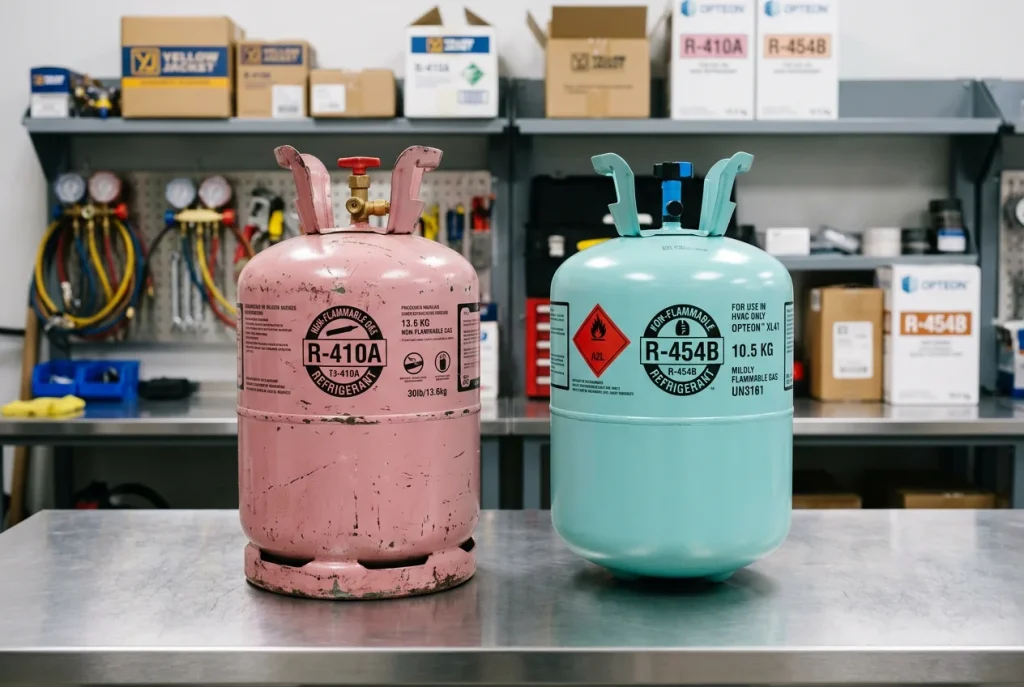
The EPA's AIM Act (American Innovation and Manufacturing Act) required manufacturers to phase down the production of high-GWP (global warming potential) refrigerants. For residential air conditioning, this means new systems manufactured after January 1, 2025, and installed after January 1, 2026, must use refrigerants with a GWP below 700.
R-410A, the refrigerant that has been the residential AC standard for over two decades, has a GWP of 2,088. That is well above the new threshold.
The two primary replacement refrigerants are:
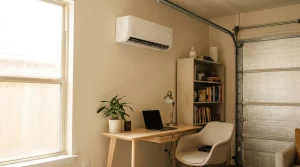
- R-454B is the dominant replacement in U.S. ducted residential systems. It is a blend of roughly 68.9% R-32 and 31.1% R-1234yf, with a GWP of 466, which is approximately 78% lower than R-410A.
- R-32 is used in some ductless mini-split systems and is common in international markets. Its GWP is 675, still well below the 700 threshold.
| Refrigerant | GWP | Status in 2026 | Primary Use |
| R-410A | 2,088 | No longer in new systems | Existing equipment service |
| R-454B | 466 | New standard for ducted AC | Ducted residential systems |
| R-32 | 675 | Alternative to ductless | Mini-splits, heat pumps |
| R-22 (Freon) | 1,810 | Fully phased out since 2020 | Legacy systems only |
This transition is not unprecedented. Houston homeowners went through something similar when R-22 (the original Freon) was phased out in favor of R-410A. That transition took roughly 15 years. This one is moving faster because the regulatory framework was established earlier, and manufacturers were given clear timelines.
What This Means for Your Current R-410A System
If you already have an R-410A air conditioning system in your Houston home, here is the most important thing to understand: nothing changes for you right now. Your existing system continues to operate exactly as before. R-410A refrigerant will remain available for servicing existing equipment for many years.
The AIM Act regulates the production and import of new equipment. It does not ban the sale of R-410A refrigerant itself. HVAC technicians can still purchase R-410A, add it during service calls, and repair your existing system.
That said, R-410A wholesale pricing has increased in some markets amid tightening production quotas. This means that over the next several years, service calls requiring refrigerant additions may cost more than they did historically. But this increase is gradual, not sudden.
Bottom line: Do not let anyone pressure you into replacing a working R-410A system because of the refrigerant change. If your AC system is performing well, cooling your home effectively, and not requiring frequent repair, it has years of serviceable life ahead, regardless of the refrigerant transition.
Why This Transition Matters More in Houston
Houston's climate makes the refrigerant transition particularly relevant for several reasons.
Extended cooling season. Houston homeowners run their AC systems 8 to 9 months per year. That means any efficiency improvement in new refrigerant systems compounds across more operating hours than in most U.S. markets. A system running in Houston accumulates roughly twice the annual runtime of a system in Chicago or Denver.
Humidity performance. R-454B and R-32 both offer slightly different thermodynamic properties than R-410A. Systems designed specifically for these new refrigerants can achieve better dehumidification performance, which matters enormously when Houston's average humidity sits above 75% for months at a time.
Energy efficiency gains. New systems designed for R-454B and R-32 incorporate updated compressor technology, improved heat exchanger designs, and more precise expansion valves. These engineering improvements, combined with the new refrigerant's properties, typically deliver measurable efficiency gains compared with comparable R-410A equipment from the same manufacturer.
For Houston homes where heating unit installation occurs alongside cooling system upgrades, heat pump systems using R-32 or R-454B are increasingly smart options given our mild winters and long cooling seasons.
Understanding A2L Safety Classification
One concern I hear from Houston homeowners is about safety. R-454B and R-32 are classified as A2L refrigerants, which means "mildly flammable." That classification understandably raises questions.
Here is what A2L actually means in practical terms. These refrigerants can ignite, but only under very specific conditions: they require a direct ignition source, specific air concentrations, and limited ventilation. The conditions required for ignition are extremely unlikely to occur in a properly installed residential HVAC system.
New AC equipment designed for A2L refrigerants includes built-in safety features:
- Leak detection sensors that can trigger a system shutdown
- Sealed motor designs that eliminate potential ignition sources inside the unit
- Refrigerant charge limits are calculated to stay below flammable concentrations even in a complete system leak
- Updated electrical components designed for A2L compatibility
Every major manufacturer, including Carrier, Trane, and Lennox, has designed its 2026 equipment lines around these safety requirements. The EPA, AHRI, and ASHRAE all established testing and certification standards specifically for A2L residential systems before approving the transition.
What to Consider If You Are Buying New AC Equipment in 2026
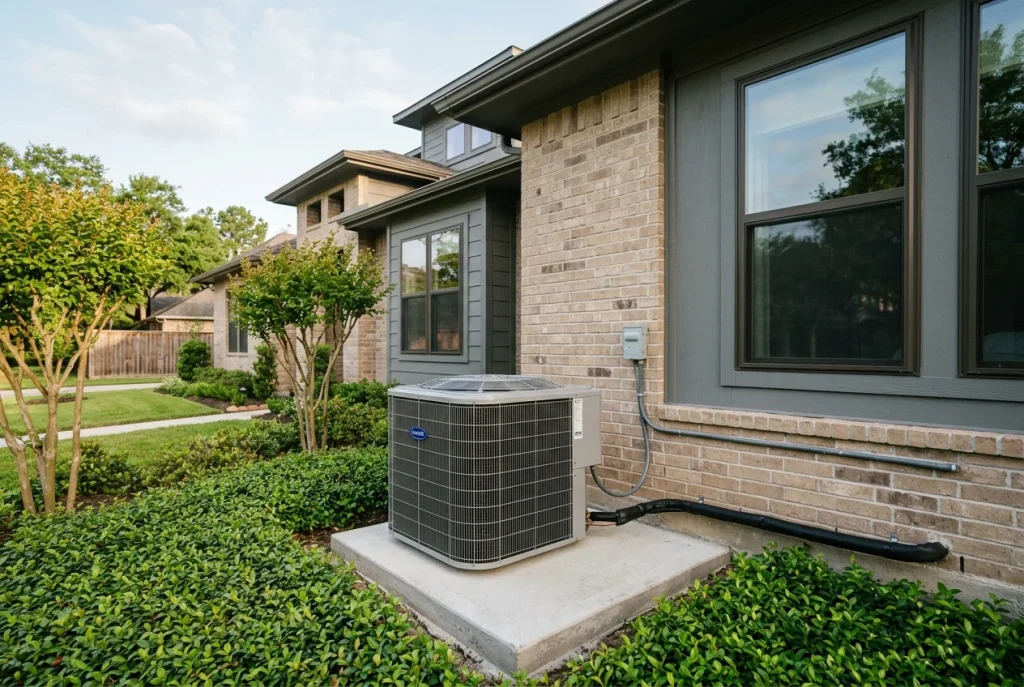
If your Houston home needs a new air conditioning system in 2026, you will receive equipment designed for R-454B (for ducted central AC systems) or R-32 (for some ductless systems). Here is what that means practically.
Equipment availability. All major manufacturers are now shipping R-454B equipment as their standard residential product line. You are not choosing between old and new refrigerants. The new refrigerant is simply what comes in every new system.
Cost considerations. New R-454B systems carry a modest price premium over comparable R-410A systems. The premium reflects updated safety components, redesigned equipment, and the new refrigerant blend. For most Houston homeowners, this increase is offset by the efficiency gains over the system's lifespan.
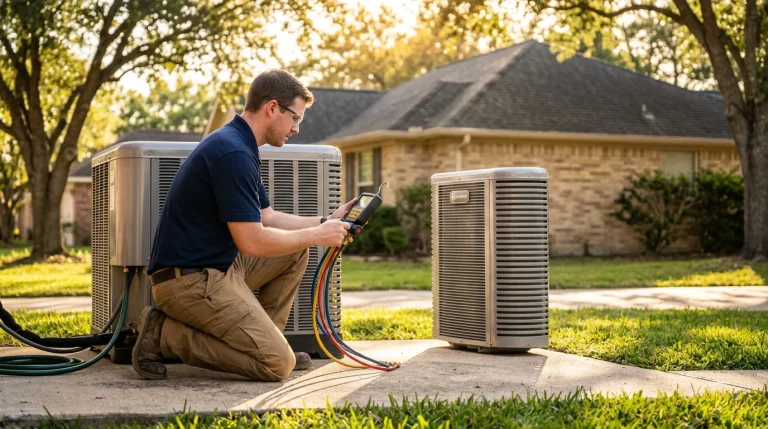
Installation requirements. R-454B systems require HVAC companies with updated training and equipment. The refrigerant operates at slightly different pressures, uses different lubricants, and requires specific charging procedures. Not every contractor has completed this training yet. When choosing an HVAC service Houston provider for a 2026 installation, verify that the company has R-454B certification and experience.
No retrofit option. You cannot convert an existing R-410A system to use R-454B or R-32. The systems are engineered differently from the compressor to the expansion valve. If you need a new system, you are getting a new system designed from the ground up for the new refrigerant.
Planning Your AC Purchase Around the Transition
If you are planning an AC replacement for your Houston home, the transition to a new refrigerant can actually offer some advantages.
Equipment maturity. By mid-2026, R-454B equipment has been in production for over a year. Early production quirks have been resolved, supply chains have stabilized, and your HVAC company has real installation experience with these systems. You are not an early adopter at this point.
Efficiency standards. New R-454B systems must meet current SEER2 efficiency standards. For the Southeast region, including Houston, the minimum is 14.3 SEER2. But because manufacturers redesigned their entire product lines for the refrigerant transition, many 2026 systems exceed the efficiency of previous-generation models at comparable price points. We recommend 16 SEER2 or higher for Houston homes to maximize the return on your AC installation and cooling investment.
Long-term refrigerant availability. Buying a system that uses the current standard refrigerant means your equipment aligns with where the industry is heading for the next 15 to 20 years. R-454B availability will increase as production scales up, while R-410A availability will gradually decrease.
Key Takeaways
- R-410A systems are not obsolete and can be serviced with R-410A refrigerant for years to come
- All new ducted residential AC systems in 2026 use R-454B refrigerant, with R-32 common in ductless systems
- R-454B has 78% lower global warming potential than R-410A, reducing environmental impact
- A2L mildly flammable classification includes built-in safety features that make residential systems safe
- Houston's 8 to 9 month cooling season means efficiency improvements in new systems compound over more hours
- Verify your HVAC contractor has completed R-454B training and certification before scheduling installation
Frequently Asked Questions
Will R-410A refrigerant become unavailable for my existing system?
Not anytime soon. The AIM Act phases down production of high-GWP refrigerants gradually, but R-410A will remain available for servicing existing equipment for many years. You may see modest price increases for R-410A service over time, but your system will not become unserviceable because of the refrigerant transition.
Is R-454B safe for residential homes?
Yes. R-454B carries an A2L "mildly flammable" classification, but new equipment includes comprehensive safety features such as leak detection, sealed motors, and refrigerant charge limits. The EPA, AHRI, and ASHRAE all approved this refrigerant for residential use after extensive safety testing. Millions of A2L systems are already operating safely worldwide.
Does the refrigerant change affect AC performance or comfort?
Systems designed for R-454B can actually deliver improved performance compared to R-410A equipment. The new refrigerant's thermodynamic properties, combined with updated compressor and heat exchanger designs, often result in better efficiency and improved humidity removal, which is particularly beneficial in Houston's climate.
Should I replace my R-410A system now before R-410A becomes harder to find?
No. If your current AC system is performing well and not requiring frequent repair, there is no urgency to replace it. R-410A refrigerant will remain available for service. Replace your system when it reaches the end of its useful life or when repair costs make replacement the better financial decision, not because of the refrigerant transition.
Can I mix R-454B with R-410A in an existing system?
Absolutely not. R-454B and R-410A are not compatible. They operate at different pressures, require different lubricants, and need different system designs. Never allow a technician to add a different refrigerant to your system than what it was designed for.
Conclusion
The 2026 refrigerant transition is a meaningful change for the HVAC industry, but it does not need to be stressful for Houston homeowners. If your existing R-410A system works well, keep using it. If you need new equipment, the R-454B systems available today are safe, efficient, and designed for Houston's demanding climate.
At VeriChill, we have completed full R-454B training and certification. When we evaluate your home for a new AC installation, we assess your insulation, ductwork condition, ceiling heights, window orientation, and airflow distribution to design a system that delivers the efficiency and comfort these new refrigerants are capable of providing. That assessment process is how we ensure your investment performs the way the equipment is designed to.Ready to learn how a new R-454B system would work in your Houston home? Call us at 281-559-6995 or visit verichill.com to schedule a consultation.