For most Houston homes, a heat pump is the smarter long-term choice. It cools just as effectively as central AC during summer and handles Houston's mild winters without needing a separate furnace. Central AC paired with a gas furnace remains a solid option, especially for homes with existing gas infrastructure. Your best fit depends on your home's setup, efficiency goals, and budget.
If you're planning a new AC installation in Houston, the central-AC-versus-heat-pump decision deserves real consideration. Both systems cool your home effectively during Houston's long summers. But heat pumps do something central AC can't: they reverse the refrigeration cycle to provide heating, giving you year-round comfort from a single outdoor unit.
This guide compares the two options head-to-head for Houston's climate, explains the practical trade-offs, and helps you determine which system matches your home.
How Do Central AC and Heat Pumps Compare for Cooling?
For pure cooling performance, central AC and heat pumps are essentially identical. Both use the same refrigeration cycle, the same type of compressor, and the same ductwork to deliver cool air. The cooling SEER2 ratings are comparable across both system types. If cooling is your only concern, the performance difference is negligible.
This surprises many homeowners. A heat pump in cooling mode is functionally equivalent to a central air conditioner. The outdoor unit compresses refrigerant, the indoor coil absorbs heat from your home's air, and conditioned air circulates through your ductwork. The engineering is identical.
Where the systems diverge is what happens during Houston's cooler months. A central AC can only cool. When you need heat, a separate system kicks in, typically a gas furnace connected to the same ductwork and blower. A heat pump reverses the flow of its refrigerant to extract heat from outdoor air and deliver it indoors.
For Houston's climate, that reversal capability is particularly valuable. Our winters are mild enough that heat pumps operate efficiently through the vast majority of heating days. On the few occasions when temperatures drop below freezing, a well-sized heat pump with a backup heating strip handles the load.
| Cooling Comparison | Central AC | Heat Pump |
| Cooling mechanism | Refrigeration cycle | Same refrigeration cycle |
| SEER2 range available | 14.3 to 22+ | 14.3 to 22+ |
| Cooling performance in Houston heat | Excellent | Excellent |
| Humidity removal | Depends on system tier | Depends on system tier |
| Paired with | Gas or electric furnace | Electric backup strips or gas furnace (dual fuel) |
What's the Real Advantage of a Heat Pump in Houston?
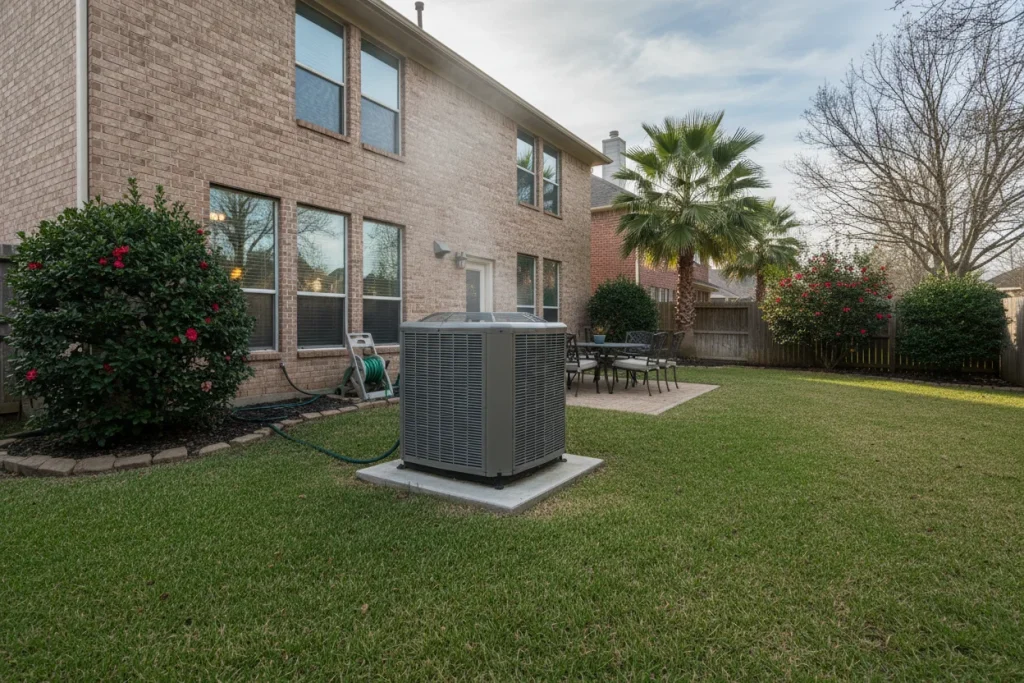
The real advantage is year-round operation from one system. A heat pump eliminates the need for a separate furnace for most Houston heating needs, simplifies your equipment, and delivers heating at a lower operating cost than gas or electric resistance heat during mild weather.
Houston's mild winters are practically designed for heat pumps. When outdoor temperatures stay above 35 to 40 degrees, which covers the vast majority of Houston's heating days, a heat pump delivers heat more efficiently than burning gas or running electric resistance coils. It moves existing heat rather than generating it, which requires significantly less energy.
The DOE's guide to purchasing air-source heat pumps notes that heat pumps can deliver up to three times more heat energy than the electrical energy they consume. That efficiency advantage is especially pronounced in moderate climates like Houston's.
Here's what this means practically for Houston homeowners:
- Lower combined heating and cooling costs. One efficient system, rather than two separate units, means simpler operation and often lower total energy bills.
- No gas line required. For homes without existing natural gas connections, a heat pump eliminates the cost of running gas infrastructure.
- Simpler equipment. One outdoor unit handles both functions, reducing the mechanical complexity of your HVAC system.
- Environmental benefit. Heat pumps don't burn fossil fuels for heating, which appeals to environmentally conscious homeowners.
The main limitation? During the rare hard freezes when Houston temperatures plunge into the teens or low 20s, heat pump efficiency drops. For those few days, backup heating, either electric strips or a gas furnace in a dual fuel configuration, supplements the heat pump's output.
| Houston Heating Scenario | Heat Pump Performance | Central AC + Furnace Performance |
| Mild winter day (50-65°F) | Highly efficient, low operating cost | Furnace fires at full capacity, higher fuel cost |
| Cool winter day (35-50°F) | Efficient, handles load independently | Furnace handles load, moderate fuel cost |
| Cold snap (20-35°F) | Works harder, may need backup assist | Furnace handles easily |
| Hard freeze (below 20°F) | Backup heating supplements | Furnace handles easily |
When Does Central AC with a Furnace Make More Sense?
Central AC paired with a gas furnace is the better choice when your home already has gas infrastructure, you want the fastest heat recovery during cold snaps, or you prefer the lowest possible upfront equipment cost. It's a proven setup that works reliably in Houston year after year.
Despite heat pumps' advantages, central AC plus furnace isn't going anywhere. There are legitimate reasons this pairing remains popular in Greater Houston:
Existing gas infrastructure. If your home already has gas lines and a gas furnace, the marginal cost of continuing with a furnace is lower than converting to a heat pump. You're leveraging infrastructure that's already in place.
Heating speed during cold snaps. Gas furnaces produce very hot air, typically 120 to 140 degrees at the register. Heat pumps produce warm air at lower temperatures, typically 90 to 100 degrees. During a hard freeze, that furnace-heated air feels warmer faster, even though both systems eventually reach the same thermostat setting.
Equipment cost. For homeowners on tighter budgets, a standard-efficiency central AC paired with a basic gas furnace typically costs less than a comparable heat pump system. The gap narrows with higher-efficiency equipment, but at entry-level tiers, central AC plus furnace is usually more affordable.
Dual fuel is the middle ground. Some Houston homeowners choose a dual fuel system: heat pump for primary heating and cooling, with a gas furnace that kicks in automatically when temperatures drop too low for efficient heat pump operation. This delivers the best efficiency across Houston's variable weather, though it carries the highest equipment cost.
| Decision Factor | Central AC + Furnace | Heat Pump | Dual Fuel |
| Upfront equipment cost | Lower | Moderate | Highest |
| Operating cost (cooling) | Same | Same | Same |
| Operating cost (heating) | Moderate (gas) | Lower (mild days) | Lowest overall |
| Heating during hard freeze | Excellent | Needs backup | Excellent (gas backup) |
| Equipment complexity | Two systems | One system | Two systems (optimized) |
| Best for | Existing gas homes, budget focus | All-electric homes, efficiency focus | Maximum efficiency, any home |
How Should Houston Homeowners Decide?

Start with a professional evaluation of your home's existing infrastructure, insulation, ductwork, and heating needs. If your home has gas, both options are viable, and the choice comes down to priorities. If you're building new or converting from electric, a heat pump is often the clear winner for Houston's climate.
The decision framework is simpler than it seems:
- Home has gas + you're budget-focused: Central AC with gas furnace
- Home has gas + you want maximum efficiency: Dual fuel (heat pump + gas backup)
- Home is all-electric: Heat pump (avoid electric furnace operating costs)
- New construction: Heat pump or dual fuel (design around maximum efficiency from the start)
- Planning to stay 10+ years: Heat pump or dual fuel (longer timeline to recoup efficiency investment)
A proper evaluation examining your home's insulation, ductwork, ceiling heights, and window orientation determines the right equipment size regardless of which system type you choose. For heating installation considerations, understanding how your home uses heat during Houston's variable winter, whether it's a few weeks of real cold or just occasional cool nights, shapes the recommendation.
Your HVAC installer should present both options with clear trade-offs so you can make a confident decision. For Houston's residential AC installation market, both systems deliver excellent cooling. The heating side is where the real differentiation happens, and that's where your specific home situation guides the choice.
Energy Star provides additional guidance on qualifying heat pump models and available efficiency certifications.
Key Takeaways
- Central AC and heat pumps cool identically. The performance difference during Houston summers is negligible, so the decision really comes down to how you want to handle heating.
- Heat pumps are ideal for Houston's mild winters, handling the vast majority of heating days more efficiently than gas furnaces.
- Central AC plus furnace remains strong for homes with existing gas lines and homeowners who want the fastest heat recovery during cold snaps.
- Dual fuel systems give you the best of both worlds at the highest equipment cost, pairing heat pump efficiency with gas furnace reliability.
- Houston's climate is one of the best markets for heat pumps because temperatures rarely drop below the range where heat pumps lose efficiency.
- The right choice depends on your home's existing infrastructure, your efficiency goals, and your budget for the initial investment.
Frequently Asked Questions
Does a heat pump cool as well as central AC in Houston's summer heat?
Yes. Heat pumps and central AC use the same refrigeration cycle for cooling. Performance during Houston's summers is essentially identical.
Can a heat pump handle Houston's occasional hard freezes?
Heat pumps handle the vast majority of Houston's heating days efficiently. During rare hard freezes below 20 degrees, backup electric strips or a gas furnace in a dual fuel setup supplement the heat pump.
Is a heat pump more expensive than central AC to install?
Heat pump equipment often costs moderately more than a comparable central AC unit. However, since you may not need a separate furnace, the total system cost can be similar or even lower.
What is a dual fuel system?
A dual fuel system pairs a heat pump with a gas furnace. The heat pump handles most heating and all cooling. The furnace activates automatically during very cold temperatures when the heat pump's efficiency drops.
Will I notice a difference in heating comfort between a heat pump and furnace?
Gas furnaces produce hotter air at the register, which some homeowners prefer during cold snaps. Heat pumps produce warm but less hot air, though they maintain the same thermostat temperature. The difference is subtle.
Should I convert from gas furnace to heat pump when replacing my AC?
If your furnace is also aging, converting to a heat pump or dual fuel system during your AC replacement makes financial sense. If your furnace is relatively new, keeping it and just replacing the AC may be more practical.
Do heat pumps use more electricity than central AC?
For cooling, energy consumption is comparable. For heating, heat pumps use electricity but typically less total energy than electric resistance heating. Gas furnace operating costs depend on natural gas prices.
How long do heat pumps last compared to central AC?
Both typically last 15 to 20 years with proper care. Heat pumps work year-round in Houston, which means more operating hours, but modern units are designed for that duty cycle.
Does VeriChill install both central AC and heat pump systems?
Yes. VeriChill installs central AC, heat pump, and dual fuel systems, and recommends the option that best matches your home's infrastructure and your comfort goals.
Can I switch from central AC to a heat pump without major home modifications?
In most cases, yes. The indoor components and ductwork typically transfer between system types. A professional evaluation confirms compatibility and identifies any needed adjustments.
Conclusion
The central AC versus heat pump debate in Houston comes down to heating strategy, not cooling performance. Both cool your home superbly through our long summers. Heat pumps add the bonus of efficient heating for most winter days. Central AC paired with a gas furnace delivers proven reliability with potentially lower upfront costs. And dual fuel gives you the best of both at a premium. When you're ready to explore which option fits your home, VeriChill can evaluate your situation and walk you through the tradeoffs. No pressure, just clear information. Call 281-559-6995 to schedule.