A traditional residential AC or heat pump has two states: full-on and off. It fires up at 100% capacity, runs until the thermostat is satisfied, and shuts off. Then it repeats. Inverter-driven heat pumps don't work that way. They modulate compressor output continuously between 25% and 100% based on real-time demand, and that single design change fixes most of the comfort and efficiency problems that plague conventional Houston HVAC systems.
If you've read about variable-speed, inverter-driven, or two-stage equipment and wondered whether the upgrade is worth it in Houston's climate, this article walks through what actually changes, where the technology shines, and where it doesn't matter.
What an Inverter Actually Does
In a conventional compressor, the motor runs at a single fixed speed while it's on. The only way to match a lighter cooling or heating load is to turn the compressor on for a shorter duration and off for longer — cycling.
An inverter is essentially a variable-frequency drive that controls the speed of the compressor motor When the home is 2°F from the setpoint, the compressor runs at 30% capacity. When it's 6°F off, it runs at 80%. On a hot summer afternoon, it may run at 100% for hours. On a cool morning, it may hum along at 25% the entire time. The system always matches output to actual demand rather than overshooting and then idling.
This is the same technology logic that changed automotive (continuously variable transmissions), computing (dynamic CPU throttling), and lighting (dimmable LEDs). Applied to HVAC, it produces five measurable changes in how the system operates.
What Changes in Daily Operation
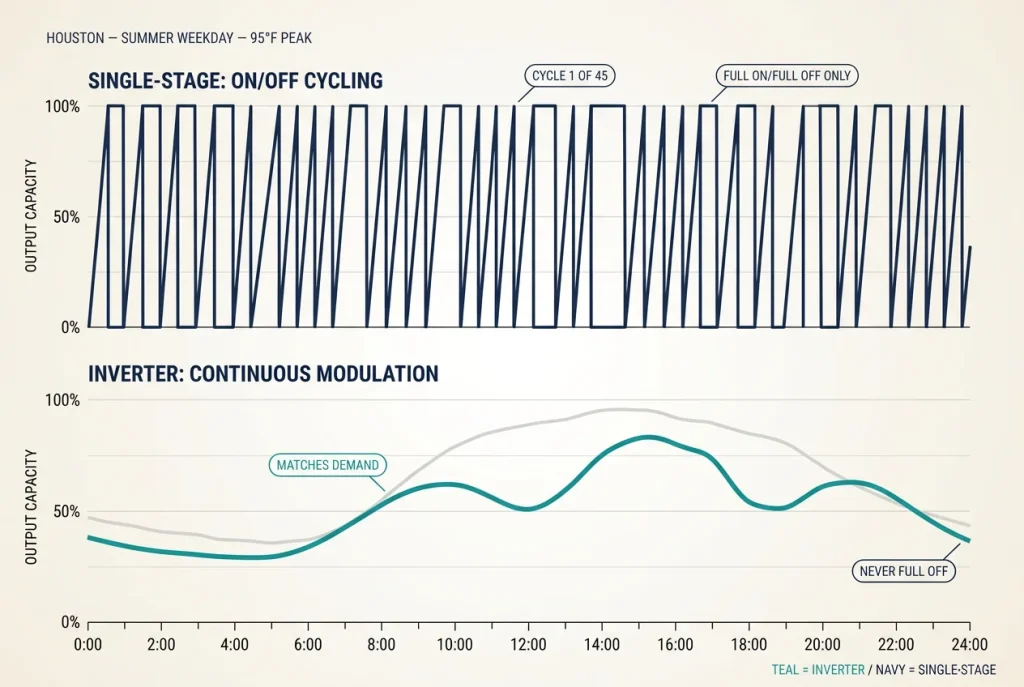
Steady, Longer Cycles Instead of On/Off Swings
A single-stage AC reaches setpoint, shuts off, and lets the house warm back up before cycling on. You feel the difference: temperature drifts by 1-2°F between cycles, humidity climbs during the off period, and the system "blasts" cold air when it restarts.
An inverter runs longer and lower. Once the house is at setpoint, the compressor idles at 25-40% to hold temperature without cycling off. Indoor temperature stays within 0.5°F of the setpoint. Supply air temperature stays moderate rather than swinging between "off" and "ice-cold blast." You stop noticing the HVAC, which is the point.
Dramatically Better Humidity Control
Humidity removal happens while the compressor is running — specifically, while air is passing over the cold evaporator coil. Short cycles remove less moisture. Long, low-capacity cycles remove more.
An inverter heat pump running at 40% for three hours removes significantly more moisture than a single-stage running at 100% for 30 minutes and then off for 90 minutes. In Houston's humid climate, that's the single biggest comfort factor of the technology changes.
For homes where humidity has been a chronic issue, a correctly sized inverter system often eliminates the need for a separate whole-home dehumidifier. For homes with extreme loads (small spaces, high occupancy, many moisture sources), the inverter plus a dehumidifier remains the gold standard.
Meaningfully Lower Energy Use
Efficiency ratings (SEER2, HSPF2) are measured at part-load operating points. An inverter spends most of its time in that efficient range. A single-stage system only briefly reaches rated efficiency at cycle start and end.
Real-world energy use on inverter systems in Houston typically runs 20-35% lower than that of equivalent single-stage units, depending on the home, ductwork, and operating patterns. Those savings aren't due to the rated SEER2 being higher (both can be rated SEER2 16-18). It's because the inverter operates closer to the rated number in actual use.
Quieter Operation — Inside and Outside
Single-stage compressors start with a noticeable clunk and run at one volume. Inverters ramp up gradually and run at low output most of the time. Outdoor noise levels at partial-load conditions are often 10-15 dB lower than those at single-stage operation at the same distance.
Inside, the blower motor on an inverter system is typically ECM (electronically commutated, also variable-speed), which reduces register noise and duct boom. The difference is most obvious at night when the system is running at low capacity, and the home is quiet.
Better Heating Performance at Cold Temperatures
This matters specifically for the heating mode in Houston. A single-stage heat pump loses capacity as outdoor temperatures drop — it can heat a Houston home efficiently at 45°F, less efficiently at 35°F, and may struggle at 25°F.
An inverter heat pump maintains capacity at lower temperatures through compressor speed modulation and advanced refrigerant circuit design. Top-end units hold useful capacity down to 5°F. For Houston's winters, which rarely fall below 20°F even during cold snaps, an inverter heat pump covers all normal heating loads without requiring electric-resistance backup or a gas-furnace auxiliary.
Where Inverter Technology Doesn't Help

It's a genuinely better technology, but it doesn't fix every HVAC problem. Worth knowing the limits:
It doesn't fix bad ductwork. A variable-speed blower is more tolerant of imperfect ductwork, but leaky returns, disconnected runs, and undersized ducts still hurt performance. Fix the ducts alongside any equipment upgrade, since ductwork problems sabotage HVAC performance in Houston homes regardless of how good the new equipment is.
It doesn't cure severe oversizing. An inverter system sized 1.5 tons larger than the home actually needs still has short cycles in shoulder seasons. The modulating range has limits; go too far below the minimum capacity, and the system still turns on and off. Start with a Manual J and size correctly.
It doesn't replace filtration and humidity control when those are genuine problems. The system moves and dehumidifies air more effectively, but it doesn't perform source filtration or control humidity outside its compressor modulation range. For serious issues, the full four-lever framework for indoor air quality in Houston homes covers what the equipment alone can't.
It doesn't make the cheapest installation work well. Inverter equipment is tuned by proper commissioning — setting refrigerant charge precisely, configuring blower speeds, and verifying sensor calibration. A poorly commissioned inverter system performs worse than a well-installed single-stage system would. The technology rewards good installation more than it rescues bad installation.
What an Inverter Heat Pump Cost in Houston
Installed pricing for residential inverter-driven heat pumps in 2026:
- Entry inverter (partial modulation, solid performance): $10,000-$14,000
- Mid-range inverter (full variable-speed, matched variable-speed air handler): $13,000-$17,000
- Premium inverter (cold-climate capability, advanced controls, high modulation range): $16,000-$22,000
Comparable single-stage heat pumps run $7,500-$12,000 installed. So the inverter premium is typically $2,500-$6,000.
Payback on pure energy savings in Houston is usually 7-11 years, depending on usage patterns. That's longer than the payback would be in Minneapolis, but the comfort and lifespan arguments usually justify the decision regardless of the energy math.
Who Should Choose an Inverter Heat Pump
Strong fit:
- Houston homes with persistent humidity issues
- Homes where the existing system is oversized and short-cycling
- Homeowners who notice the AC's on/off operation and want it to disappear into the background
- New construction where the full duct system and equipment can be specified correctly
- Homes combining heating and cooling on a single system
- Two-story homes, where temperature consistency between floors has been a challenge
Less compelling fit:
- Small homes with very low cooling loads, where even a small single-stage system runs efficiently
- Homes are about to undergo a major renovation that will reshape the load calculation
- Homeowners staying in the home for less than 5-7 years who won't recoup the comfort or energy benefits
Not recommended:
- Any install where ductwork or sizing isn't being evaluated (the inverter can't compensate for fundamental system design problems)
What to Ask Before Buying
When evaluating an inverter heat pump quote, the questions worth asking your contractor:
- Is this system sized based on a Manual J calculation for the current home?
- What's the modulation range? (Look for 25-100%; some "inverter" systems only modulate 50-100%, which is closer to two-stage.)
- Is the air handler matched (variable-speed blower)?
- How is refrigerant charge verified at commissioning — weighed in by manufacturer spec, or measured via subcooling/superheat?
- What's the humidity control strategy — onboard humidistat, thermostat-driven, or separate dehumidifier?
- What's the actual warranty on the compressor and parts? (Top manufacturers offer 10-year compressors, 10-year parts, with registration.)
- Is the contractor certified for the specific brand's inverter system? (Training matters on this technology.)
A contractor who can answer these in detail is the one who'll install the system correctly. A contractor who can't is the one whose inverter install will underperform.
How Inverter Heat Pumps Fit the Full Picture
The broader landscape of heating technology for Houston homes in 2026 covers where inverter heat pumps fit in. They're the single most important development for Houston specifically, but they're part of a bigger equipment and design ecosystem, ductwork, controls, humidity management, filtration that has to work together. Getting one part right doesn't rescue the whole system; getting the system right lets the inverter do what it can do.
Frequently Asked Questions
What's the difference between variable-speed, inverter, and two-stage?
Two-stage means two compressor speeds (typically 67% and 100%). Variable-speed and inverter are essentially interchangeable terms for continuous modulation across a wide range (typically 25-100%). Marketing sometimes blurs these lines. Ask for the modulation range specifically.
Will an inverter heat pump work with my current ductwork?
Usually yes, as long as your ducts aren't severely undersized or leaky. The variable-speed blower is more tolerant of suboptimal ducts than a single-stage blower would be. A static pressure test at installation confirms whether additional ductwork is needed.
Do inverter heat pumps break more often?
No — and often the opposite. Fewer startup cycles mean less compressor stress, which extends equipment life. The electronics are more complex, but modern inverter boards are mature and reliable. Lifespan is comparable to, or better than, that of single-stage equipment.
How cold can an inverter heat pump handle in Houston?
Standard inverter heat pumps handle any temperature Houston realistically sees (rarely below 20°F). Cold-climate inverter units add capacity down to -15°F, but are overkill for this market unless you have a specific reason to specify them.
Is an inverter heat pump worth it for a small home in Houston?
The humidity and comfort benefits matter regardless of home size, but the energy savings are proportional to usage. For a 1,400-square-foot home, the payback period stretches to 12-15 years. For a 2,800 square-foot home, it's usually 7-10. In both cases, the improvement in comfort is immediate.
Do inverter systems need different maintenance?
Same visit profile as any modern system — annual professional service covering refrigerant verification, capacitor check, coil cleaning, and electrical inspection. Inverter boards occasionally need firmware updates; most manufacturers push those via the system's control board or the thermostat.
If your current system is nearing replacement age and you've been living with humidity problems, noisy cycling, or uneven temperatures, an inverter heat pump is the equipment upgrade most likely to make the biggest difference in a Houston home. The technology rewards good installation and proper sizing. It's not a fix for a broken system design — but paired with a correct sizing calculation and healthy ductwork, it's the best residential HVAC technology available in 2026.