You just spent $12,000 on a new AC system. The unit is variable-speed, the SEER2 is 17, the install crew was professional, and a month later, the house still has the same hot room over the garage, the same dust problem, and an electric bill that barely moved. The equipment isn't the problem. The ductwork is.
We see this pattern constantly in Houston. Homeowners invest in high-efficiency equipment and see only a fraction of the expected return because the duct system it feeds is leaky, undersized, collapsed, or poorly designed. Industry studies estimate average duct leakage in U.S. residential systems at 20-30%, meaning a quarter to a third of the conditioned air you're paying to produce never reaches the living space. In a Houston attic, where duct runs sit in 130°F heat, the losses compound.
This is the article where we tell you what's actually going wrong with the ductwork in Houston homes — and how to identify it before the next equipment upgrade becomes another expensive lesson.
Why Ductwork Matters More in Houston Than Almost Anywhere Else
Three things stack the deck against Houston duct systems:
- Attic location. In Houston, ducts almost always run through unconditioned attic space. Summer attic temperatures hit 130-140°F. Every foot of unsealed or poorly insulated duct is losing cooling capacity to that heat.
- Flex duct prevalence. Most Houston homes built since the 1980s use flexible (flex) ductwork rather than rigid sheet metal. Flex is cheap and fast to install. It's also easy to install badly — kinked at elbows, compressed under insulation, drooped between supports, or run with 90-degree turns that starve airflow.
- Long AC runtime. Your system runs 8-9 months a year. Every problem the ductwork has gets 3x the operating hours compared to a milder climate. Small leaks become large annual losses.
The result: the best equipment in the world loses a third of its efficiency before the air reaches your living room.
The Ductwork Problems We See Most Often in Houston Homes
1. Disconnected or loose duct runs
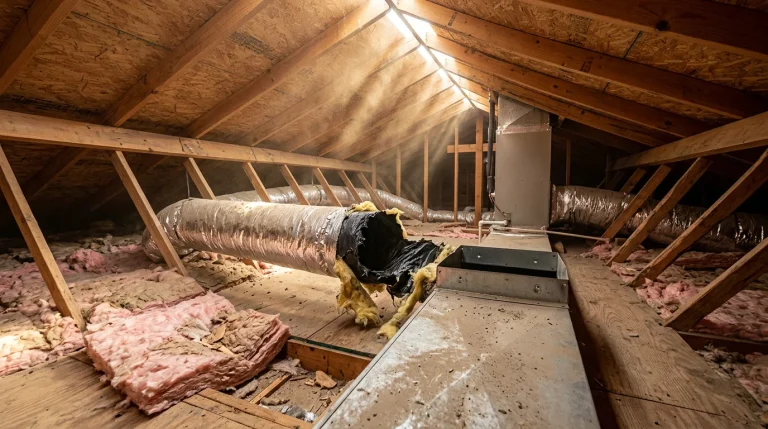
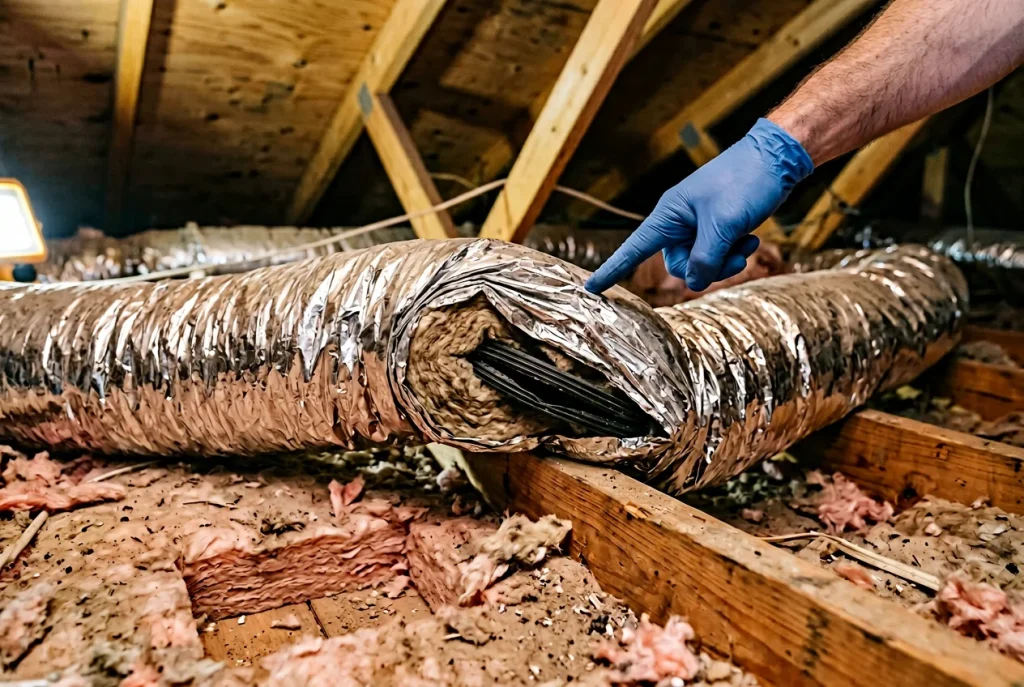
The flex duct attached to a metal boot with cloth tape or a loose zip tie eventually pulls away. The disconnect might be partial — a gap the size of your fist — or complete, with the duct dumping conditioned air into the attic while a room sits at 82°F. This is the single most common failure pattern we find during evaluations, and it's invisible until someone climbs into the attic.
2. Kinked or crushed flex duct
Flex duct relies on its spiral inner liner to maintain shape. If it's bent past its turning radius, stepped on, or compressed under attic insulation, the cross-section collapses. A duct with a 6" nominal diameter can be reduced to 3" at a kink point. Airflow to downstream rooms crashes.
3. Leaky return plenums
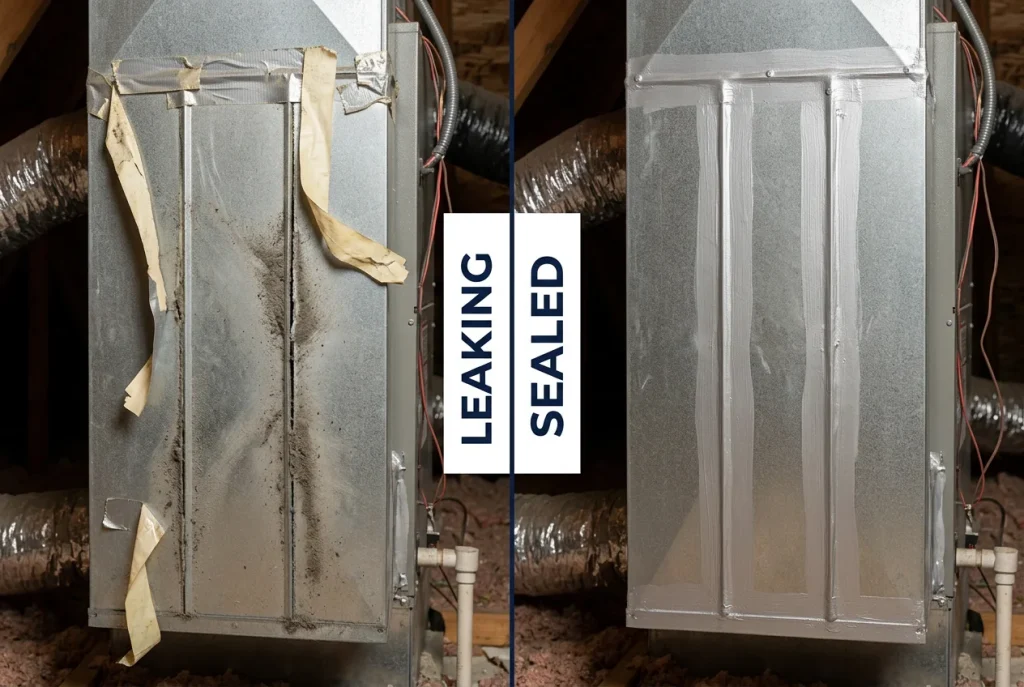
The return side of the system is under negative pressure. Any gap — around the filter frame, at plenum seams, or where the plenum meets the air handler — allows attic air, insulation fibers, pollen, and sometimes rodent contaminants to enter. This is how "the dust won't stop" problems start.
4. Undersized return ductwork
A common Houston issue. A 3-ton system often has sufficient supply capacity, but a single undersized return can choke the blower. The system can't move enough air through the coil, which causes refrigerant issues, comfort problems, and shortened equipment life. You'll feel it as weak airflow at the registers and high humidity despite the AC running.
5. Improperly sealed joints
Cloth duct tape (the gray fabric kind most homeowners think of as "duct tape") fails in Houston attics within a year or two. The industry standard is either UL-181-listed mastic, foil-backed mastic tape, or metal screws with mastic. We routinely find 10-year-old installations where cloth tape has curled, browned, and released, leaving every joint leaking.
6. Ducts with no insulation or compressed insulation
The foil-and-fiberglass jacket on the flex duct is the only thing between the 55°F supply air and the 135°F attic air. If that insulation is torn, compressed, or missing (sometimes stripped by rodents), you're essentially letting the attic cool.
7. Too few supply registers for the room size
Sometimes the ductwork isn't broken — it was never adequate to begin with. A large primary bedroom served by a single 6" supply will always be hotter in summer than a smaller room with two 6" supplies.
8. No damper strategy
Multi-zone homes often have a single-zone system with manual dampers that nobody has touched in 15 years. Rooms that need more air in summer need less in winter, yet nothing adjusts.
The Symptoms That Point to Ductwork — Not Equipment
If you're trying to diagnose whether a comfort or efficiency problem is your AC or your ducts, watch for these:
- One or two rooms are consistently 4-8°F warmer or cooler than the rest of the home
- Dust accumulates on surfaces faster than you can clean it
- Allergy symptoms are worse indoors than outdoors
- The AC runs constantly, but the house doesn't feel cold
- Humidity stays above 55% even with the system running
- Energy bills are higher than those of neighbors with similar-sized homes
- You can hear airflow noise at specific registers (whistling or roaring)
- The house feels pressurized or depressurized when doors close
Any one of these can be a ductwork symptom. Three or more, and it's almost certainly ducts.
How a Proper Ductwork Evaluation Works
A contractor who tries to diagnose ductwork without measuring anything is guessing. A real evaluation includes:
Static pressure testing. We take pressure readings on the return and supply sides of the air handler with the blower running at full speed. The target total external static pressure is typically 0.5 in WC (inches of water column). Anything above 0.8 indicates a restriction — undersized return, a dirty coil, a blocked filter, or a duct issue. This one number tells you more about airflow health than any visual inspection.
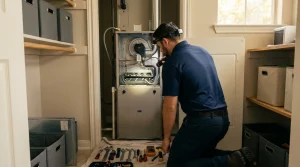
Visual inspection of every accessible run. We climb the attic, photograph disconnects, note kinks and crushed sections, check seal quality at every accessible joint, and verify insulation condition.
Room-by-room airflow measurement. A flow hood or vane anemometer at each supply register tells us whether individual rooms are receiving their designed CFM. Discrepancies point to damper issues, duct damage, or sizing problems.
Return air quantity check. Total return CFM should roughly equal total supply CFM. If they don't match, the system is starved somewhere.
Pressure pan or duct blaster test (optional for severe leaks). Quantifies the exact leakage percentage. Worth doing when the visual evaluation suggests widespread problems.
Without these measurements, any ductwork diagnosis is opinion, not engineering. Unfortunately, the measurement step is what most contractors skip.
The Fixes — In Order of Cost and Impact
If the evaluation finds problems, the repair path is usually this sequence:
Start with seal-and-connect repairs. Reconnecting disconnected runs, sealing plenum leaks with mastic, and replacing failed tape with UL-181 seal. Low cost, immediate, and meaningful improvement. Most Houston homes can gain 10-15% in effective system capacity from this alone.
Then address sizing issues. Add a second return if the existing one is undersized. Replace crushed flex runs with properly supported new runs. Add a supply to the underserved rooms.
Then consider redesign. In older homes with fundamentally under-designed duct systems, piecemeal fixes hit a ceiling, and a full duct system redesign for hot-humid climates — properly sized trunk lines, adequate returns, balanced supplies — is what federal Building America research recommends.
Replacing the equipment without addressing the ducts is the wrong order of operations. Fix the ducts first. The AC you already have will probably feel like a different system.
How Ductwork Ties Into the Bigger Picture
Ductwork failures are one of the top causes of indoor air quality problems in Houston. Our article on indoor air quality explains how leaky returns draw attic contaminants into the supply stream. It's also one of the reasons whole-home dehumidification gets added unnecessarily — sometimes the humidity problem is actually a ductwork problem.
Good ductwork is invisible. Bad ductwork quietly ruins every other investment you make in the system.
Frequently Asked Questions
How much does ductwork repair cost in Houston?
Simple seal-and-reconnect work is typically $400-$1,200. Adding a return or replacing several runs runs $1,500-$4,000. Full duct system redesigns for a single-family home range from $6,000 to $12,000, depending on complexity and access.
Can I inspect my own ductwork?
You can do a visual pass for disconnects, visible tape failure, and insulation damage. You cannot measure static pressure or CFM without specialized tools. A DIY visual check will catch the most egregious issues. Everything else needs measurement.
How often should ductwork be inspected?
Every 5-7 years for homes in good condition, and anytime you install new HVAC equipment. Always inspect after any attic work (insulation, roofing, electrical) since those trades regularly damage ductwork without noticing.
Is duct cleaning the same as duct sealing?
No. Duct cleaning removes dust and debris from inside the ducts. Duct sealing closes leaks in the duct walls and joints. Cleaning is occasionally useful. Sealing is almost always worth doing if leaks are present.
Will new equipment fix old ductwork?
No. New equipment matched to bad ductwork performs like bad equipment. This is the most common mistake we see in Houston — upgrading the AC without inspecting the feed that supplies it.
How do I know if my ductwork is undersized?
Signs include consistent whistling at the registers, a blower that runs constantly without reaching the setpoint, high static pressure readings, and rooms that never quite reach the thermostat temperature. A Manual D duct design review against your current ducts will confirm.
If your HVAC isn't performing the way it should and the equipment is relatively new, the ductwork is the first thing to rule out. A proper duct evaluation costs less than a service call and answers questions that have been costing you money every month. That's the diagnostic to run before any equipment decision.