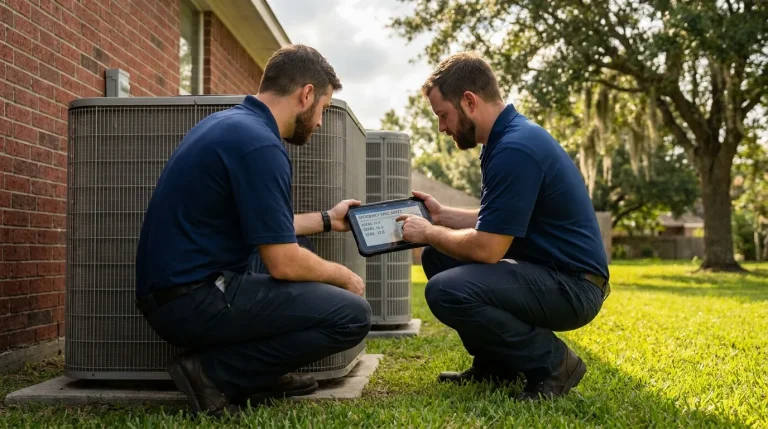
The SEER2 vs. EER2 question comes down to what each rating actually measures. SEER2 is a weighted seasonal average of efficiency across a range of outdoor temperatures, while EER2 measures efficiency at a single hot, steady 95-degree condition. Both are tested to current AHRI methodology, and both appear on the same equipment. For most of the country, SEER2 is the headline number. In Houston, where afternoons sit at or above that 95-degree test point for weeks at a time, EER2 arguably predicts real-world performance better, which is why our team looks at both numbers rather than shopping on SEER2 alone.
Efficiency ratings are supposed to make AC shopping easier. Instead, they often make it more confusing. You start comparing systems, and suddenly there are two numbers that both claim to measure efficiency: SEER2 and EER2. The salesperson leads with the bigger SEER2 figure, the spec sheet lists both, and nobody explains why there are two ratings in the first place or which one should actually drive your decision.
Here is the part that matters for us specifically. These ratings were built around a national average climate, and Houston is not average. Our cooling season runs eight to nine months, our humidity sits above 75 percent for weeks at a time, and our summer afternoons spend real hours at the exact temperature EER2 is tested at. That changes which number tells you the most about how a system will actually perform in your home.
Let us walk through what each rating measures, how they are tested, and why our team weighs them differently for Houston homes than a generic national AC efficiency rating comparison would suggest.
What SEER2 and EER2 Actually Measure
Both ratings describe how much cooling you get for the electricity you spend, expressed as cooling output divided by power input. The difference is the conditions under which each number is measured.
SEER2 methodology
SEER2 stands for Seasonal Energy Efficiency Ratio 2. The word "seasonal" is the key. SEER2 estimates efficiency across an entire cooling season by testing the equipment at several outdoor temperatures and weighting the results to reflect a typical mix of mild and hot days. It rewards systems that run efficiently at partial load, which is where most equipment spends the majority of a normal cooling season in a moderate climate.
EER2 methodology
EER2 stands for Energy Efficiency Ratio 2. It is a single-point measurement taken at a steady 95-degree outdoor temperature with the system running at full load. There is no seasonal averaging and no partial-load weighting. It answers one focused question: how efficiently does this system cool when it is genuinely hot outside, and the equipment is working hard?
Why there are two numbers
The two ratings exist because efficiency is not constant. A system that looks excellent when it is coasting at partial load on a mild day may look ordinary when it is pinned at full output on a 98-degree afternoon. SEER2 captures the coasting; EER2 captures the grind. The 2023 transition from SEER and EER to SEER2 and EER2 updated the testing conditions to use higher external static pressure, which better reflects real installed ductwork, so today's numbers map more closely to actual performance than the older ratings did.
How the Ratings Are Tested and Why Testing Conditions Matter
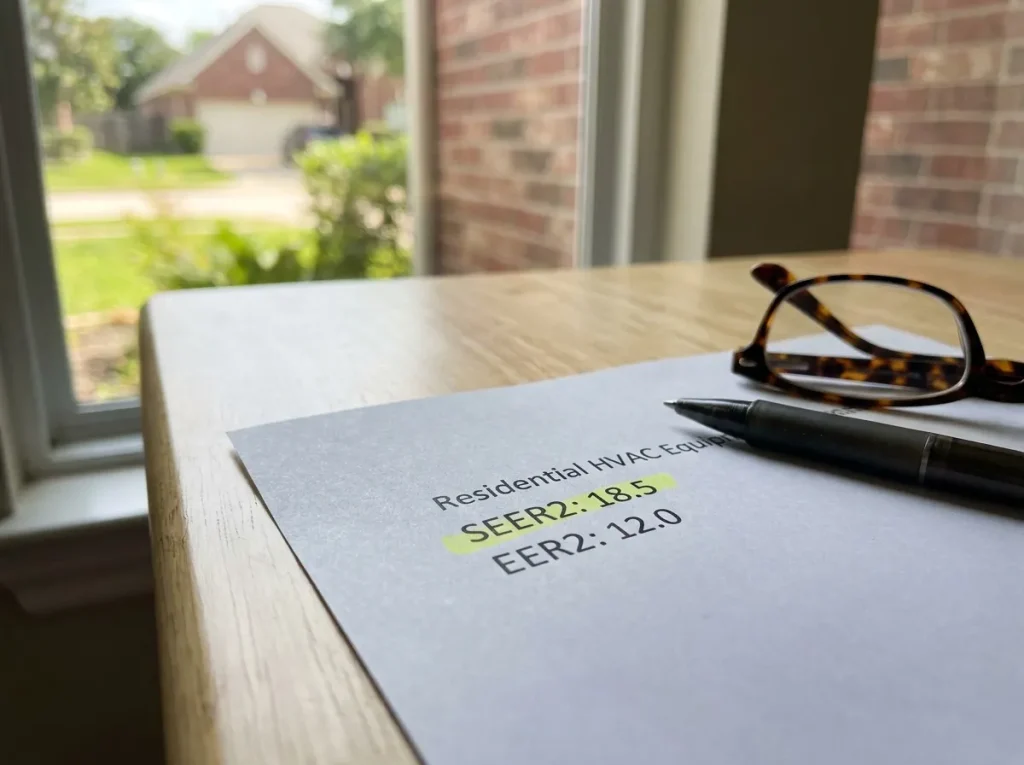
The reason our team pushes homeowners to understand the difference is that the testing conditions are everything. A rating is only as useful as the match between its test conditions and your actual climate.
| Factor | SEER2 | EER2 |
|---|---|---|
| What it measures | Seasonal average efficiency | Peak-load efficiency |
| Test temperature | Range, weighted toward milder conditions | Single point at 95 degrees |
| Load condition | Weighted across part-load and full-load | Full load |
| Best predicts performance in | Moderate, mixed climates | Hot, sustained-heat climates |
| Where it appears | Headline efficiency number | Secondary spec, often overlooked |
SEER2 assumes your season looks like the national test weighting, with plenty of mild days where the equipment sips power at partial load. That assumption holds up well in much of the country. It holds up less well here because a Houston cooling season front-loads the hot end of the distribution. When the test model expects mild days, and your reality delivers 95-plus, the seasonal average starts to overstate what you will actually experience during the months that drive your electric bill.
EER2, by contrast, is measured at conditions Houston reproduces naturally, over and over, all summer. That single 95-degree data point is not an edge case here. It is a Tuesday in July.
Why EER2 Deserves More Weight in Houston Than the National Conversation Gives It
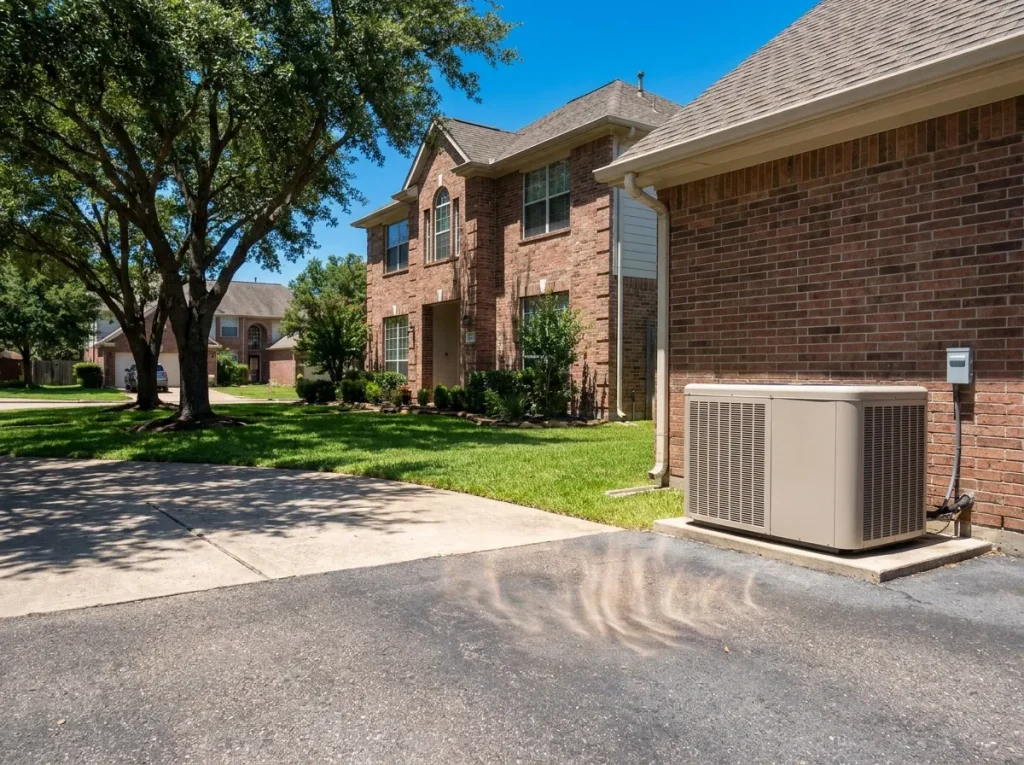
Here is the editorial position our team holds, grounded in how systems actually behave across thousands of Houston cooling seasons: in our climate, EER2 arguably predicts real-world summer performance better than SEER2, and it should never be ignored in favor of the headline SEER2 number alone.
The logic is straightforward. Efficiency during your hottest, longest-running hours is what determines your peak summer electric consumption. Those hours are exactly when EER2 is measured and exactly when a Houston system spends an enormous share of its runtime. A system with a strong SEER2 but a mediocre EER2 can look great on paper and still cost more to run during the stretch of the year that matters most here.
This does not mean SEER2 is useless. It remains the current rating standard, and for good reason. The Southeast regional minimum is 14.3 SEER2, and our team recommends targeting 16-plus SEER2 for Houston homes because a higher SEER2 platform generally carries the better components, tighter tolerances, and higher-staged compressors that also tend to post strong EER2 numbers. ENERGY STAR publishes the central air conditioner efficiency criteria that define which systems qualify as high-efficiency, a useful reference when you compare finalists. The point is not SEER2 versus EER2 as enemies. The point is that you read both, and you give the peak-load number real weight because you live in a peak-load climate.
Reading a Spec Sheet: What to Ask For
Because the marketing leads with SEER2, the EER2 number is easy to miss. It is usually printed on the AHRI certificate and the detailed spec sheet rather than the brochure cover. When our team walks a homeowner through options, we look at the full picture rather than a single figure.
Ask for the AHRI certificate
Every certified matched system has an AHRI reference number that documents the rated SEER2 and EER2 for that specific outdoor unit, indoor coil, and air handler combination. Ratings only hold for matched equipment, so the number on a random outdoor unit means little without the matching indoor components. The AHRI certificate is where the real, verified pair of numbers lives.
Compare EER2 across your finalists
Once you have narrowed to two or three matched systems in a similar SEER2 range, compare their EER2 figures side by side. That comparison often separates systems that looked identical on the showroom floor, and in Houston it frequently reveals which one will be cheaper to run in August.
Confirm the rating matches the installed configuration
A rating assumes a specific coil, blower, and airflow setup. If the installed configuration differs from the rated match, the real efficiency drifts from the label. This is one more reason installation quality and correct matching matter as much as the numbers themselves. Homeowners comparing quotes from different providers of residential HVAC installation should confirm each quote lists the AHRI-matched SEER2 and EER2 for the exact configuration being proposed.
How Efficiency Ratings Fit Into a Real Houston Buying Decision
Ratings are a tool, not the whole decision. Our team treats SEER2 and EER2 as two of several inputs, alongside compressor staging, humidity control, and correct sizing.
Staging and efficiency travel together
Higher SEER2 and EER2 numbers tend to appear on two-stage and variable-speed platforms, which is convenient because two-stage systems are also the sweet spot our team recommends for most Houston homes. The longer, gentler run cycles that make two-stage equipment so good at pulling humidity out of our air are the same behavior that helps it post strong efficiency numbers in real conditions.
Sizing beats rating every time
A high-efficiency system that is oversized will underperform its label, because oversizing forces short cycling that undercuts both comfort and efficiency. Oversizing is the single most common HVAC problem our team sees in Houston. No SEER2 or EER2 number rescues a system that is too big for the house. Correct sizing, based on a real assessment of insulation, ductwork condition, ceiling heights, window orientation, and airflow distribution, is what lets the rated efficiency actually show up on your bill.
The ratings guide the shortlist, the home makes the choice
By the time a homeowner is comparing SEER2 and EER2, our team has already scoped the home. The ratings then help choose among genuinely suitable options rather than serving as the starting point. That sequence, home first and ratings second, is what separates a smart AC installation service decision from a spec-sheet guess. Homeowners planning a heating upgrade in the same project should apply the same read-both-numbers discipline to the heating side, where a similar logic drives a smart heating installation services decision.
Key Takeaways
- SEER2 measures weighted seasonal efficiency across a range of temperatures, while EER2 measures efficiency at a single hot 95-degree full-load condition
- Both ratings appear on the same equipment and are tested to current AHRI methodology using realistic installed static pressure
- Houston's sustained high temperatures make EER2 a strong predictor of real summer performance, so it deserves more weight here than the national conversation gives it
- SEER2 remains the current rating standard; Southeast minimum is 14.3 SEER2 and our team recommends 16-plus for Houston homes
- The EER2 number lives on the AHRI certificate and detailed spec sheet, not usually the brochure cover, so you often have to ask for it
- Correct sizing and proper equipment matching determine whether rated efficiency actually shows up on your bill, and oversizing remains Houston's most common HVAC problem
Frequently Asked Questions
Is SEER2 or EER2 more important for a Houston home?
Both matter, but our team gives EER2 more weight in Houston than the national conversation typically does. EER2 measures efficiency at a steady 95-degree condition, which Houston reproduces for weeks every summer, so it closely predicts how your system performs during the hottest, longest-running hours that drive your peak electric consumption. SEER2 is still the headline standard and worth targeting at 16-plus, but reading it alone can overstate real Houston performance because its seasonal weighting assumes more mild days than our climate delivers.
What is a good SEER2 rating for Houston?
The Southeast regional minimum is 14.3 SEER2. For Houston homes, our team recommends targeting 16-plus SEER2. A higher SEER2 platform generally carries the two-stage or variable-speed components, tighter tolerances, and better coils that also post strong EER2 numbers, so aiming for 16-plus tends to improve both ratings at once. Beyond the mid-to-high teens, the additional benefit depends on how long you plan to stay in the home and how much your comfort priorities justify the step up.
Why are there two efficiency ratings instead of one?
Because efficiency is not constant across conditions. A system can be very efficient coasting at partial load on a mild day and only ordinary when it is running flat out on a hot afternoon. SEER2 captures the seasonal average across a mix of conditions, while EER2 captures the peak-load moment at 95 degrees. Having both lets you see how a system behaves both when it is coasting and when it is working hard, which is exactly the distinction that matters in a hot, long-season climate like ours.
Where do I find the EER2 number when comparing systems?
EER2 is usually printed on the AHRI certificate and the detailed spec sheet rather than the brochure cover, so you often have to ask for it specifically. Every certified matched system has an AHRI reference number documenting the SEER2 and EER2 for that exact combination of outdoor unit, indoor coil, and air handler. Ask each provider for the AHRI-matched numbers on the precise configuration they are quoting, because a rating only holds for the matched equipment, not a mismatched swap of components.
Does a higher efficiency rating guarantee lower bills?
No. Ratings describe the equipment under controlled test conditions, but your actual bill depends on correct sizing, proper matching, ductwork condition, and how the system is installed. An oversized high-efficiency system will short cycle and underperform its label, and oversizing is the most common HVAC problem we see in Houston. The rating tells you the potential; correct design and installation determine whether that potential shows up on your bill.
Conclusion
SEER2 and EER2 are not competing ratings so much as two lenses on the same equipment. SEER2 tells you how a system averages across a season; EER2 tells you how it holds up when it is genuinely hot. In most of the country, the seasonal number leads the conversation. In Houston, where the hot end of the distribution is where we spend our summers, the peak-load number deserves a seat at the table it rarely gets.
At VeriChill, when our team helps a homeowner compare systems, we read both numbers off the AHRI certificate, weigh EER2 heavily because of our climate, and check them against the things ratings cannot capture: correct sizing, proper matching, and the condition of the ductwork carrying the air. The numbers narrow the field. The home makes the final call.
Want help reading the SEER2 and EER2 numbers on a quote you are considering? Call us at 281-559-6995 or visit verichill.com to schedule a consultation.