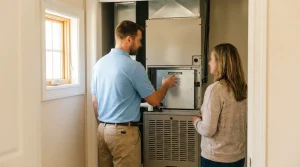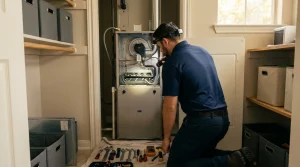
The three primary HVAC system types used in Houston homes are central split systems, heat pump systems, and ductless mini-split systems, with central splits being the most common and heat pumps growing rapidly due to their efficiency in Houston's mild winters.
When Houston homeowners talk about HVAC systems, they are usually thinking about the equipment configuration, whether the system uses ducts, how heating and cooling are delivered, and what hardware is involved. At the broadest level, three system types cover the vast majority of residential installations in this market.
This guide explains how each of the three system types works, where each performs best in Houston's climate, and what homeowners should understand before choosing one for a replacement or new installation. For a closer look at how compressor staging affects humidity control and efficiency, our two-stage systems page covers that comparison in detail. Homeowners ready to move forward can also review our ac installation process.
Key Takeaways
- The three HVAC system types used in Houston homes are central split systems, heat pump systems, and ductless mini-split systems
- Central split systems are the most common configuration, using a two-component outdoor and indoor setup with ductwork for air distribution
- Heat pump systems provide heating and cooling from one unit and are increasingly preferred for Houston installations due to mild winters and inverter technology efficiency
- Ductless mini-splits excel in additions, older homes without ductwork, and targeted zone solutions rather than standard whole-home replacement
- Within central split and heat pump systems, two-stage and variable speed compressor technology outperforms single-stage for Houston's humidity management
- A whole-home assessment covering insulation, ductwork, ceiling heights, window orientation, and airflow is the accurate basis for system type selection
- 2026 new installations use R-454B or R-32 refrigerant; confirm any replacement system meets current refrigerant standards
Why System Type Matters in Houston's Climate
Houston's combination of extreme heat, persistent humidity, and a cooling season spanning eight to nine months creates performance requirements that eliminate poorly matched equipment. Not every system type handles this climate equally.
The most critical performance requirement in Houston is humidity removal. A system that cools the air without adequately dehumidifying it leaves a home feeling uncomfortable regardless of the thermostat reading. System type and compressor technology both affect how well a unit removes moisture during operation.
A whole-home assessment covering insulation levels, ductwork condition, ceiling heights, window orientation, and airflow distribution determines which system type is most appropriate for a specific home. That assessment is the starting point, not the equipment selection itself.
Type 1: Central Split Systems
The central split system is the most commonly installed HVAC configuration in Houston homes. The name "split" refers to the fact that the system has two main components: an outdoor unit housing the compressor and condenser, and an indoor unit housing the evaporator coil and air handler. These two units are connected by refrigerant lines and work together to cool and dehumidify the home.
Conditioned air is distributed throughout the home through a duct network, with supply registers delivering cooled air to living spaces and return registers pulling warm air back to the air handler for recirculation. The ductwork design and condition are critical to whole-home comfort; leaking or undersized ducts reduce system effectiveness even when the equipment itself is performing correctly.
Within central split systems, three compressor technologies determine performance:
- Single-Stage: The compressor runs at full capacity or shuts off. It is the simplest and most affordable configuration, but it is less effective at humidity removal because it does not run long enough at partial load to extract moisture thoroughly.
- Two-Stage: The compressor operates at lower capacity (typically 65 percent) under normal conditions and steps up to full capacity during peak demand. Extended low-stage runtime improves humidity removal significantly. This is the most practical configuration for most Houston homes.
- Variable Speed: The compressor modulates its output continuously based on real-time conditions. This provides the best humidity control and highest efficiency, with more consistent indoor temperatures and the quietest operation. The upfront investment is higher.
| Central Split Compressor Type | Efficiency Typical | Humidity Control | Best For |
| Single-Stage | 14.3 SEER2 minimum | Fair | Budget-focused replacement with sound ductwork |
| Two-Stage | 16 to 18 SEER2 | Good | Most Houston homes; best value for humidity management |
| Variable Speed | 18+ SEER2 | Excellent | Comfort-priority installations; larger homes |
Type 2: Heat Pump Systems
A heat pump system uses the same refrigerant cycle as an air conditioner but can reverse its direction, providing heating in winter and cooling in summer from a single piece of equipment. In cooling mode, a heat pump works identically to a central split system. In heating mode, it extracts heat from outdoor air and transfers it indoors.
For Houston's climate, heat pump systems are increasingly the recommended choice for full system replacements. Three factors drive this recommendation.
Mild Winters: Houston's average winter temperatures are well within the operating range of modern heat pump systems. Unlike colder northern climates where heat pumps lose efficiency in extreme cold, Houston rarely sees temperatures that stress heat pump heating performance. The mild winter allows heat pumps to deliver efficient heating without the need for gas heat or high-resistance electric backup.
Superior Humidity Control with Inverter Technology: Modern inverter-driven heat pumps modulate output continuously, running longer at lower capacity. This extended runtime is ideal for Houston's humidity management requirement, providing consistent dehumidification without temperature swings.
Refrigerant Standards: Heat pump installations in 2026 use R-454B or R-32, replacing R-410A which is being phased out. New heat pump systems are fully compliant with current refrigerant standards and carry better long-term serviceability as a result.
| Heat Pump Feature | How It Benefits Houston Homeowners |
| Heating and cooling in one system | Eliminates need for separate furnace in most Houston applications |
| Inverter compressor technology | Continuous output modulation provides superior humidity control and efficiency |
| Mild winter suitability | Houston's temperatures are well within heat pump heating range year-round |
| 2026 refrigerant compliance | R-454B and R-32 systems are fully serviceable under current standards |
Type 3: Ductless Mini-Split Systems
Ductless mini-split systems deliver conditioned air directly to specific areas without using a central duct network. Each indoor air handler is mounted in the zone it serves, typically on a wall or ceiling, and connected to an outdoor compressor through a small conduit containing refrigerant lines and electrical connections.
Mini-splits are not typically the first choice for whole-home replacement when good ductwork already exists, but they are the strongest solution for several specific Houston applications.
Where Mini-Splits Excel in Houston
Additions and Converted Spaces: A garage apartment, sunroom, or home addition that is not connected to the central duct system can be cooled and heated efficiently with a mini-split air handler without extending ductwork.
Older Homes Without Ductwork: Houston has a significant stock of older homes built before central air conditioning was standard. These homes often lack the wall cavities and ceiling space for conventional ductwork. Mini-splits provide modern HVAC capability without requiring invasive duct installation.
Specific Problem Zones: Rooms that consistently run warmer or cooler than the rest of the home can be addressed with a mini-split without redesigning the entire system. This is a targeted solution for comfort complaints that do not justify a full system replacement.
| System Type | Ductwork Required | Serves Whole Home | Ideal Houston Application |
| Central Split System | Yes | Yes, with proper ducts | Standard whole-home replacement with existing ductwork |
| Heat Pump System | Yes (or ductless) | Yes | Full replacement prioritizing efficiency and year-round performance |
| Ductless Mini-Split | No | Possible but complex | Additions, older homes, specific zone solutions |
Choosing Between the Three Types for a Houston Home
The three system types are not interchangeable. The right choice for a Houston home depends on the existing infrastructure, the home's layout, and the specific comfort goals of the homeowner.
If the home has existing ductwork in sound condition: A central split system or heat pump system is generally the most practical and cost-effective choice. The ductwork investment has already been made, and a central system replacement is straightforward. Heat pumps are increasingly preferred for new installations due to their efficiency in Houston's climate.
If the home has no ductwork or ductwork in poor condition: Mini-splits or a heat pump with ductless configurations may be more practical than installing or replacing a full duct network. Ductwork replacement is a significant project; in some homes, ductless solutions are the better path.
If the project involves an addition or isolated space: Mini-splits are the specific tool for this application. Extending the central system to a new addition is sometimes feasible but often not cost-effective compared to a dedicated mini-split installation.
A whole-home assessment determines which of these paths makes sense for a specific property. Without that evaluation, any residential hvac installation recommendation is a guess.
Not Sure Which System Type Is Right for Your Home?
The right system type comes down to your ductwork, gas availability, home layout, and comfort goals. A whole-home assessment answers those questions before any equipment is selected. Schedule a consultation with VeriChill and we'll evaluate your home's specific conditions first.
Call 281-559-6995
Frequently Asked Questions
What is the most common HVAC system type in Houston?
Central split systems are the most common configuration in Houston homes. They pair an outdoor compressor and condenser with an indoor air handler connected by refrigerant lines, distributing conditioned air through a duct network. Heat pump systems are growing in popularity for new installations.
Is a heat pump the same as an air conditioner?
In cooling mode, a heat pump functions identically to an air conditioner. The difference is that a heat pump can reverse its refrigerant cycle to provide heating in winter, making it a single system that handles both functions. This is particularly practical in Houston's mild climate.
Do I need ductwork for all three HVAC system types?
Central split and most heat pump systems require ductwork for air distribution. Ductless mini-splits and ductless heat pump configurations do not require ducts. Mini-splits deliver conditioned air directly to the zone through wall or ceiling-mounted air handlers.
Which system type handles Houston's humidity best?
Inverter-driven heat pumps and variable speed central systems typically provide the best humidity control because they modulate output and run longer at lower capacity. Extended runtime at partial load removes more moisture from the air than systems that cycle on and off at full capacity.
Can one outdoor unit power multiple indoor mini-split units?
Yes. This is called a multi-zone or multi-split system. One outdoor compressor connects to multiple indoor air handlers, each serving a separate zone. This is how mini-splits can be used for whole-home coverage, though the installation is more complex than a standard central system replacement.
How do I know if my Houston home's ductwork is in good enough condition to support a new system?
A ductwork evaluation during a whole-home assessment identifies leaks, blockages, and undersized sections. Signs of significant duct problems include rooms with poor airflow, unusually high energy bills, or humidity inconsistency across different areas of the home.
Are mini-splits more efficient than central systems in Houston?
Mini-splits often carry higher SEER2 ratings than standard central systems and eliminate duct losses, which can account for 20 to 30 percent of conditioned air in systems with leaking ductwork. However, for homes with well-sealed central ductwork, the efficiency advantage narrows.
What is the difference between a heat pump and a central split system for Houston heating?
A central split system typically uses a gas furnace or electric heat strips for heating, separate from the cooling function. A heat pump uses the same refrigerant cycle for both heating and cooling, extracting heat from outdoor air in winter. In Houston's mild winters, heat pump heating is efficient and practical.
How long do each of the three system types last in Houston?
All three system types have realistic lifespans of 15 to 20 years with proper installation and maintenance. Houston's long cooling season means systems accumulate run-hours faster than in moderate climates, so 15 years is common for systems installed without sufficient sizing or installation quality.
Which system type is easiest to install in an older Houston home?
Ductless mini-splits are the least disruptive installation in older homes without existing ductwork. They require only a small conduit through the wall rather than a duct network, preserving the home's existing structure while providing modern HVAC performance.
Final Thoughts
The three HVAC system types used in Houston homes each fit specific situations and priorities. Central split systems remain the most common choice for homes with existing ductwork. Heat pumps are becoming the preferred option for new installations because of their efficiency in Houston's mild climate. Mini-splits solve specific problems that central systems are not designed to address.
VeriChill handles hvac installation and replacement across Houston, Cypress, Katy, Spring, Sugar Land, and Tomball. Every project starts with a whole-home assessment to determine which system type and configuration will actually perform in your home.
Call 281-559-6995 to discuss your system type options.
Find out which HVAC configuration fits your Houston home.