The most expensive mistake in a Houston AC install is the one that feels safest at the time: buying a bigger system than the home needs. It's intuitive: hotter climate, bigger AC. It's also wrong, and we see the consequences every week. Oversized AC systems short-cycle, fail to dehumidify, wear out their compressors years ahead of schedule, and leave homeowners with houses that feel cold and clammy instead of cool and dry.
If your current system was sized by a contractor who eyeballed your square footage and added a ton "to be safe," this article is for you. Here's what actually happens when an AC is too big for the house, how to tell if yours is, and what the fix looks like.
Why "Bigger Is Safer" Is Backward
The math looks simple. A 2,200-square-foot home in Houston "needs" about 3.5 tons of cooling, based on the rough rule of one ton per 500-600 square feet. But that rule was invented for average homes in average climates with average insulation. It ignores window orientation, shade, insulation R-values, air sealing, ceiling height, and the specific way heat moves through your home on a Houston summer afternoon.
A proper sizing calculation, called a Manual J load calculation, the industry standard set by the Air Conditioning Contractors of America, often comes in a half-ton to a full ton below what the rule of thumb suggests. Homes with good insulation and shading might need 2.5 tons, whereas the rule of thumb suggests 3. The oversized system is the default because it's faster to specify, rarely gets callbacks about "not cold enough" in the first week, and leaves margin for lazy ductwork.
The problem is what happens over the next 10 years.
What Actually Goes Wrong with an Oversized AC
Short Cycling Destroys the Compressor
A properly sized AC runs in cycles of 15-25 minutes. The compressor starts, the system reaches thermal equilibrium, the coil gets cold enough to pull moisture out of the air, and by the time the thermostat is satisfied, the home has been meaningfully dehumidified and evenly cooled.
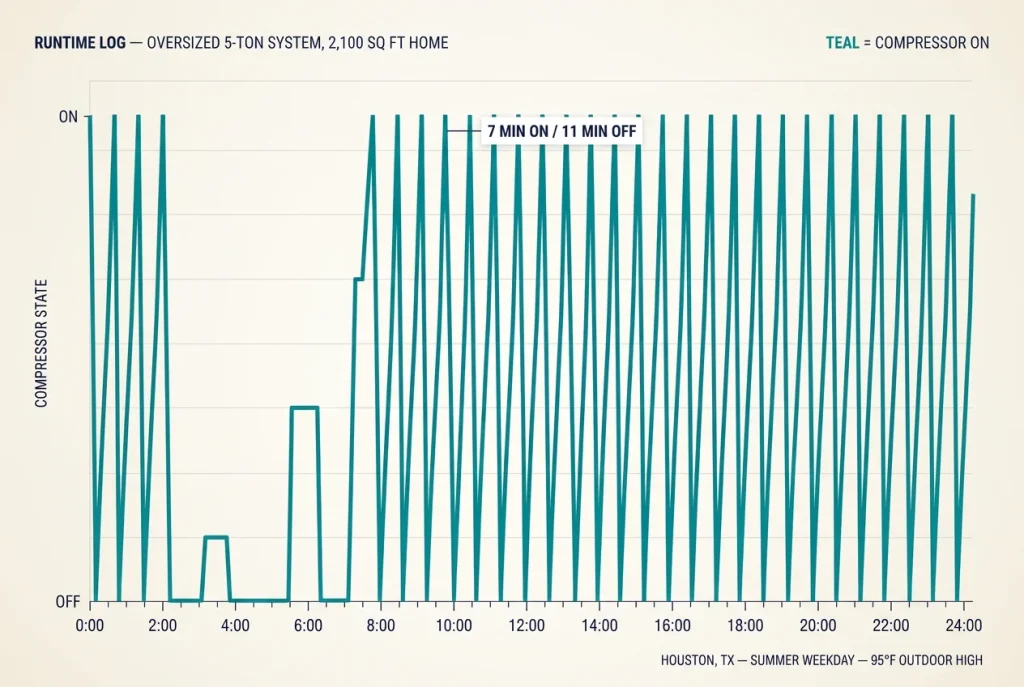
An oversized AC runs in cycles of 5-10 minutes. It hits the setpoint before it finishes doing the work. Then it shuts off. Fifteen minutes later, it starts again. On a hot Houston day, an oversized 4-ton system in a 2,200 square-foot home might cycle 30-40 times. A right-sized system might cycle 10-15 times.
Every startup is the hardest moment for a compressor. That's when current draw spikes, when mechanical stress on the motor windings is highest, and when wear happens fastest. Tripling the number of cycles over a decade is roughly equivalent to running the compressor three times as long. Compressors that should last 12-15 years fail at 8-9.
Humidity Stays High Even When the AC Is Running
Dehumidification happens slowly. Air has to pass over the evaporator coil long enough for water vapor to condense on the cold surfaces. A 20-minute cycle removes a meaningful amount of moisture. A 7-minute cycle removes almost none.
This is why a Houston home with an oversized AC feels clammy at 72°F. The system is cold, but the air is wet. Indoor humidity sits at 60-70% instead of the 45-55% target. Mold grows in bathroom corners. Wood floors cup. The furniture smells musty. The homeowner turns the thermostat down further to try to feel comfortable, the system cycles even faster, and the problem deepens.
Humidity control is arguably the single biggest comfort factor in a Houston home. An oversized AC actively undermines it.
Inconsistent Room-to-Room Temperature
Short cycles don't give air time to circulate evenly through the ductwork. The rooms closest to the air handler get cold quickly; the rooms at the ends of long duct runs never receive conditioned air before the system shuts off. You end up with the primary bedroom at 68°F and the back office at 78°F, running the system harder to try to balance it, and cycling more as a result.
A right-sized system running longer cycles moves enough air to equalize temperatures throughout the house. This is one of the most dramatic differences homeowners notice after a proper replacement.
Higher Energy Bills, Not Lower
Efficiency ratings (SEER2) are measured under steady-state operation. A system that spends most of its time starting up and shutting down never runs in its efficient range. In practice, operating SEER on an oversized system is often 30-40% below the rated number on the label.
You're paying more upfront for a bigger unit, spending more on compressor wear, and incurring higher operating costs than a smaller, right-sized system would. Every part of the economy is worse.
Shorter Equipment Life, More Repairs
We've already covered compressor wear. The other components, contactors, capacitors, blower motors, and fan motors all have failure profiles driven by cycle counts and thermal swing. Oversized systems punish all of them. Service calls come more often. Repairs stack up. The replacement conversation starts sooner.
How to Tell If Your Houston AC Is Oversized
You can't measure this precisely without a Manual J, but a few strong signals:
- The system reaches the thermostat setpoint in under 10 minutes on hot days
- Indoor humidity consistently reads above 55% with the AC running
- The home feels "cold and clammy" rather than "cool and dry."
- You hear the AC start and stop repeatedly during the afternoon operation
- Dust accumulates faster than normal (short cycles mean less total filtration time)
- Energy bills are higher than those of neighbors with similar homes
- The system has been serviced more than a similar-age system should need
- A previous contractor sized the unit based on "tonnage per square foot" rather than a load calculation
Two or more of these and oversizing are likely. Four or more, and it's near-certain.
You can also just compare tonnage against square footage as a rough check. Most well-insulated Houston homes need less than 1 ton per 600-700 square feet. If you're at 1 ton per 400-500 square feet, there's a good chance the system is oversized by a half-ton or more.
What the Fix Actually Looks Like

Right-sizing an existing system isn't a tune-up adjustment. You can't "turn down" a 4-ton compressor to act like a 3-ton. The fix depends on how egregious the oversizing is and when the next replacement is coming.
Mild oversizing (half-ton too big): Variable-speed or two-stage equipment on the next replacement. Those systems modulate capacity down to 40-60% of nominal when the load is low, which fixes the short-cycling problem even if the nominal tonnage is slightly oversized.
Moderate oversizing (full ton too big): Replacement with a properly sized system is worth planning now rather than letting the oversized unit wear out on its own schedule. The long-term cost of running it to failure is higher than the cost of an earlier replacement.
Severe oversizing (1.5+ tons too big): Replacement is the fix. The system is causing enough humidity and comfort issues to justify it, and the replacement pays off in comfort, equipment longevity, and energy savings.
In every case, the first step is a Manual J calculation on the home as it currently exists. Not based on the old system's tonnage. Not based on the builder's spec. Based on actual square footage, insulation, window count, shade, and air sealing today.
Why This Matters for the Rest of the System
Oversizing is almost never the only problem. It's usually bundled with undersized returns, leaky ductwork, and missed humidity control. Right-sizing the equipment is one piece of AC performance and lifespan in Houston, and the duct side and humidity side often need attention alongside it.
Right-sizing is the foundation. Everything else builds on it.
FAQ: Oversized AC Problems in Houston
How do I know my AC is oversized without a Manual J?
The shortest indicator is cycle time. Time the system on a hot day. If it's hitting the thermostat setpoint in under 10 minutes and shutting off, it's probably oversized. A Manual J confirms by how much.
Can a variable-speed system be oversized?
Less of a problem because the system modulates down to low capacity. But severely oversized variable-speed systems are still short-cycle in shoulder seasons and still can't dehumidify properly. Right-sizing matters regardless of compressor type.
Why do contractors oversize in the first place?
Three reasons: it's faster than running a load calculation, it reduces "not cold enough" complaints in the first week, and it allows sloppier ductwork to still feel like it's working. None of those benefits the homeowner.
If my AC is oversized, should I replace it immediately?
Not automatically. If it's working acceptably and not near end-of-life, the right move is to plan the next replacement around a proper Manual J rather than reacting to an emergency. In the meantime, make sure filter, ductwork, and maintenance are dialed in.
Will downsizing the AC leave the house hot on peak days?
No, if the sizing is correct. A properly sized Manual J-based system is designed to handle 97.5% of hours in a typical Houston summer. The 2-3 hottest hours on the 2-3 hottest days of the year may see the system run continuously, as designed. That's the only way to remove humidity.
How much does a Manual J calculation cost?
Typically $150-$350 for a single-family home, often free when bundled into a replacement quote. It's not an expensive step, and it's the single most valuable investment in HVAC engineering you can make.
If your AC is running short cycles, leaving humidity high, or just past age 10 and on the replacement horizon, the sizing question is the one to answer before anything else. Fix the ton count first. The rest of the system design flows from there.