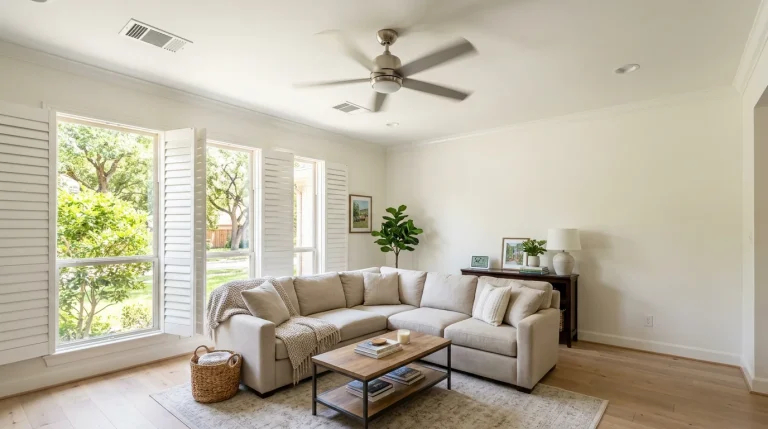
Proper home ventilation brings controlled fresh air into your living spaces while exhausting stale indoor air, without overwhelming your AC system with uncontrolled humidity. In Houston's humid subtropical climate, ventilation strategy matters as much as your cooling equipment because unmanaged outdoor air brings moisture problems that no air conditioner can fully compensate for.
Most Houston homeowners think about their AC system when they think about indoor comfort. Temperature and humidity get the attention. But ventilation, the exchange of indoor and outdoor air, is the piece of the comfort equation that rarely gets discussed until a problem appears.
Stuffy rooms despite the AC running. Lingering cooking odors that persist for hours. Moisture is accumulating in bathrooms and closets even though the air conditioning runs constantly. These are ventilation problems, not cooling problems. And in Houston, where the outdoor air is extremely humid for 8 months of the year, how you ventilate your home has a direct impact on both comfort and your HVAC system's workload.
After 14 years of working in Houston homes, I have found that ventilation is one of the most misunderstood aspects of residential HVAC. Let me explain how ventilation works, why Houston's climate makes it uniquely challenging, and what options exist to get it right.
Why Ventilation Matters for Houston Homes
Every home needs fresh air exchange. Cooking, cleaning products, building materials, and even breathing generate indoor air pollutants that accumulate without ventilation. The EPA notes that indoor air pollutant concentrations can be two to five times higher than outdoor levels, making adequate ventilation a fundamental health consideration.
The challenge in Houston is that outdoor air is not just air. From April through October, outdoor air in Houston carries relative humidity above 75% and dew points frequently exceeding 70 degrees. Simply opening windows or pulling in uncontrolled outdoor air floods your home with moisture that your AC system must then remove.
This creates a tension that does not exist in dry climates. You need fresh air for health and comfort. But bringing in unconditioned outdoor air in Houston significantly increases your cooling and dehumidification load. The solution is not less ventilation. It is smarter ventilation that controls how, when, and how much outdoor air enters your home.
Types of Home Ventilation
Residential ventilation falls into three categories, each with different implications for Houston homes.
Natural ventilation relies on open windows, doors, and structural air leaks to exchange indoor and outdoor air. In dry, temperate climates, this works adequately for much of the year. In Houston, natural ventilation is practical only during brief windows in late fall and early spring when outdoor humidity drops to comfortable levels. During most of the year, opening windows introduces humidity, increasing your AC system's workload and contributing to mold growth.
Exhaust ventilation uses fans, typically in bathrooms and kitchens, to pull stale air out of the home. As exhaust fans remove indoor air, replacement air enters through gaps in the building envelope, essentially pulling outdoor air in through leaks. While exhaust fans are necessary for removing cooking moisture and bathroom humidity at the source, relying on exhaust-only ventilation in Houston means pulling in hot, humid outdoor air through uncontrolled pathways. This approach increases both cooling costs and moisture load.
Balanced mechanical ventilation uses dedicated equipment to simultaneously bring in fresh outdoor air and exhaust stale indoor air in controlled, equal quantities. This is the approach best suited to Houston's climate because it gives you control over both the volume of air exchange and, with the right equipment, the moisture content of incoming air.
Energy Recovery Ventilators: The Houston Solution
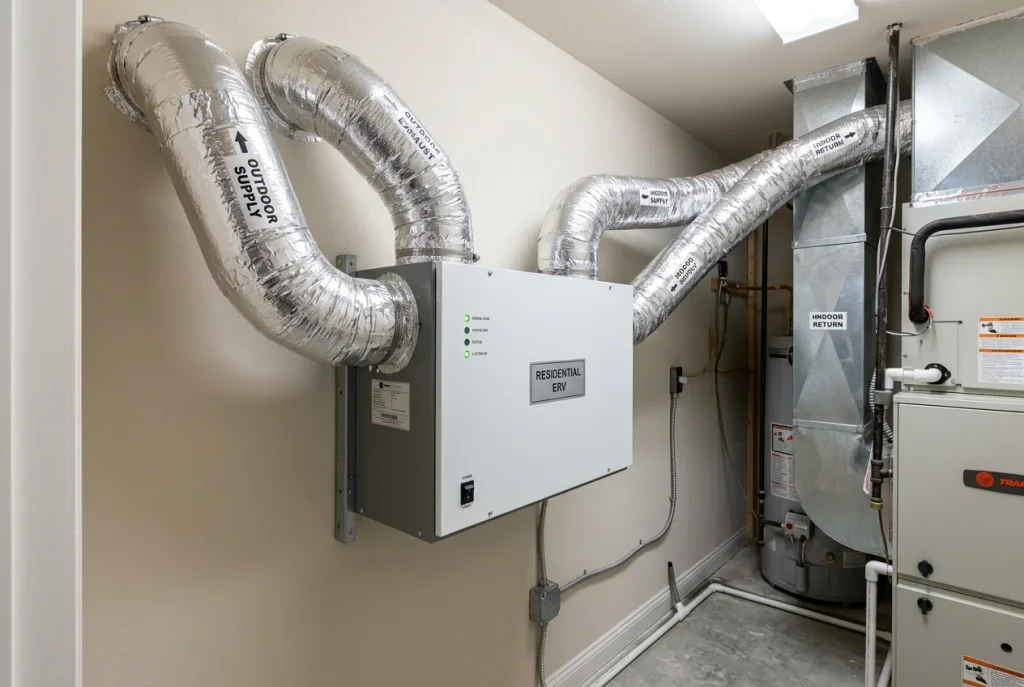
For Houston homes, the energy recovery ventilator (ERV) is the ventilation technology specifically designed for humid climates. An ERV exchanges indoor and outdoor air through a heat exchanger core that transfers both heat and moisture between the two airstreams without mixing them.
Here is how that works in practice during a Houston summer. Hot, humid outdoor air enters the ERV on one side. Cool, drier indoor air exits on the other side. As the two airstreams pass through the ERV core, the incoming outdoor air transfers its heat and a portion of its moisture to the outgoing indoor air. The fresh air entering your home is pre-cooled and partially dehumidified before reaching your AC system.
The result is meaningful. An ERV can recover 70 to 80% of the energy in outgoing air, reducing the additional cooling and dehumidification load that fresh air ventilation would otherwise create. Your hvac service houston system handles less work to condition the incoming air, which translates directly to lower energy consumption.
| Ventilation Type | Fresh Air Control | Moisture Control | Houston Suitability |
| Natural (windows) | None | None | Limited to mild weather only |
| Exhaust only (bath fans) | Minimal | None | Necessary but insufficient alone |
| HRV (Heat Recovery) | Yes | No | Better for dry/cold climates |
| ERV (Energy Recovery) | Yes | Yes | Recommended for Houston |
Note the distinction between ERVs and HRVs (heat recovery ventilators). HRVs transfer heat between airstreams but do not transfer moisture. In cold, dry climates where winter humidity retention matters, HRVs are the right choice. In Houston, where moisture control is the primary concern, ERVs are the appropriate technology because they prevent outdoor humidity from entering your home with the ventilation air.
Signs Your Houston Home Has Ventilation Problems
Several common comfort complaints in Houston homes trace directly to inadequate or poorly managed ventilation.
Persistent stuffiness despite AC running
If rooms feel stale or stuffy even though the temperature is at your set point, the space is not receiving adequate fresh air exchange. Your AC cools and partially dehumidifies, but it does not ventilate. These are separate functions.
Lingering odors
Cooking odors, cleaning product smells, or other household scents that persist for hours indicate insufficient air exchange. In a properly ventilated home, these odors dissipate within 15 to 30 minutes through fresh air dilution and exhaust.
Condensation on windows or cold surfaces
If you see moisture forming on windows, mirrors, or cold water pipes, indoor humidity levels are too high. This often indicates that outdoor humidity is entering the home through uncontrolled air leaks faster than the AC system can remove it.
Mold or mildew in closets, bathrooms, or low-traffic rooms
These spaces often have the least air circulation and the highest moisture accumulation. Mold growth indicates a combination of excessive moisture and inadequate air movement that ventilation improvements can address.
Musty smells from ductwork or specific rooms
Musty odors typically indicate moisture accumulation in ductwork or building materials. This can result from condensation caused by ductwork in unconditioned spaces, a common configuration in Houston homes where ducts run through hot attics.
How Ventilation Affects Your AC System's Efficiency
Ventilation and your AC system are not independent. They interact in ways that directly affect both comfort and operating costs.
Uncontrolled air infiltration increases cooling load
Every cubic foot of hot, humid outdoor air that leaks into your home through gaps, cracks, and penetrations must be cooled and dehumidified by your AC system. In a typical Houston home, air infiltration can account for 25 to 40% of the total cooling load. Controlling ventilation through mechanical systems reduces this unmanaged load.
Proper ventilation supports dehumidification
When ventilation is controlled and incoming air is pre-conditioned through an ERV, your AC system can focus on maintaining temperature rather than fighting an ongoing battle against incoming moisture. This allows the system to cycle more normally, which improves both efficiency and equipment longevity.
Ductwork ventilation losses
If your ductwork runs through an unconditioned attic, which is common in Houston, any duct leaks pull superheated attic air into your supply system. This is both a ventilation failure and an efficiency failure. Sealing ductwork and ensuring proper insulation addresses both problems simultaneously.
For homeowners evaluating a complete system upgrade through an ac installation houston project, incorporating ventilation improvements at the same time maximizes the return on the investment by ensuring the new equipment operates under the conditions it was designed for.
Practical Steps to Improve Home Ventilation
Several improvements address ventilation issues in Houston homes, ranging from simple adjustments to equipment additions.
Use bathroom exhaust fans correctly
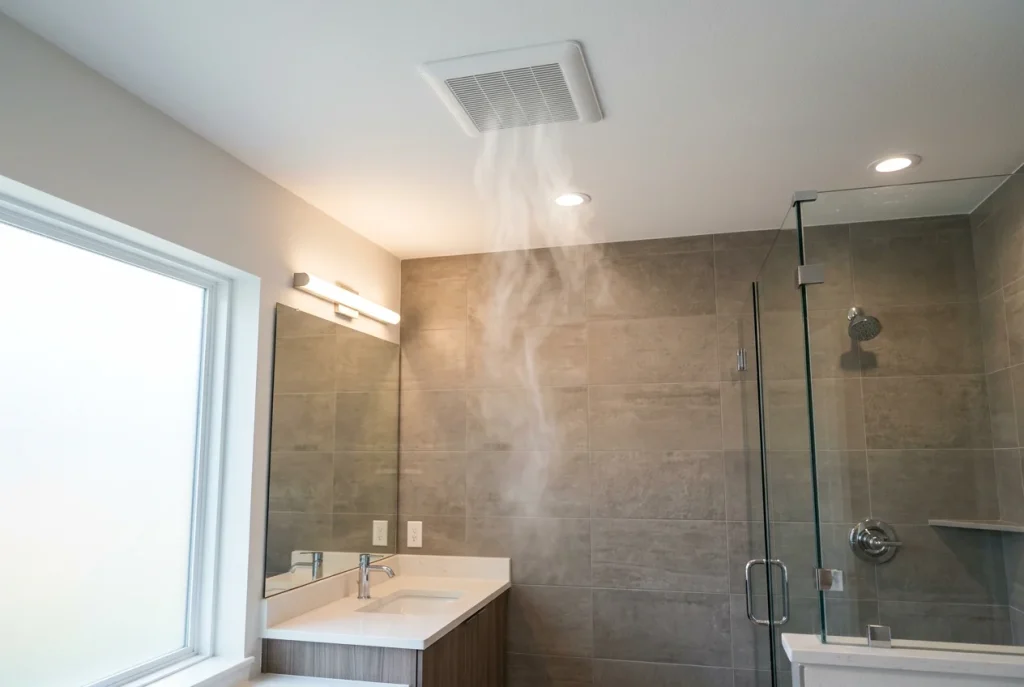
Run bathroom exhaust fans during and for 15 to 20 minutes after every shower or bath. This removes moisture at the source before it spreads to other areas of the home. Verify that exhaust fans actually vent to the exterior, not into the attic. Venting moisture into a Houston attic creates significant problems.
Run kitchen exhaust during cooking
Range hoods and kitchen exhaust fans remove cooking moisture, grease particles, and combustion byproducts. Use them every time you cook, not just when something is burning. Ensure the kitchen exhaust vents to the exterior.
Seal uncontrolled air leaks
Before adding mechanical ventilation, reduce uncontrolled air infiltration through weatherstripping, caulking, and sealing penetrations around pipes, wires, and recessed lights. This does not mean making your home airtight. It means ensuring that air exchange happens through controlled pathways rather than random gaps.
Consider ERV installation
For homes with persistent stuffiness, humidity issues, or occupants with air quality sensitivities, an ERV provides the controlled, energy-efficient ventilation that Houston's climate demands. ERVs integrate with your existing HVAC system and can be installed as part of a system upgrade or as a standalone addition.
Evaluate ceiling fan use
Ceiling fans do not ventilate, but they do improve air circulation within rooms, helping conditioned air distribute more evenly and reducing the perceived temperature by 3 to 4 degrees through wind chill effect. Better air movement within your home supports both comfort and the effectiveness of your HVAC system.
When planning HVAC upgrades that include both cooling and heating installation components, integrating ventilation improvements into the project scope provides the most comprehensive comfort solution for your Houston home.
Key Takeaways
- Houston's humid climate makes ventilation strategy as important as cooling equipment for maintaining indoor comfort
- Energy recovery ventilators (ERVs) are the recommended ventilation technology for Houston homes, recovering 70 to 80% of energy while controlling incoming moisture
- Uncontrolled air infiltration can account for 25 to 40% of a Houston home's total cooling load
- Bathroom and kitchen exhaust fans are essential for removing moisture at the source but insufficient as a complete ventilation strategy
- Persistent stuffiness, lingering odors, window condensation, and mold growth are primary indicators of ventilation problems
- Ventilation improvements deliver the highest return when integrated with HVAC system upgrades
Frequently Asked Questions
What is the best ventilation system for Houston homes?
An energy recovery ventilator (ERV) is the recommended ventilation system for Houston homes. ERVs bring in fresh outdoor air while simultaneously removing stale indoor air, and the heat exchanger core pre-conditions the incoming air by transferring both heat and moisture to the outgoing airstream. This reduces the additional cooling and dehumidification load on your AC system. HRVs (heat recovery ventilators) are better suited to cold, dry climates and do not provide the moisture control that Houston's humidity demands.
Can I improve ventilation by opening windows in Houston?
Opening windows is effective during brief periods when outdoor conditions are mild and humidity is low, typically a few weeks in late fall and early spring. For most of the year, opening windows lets hot, humid air in, increasing your AC system's workload and contributing to indoor moisture problems. For consistent year-round ventilation, mechanical systems like ERVs provide controlled fresh air exchange without the humidity penalty.
How does poor ventilation affect my energy bills?
Poor ventilation contributes to higher energy bills in two ways. First, uncontrolled air infiltration through gaps and leaks brings in hot, humid outdoor air that your AC system must cool and dehumidify, increasing its runtime. Second, inadequate exhaust ventilation allows indoor moisture from cooking, bathing, and breathing to accumulate, raising indoor humidity and making your AC system work harder. Controlled mechanical ventilation with an ERV reduces both of these efficiency losses.
Do newer Houston homes have better ventilation than older ones?
Newer Houston homes are typically built with tighter construction, which reduces uncontrolled air infiltration but also reduces natural air exchange. This means newer homes actually need mechanical ventilation more than older, leakier homes. Current building codes address this by requiring mechanical ventilation in tightly constructed homes. Older homes may have adequate air exchange through natural infiltration but lack control over that exchange, meaning they bring in unconditioned outdoor air through random gaps rather than through managed pathways.
Should ventilation be addressed during an AC replacement?
Yes. An AC replacement is the ideal time to evaluate and improve your home's ventilation strategy. Your HVAC contractor is already assessing ductwork, airflow, and system design during the replacement process. Adding ventilation improvements, such as an ERV, duct sealing, or exhaust-fan upgrades, at this stage integrates naturally with the installation work and ensures your new cooling equipment operates under optimal conditions. Addressing ventilation separately later requires additional labor and access to components that are already exposed during a system replacement.
Conclusion
Ventilation is the quiet partner to your AC system. When it works well, you do not think about it. When it fails, you notice the symptoms but don't always connect them to the cause. In Houston's climate, getting ventilation right means controlling how outdoor air enters your home rather than letting your building envelope decide.
At VeriChill, ventilation assessment is part of every home evaluation we perform. We check exhaust fan function, evaluate air infiltration patterns, and discuss mechanical ventilation options when the home's conditions warrant them. When we design a new system installation, we consider the complete picture of how air moves through your home, not just how it gets cooled.Want to understand how ventilation affects your home's comfort and efficiency in Houston? Call us at 281-559-6995 or visit verichill.com to schedule an evaluation.