Houston's average humidity exceeding 75% forces your HVAC system to work as a dehumidifier just as much as a cooler. When your system can't keep up with moisture removal, you get clammy rooms, higher energy bills, and conditions that promote mold growth. The right HVAC installation, properly sized and configured for Houston's humidity, solves these problems at the source.
Most Houston homeowners think of their HVAC system as a temperature machine. Set the thermostat, get cool air. But in Houston's subtropical climate, your system's most demanding job isn't reaching the right temperature. It's pulling moisture from the air as it does so. When that dehumidification function falls short, your home might hit 72 degrees and still feel uncomfortable.
This guide explains the relationship between Houston's humidity and your HVAC performance, why some systems handle it better than others, and what you can do about it, whether you're replacing equipment or trying to get more from what you have.
Why Does Houston's Humidity Hit HVAC Systems So Hard?
Houston's subtropical climate produces humidity levels that most HVAC systems weren't originally designed for. Average relative humidity exceeds 75% year-round, with summer morning readings often hitting 90%+. This persistent moisture load forces your cooling system to remove gallons of water from the air daily while simultaneously lowering temperature, a dual workload that strains equipment and increases energy consumption.
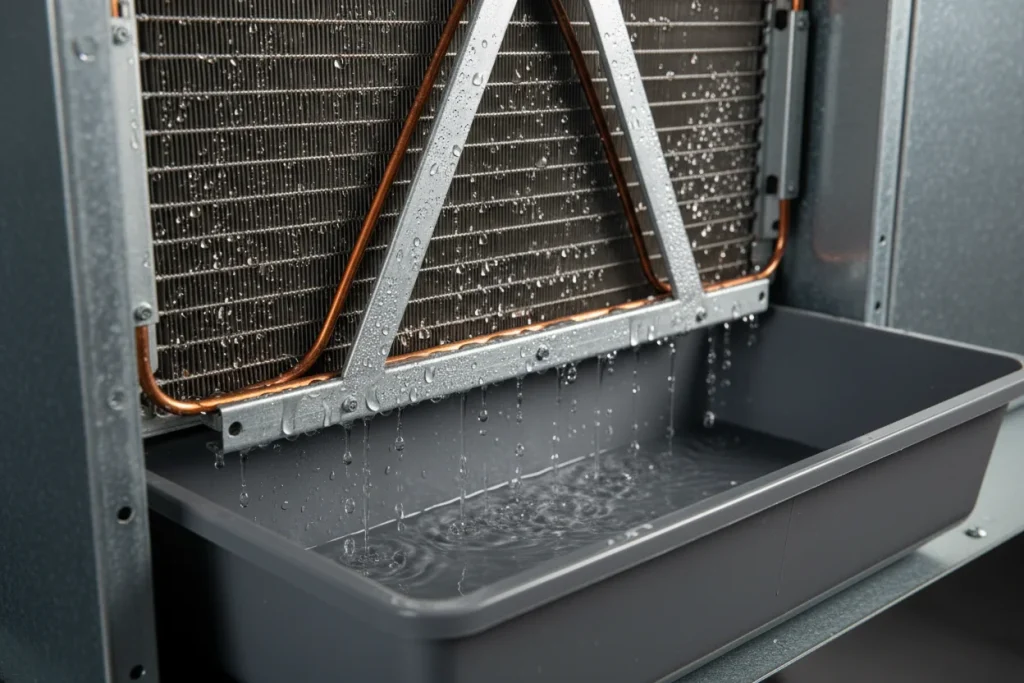
To understand the challenge, think about what your AC actually does. As warm, humid air passes over the cold evaporator coil, two things happen simultaneously: the air cools down, and moisture in the air condenses on the coil surface and drains away. Both processes require energy, and in Houston's climate, the moisture removal component can account for nearly half of your system's total workload.
This creates several Houston-specific problems:
- Short cycling kills dehumidification. When an oversized system cools the air too quickly, it shuts off before running long enough to remove adequate moisture. The temperature reads right, but the air feels damp and uncomfortable.
- Spring and fall are the worst. During Houston's shoulder seasons, when temperatures are mild but humidity stays high, your system may not run long enough to dehumidify because the cooling demand is too low. These are the months when indoor air quality suffers most.
- Overnight humidity builds up. Houston's warm nights keep humidity high while your system runs less. By morning, indoor humidity levels can climb uncomfortably high.
- Attic conditions compound the problem. Houston's hot, humid attics can push moisture through ductwork into conditioned spaces, especially when ducts aren't properly insulated or sealed.
The EPA's guidance on indoor air quality recommends maintaining indoor relative humidity between 30% and 50% for optimal comfort and health. In Houston, achieving the lower end of that range requires an HVAC system specifically designed and sized for our humidity load.
| Houston Humidity Factor | Impact on HVAC Performance |
| Average RH 75%+ year-round | Constant dehumidification demand, even during mild weather |
| Summer morning RH 90%+ | Maximum moisture load, highest energy consumption |
| Mild shoulder seasons (65-80°F) | Insufficient cooling demand to trigger adequate dehumidification |
| Warm overnight temperatures | The system runs less at night, and humidity builds indoors |
| Hot, humid attic spaces | Moisture infiltration through ductwork and the ceiling |
What Happens When Your HVAC Can't Handle Houston's Humidity?
When your system fails to manage humidity adequately, you experience clammy indoor air even at cool temperatures, condensation on windows and cold surfaces, musty odors from moisture accumulation, and conditions that promote mold and mildew growth. Over time, excess indoor humidity also degrades your home's building materials, including drywall, wood trim, and insulation.
Here's the thing about humidity in Houston homes: the problems don't announce themselves in dramatic ways. They build gradually. A slightly clammy feeling becomes normal. You stop noticing the musty smell in closets. Window condensation seems like just a Houston thing. But each of these signals means your HVAC system isn't removing enough moisture.
Comfort Issues
When indoor humidity stays above 55% to 60%, your body's ability to cool itself through evaporation decreases. That's why a room at 72 degrees with 60% relative humidity feels warmer and less comfortable than the same room at 72 degrees with 45% humidity. Many Houston homeowners compensate by lowering the thermostat, which increases energy costs without actually solving the humidity problem.
Health and Home Risks
The Department of Energy recommends proper ventilation to maintain healthy indoor air quality. In Houston's humid climate, ventilation must be balanced carefully. Bringing in outdoor air introduces more moisture, so mechanical dehumidification through your HVAC system or supplemental equipment becomes essential.
Persistent high humidity creates conditions where mold and mildew thrive. In Houston's climate, this isn't a theoretical risk. It's a practical reality affecting thousands of homes, particularly those with undersized or aging HVAC equipment that can't keep pace with moisture-removal demands.
| Humidity Level (Indoor RH) | Comfort | Health Risk | HVAC Implication |
| Below 30% | Dry, uncomfortable | Dry skin, respiratory irritation | System over-dehumidifying (rare in Houston) |
| 30-45% | Optimal comfort | Low risk | System performing well |
| 45-55% | Acceptable | Minimal risk | Adequate but monitor during shoulder seasons |
| 55-65% | Clammy, uncomfortable | Mold growth possible | System underperforming for Houston humidity |
| Above 65% | Very uncomfortable | Mold growth likely, allergen increase | System needs evaluation or replacement |
What HVAC Features Best Control Houston's Humidity?
Variable-speed and two-stage systems control humidity far better than single-stage equipment because they run longer at lower output, thereby maximizing moisture-removal time. Proper system sizing, avoiding oversizing, is equally critical. An oversized system short-cycles and fails to dehumidify regardless of how advanced the equipment is.
If you're choosing a new HVAC system for your Houston home, humidity control should be one of your top priorities. Here's what actually makes a difference:
Variable-Speed Compressors
Variable-speed systems run nearly continuously at low output, which means the evaporator coil is constantly pulling moisture from the air. They're the gold standard for Houston humidity control, maintaining indoor relative humidity in the 45% to 50% range even during the shoulder seasons when single-stage systems struggle.
Two-Stage Operation
Two-stage systems operate in their lower-stage most of the time, providing longer run cycles that improve dehumidification over single-stage units. For homeowners who want good humidity control without the premium cost of variable-speed, two-stage is the sweet spot.
Proper Sizing
This is where many Houston homes go wrong. Contractors who size equipment based solely on square footage, without evaluating insulation, ductwork, window orientation, or ceiling heights, often install systems that are too large. An oversized system cools the air quickly but shuts off before pulling enough moisture, creating the clammy conditions that plague so many Houston homes.
Ductwork Integrity
Leaky or poorly insulated ductwork in Houston's humid attics allows moisture from outside to enter the system. Sealing and insulating ducts as part of a new hvac installation directly improves your system's ability to maintain low indoor humidity.
| Feature | Humidity Impact | Cost | Recommendation for Houston |
| Variable-speed compressor | Excellent: near-continuous dehumidification | Highest | Best choice for humidity-sensitive homeowners |
| Two-stage operation | Good: longer run times improve moisture removal | Moderate | Strong value for most Houston homes |
| Single-stage | Basic: short cycles limit moisture removal | Lowest | Consider supplemental dehumidifier |
| Proper sizing (not oversized) | Critical: enables adequate run times | No extra cost | Non-negotiable for Houston |
| Sealed, insulated ductwork | Important: prevents moisture infiltration | Moderate | Essential for Houston attic duct runs |
What Can Houston Homeowners Do About Humidity Problems?

If your current system struggles with humidity, start by checking for oversizing, ductwork leaks, and thermostat settings. When it's time for replacement, prioritize proper sizing, two-stage or variable-speed operation, and ductwork improvements as part of the heating and air conditioning installation project.
Addressing Houston humidity issues involves both immediate adjustments and long-term equipment decisions:
Right now, without replacing equipment:
- Run your system on "auto" fan setting rather than "on." The "on" setting circulates air continuously, re-evaporating moisture from the coil and pushing it back into your home.
- Keep your thermostat at a consistent setting rather than adjusting it frequently. Consistent operation improves dehumidification performance.
- Check for and seal obvious duct leaks in attic spaces where Houston's humid air can infiltrate.
When replacing your system:
- Insist on proper sizing based on a thorough evaluation, not square footage rules of thumb. This is the most important decision for humidity control.
- Choose at least a two-stage system. For Houston's humidity, the run-time advantage over single-stage makes a meaningful comfort difference.
- Include ductwork evaluation and improvements in your AC installation project scope. New equipment paired with leaky ducts won't solve humidity problems.
- Consider a whole-home dehumidifier integrated with your HVAC system if your home has persistent humidity challenges that even a properly sized system can't fully address.
Key Takeaways
- Houston's 75%+ average humidity makes dehumidification your HVAC system's most demanding function, often more challenging than temperature control alone.
- Oversized HVAC systems are Houston's biggest humidity problem because they cool too quickly and shut off before removing enough moisture.
- Variable-speed and two-stage systems deliver the best humidity control through longer, more consistent run times that maximize moisture removal.
- Indoor humidity above 55% indicates your system isn't keeping up, even if the temperature readings are correct. That clammy feeling isn't normal.
- Ductwork in Houston's hot, humid attics needs proper sealing and insulation to prevent moisture infiltration that undermines your system's dehumidification.
- Proper system sizing based on a thorough home evaluation is the single most important factor in achieving both temperature and humidity comfort.
Frequently Asked Questions
What indoor humidity level should I target in my Houston home?
Aim for 45% to 50% relative humidity for optimal comfort. Anything above 55% starts to feel clammy and creates conditions for mold growth. A hygrometer helps you monitor levels.
Why does my home feel clammy even when the AC is running?
Your system is likely oversized, short-cycling before it can remove enough moisture. It could also indicate duct leaks allowing humid attic air to enter, or a single-stage system that can't keep up during mild weather.
Does lowering the thermostat help with humidity?
Not directly. Lowering the thermostat makes the system run longer, which can improve dehumidification. But it also wastes energy. A properly sized and configured system controls humidity without requiring artificially low temperature settings.
How much moisture does an HVAC system remove daily in Houston?
A properly working residential system in Houston can remove 5 to 20 gallons of moisture per day during summer, depending on home size and outdoor conditions.
Do I need a separate dehumidifier with a new HVAC system?
Usually not, if the system is properly sized and uses two-stage or variable-speed operation. Supplemental dehumidifiers are sometimes recommended for homes with persistent moisture issues or unusual layouts.
Why is spring the worst for indoor humidity in Houston?
During spring, outdoor temperatures are mild but humidity is high. Your AC doesn't run long enough to dehumidify because the cooling demand is low. Variable-speed systems handle this best by running at very low speeds continuously.
Can ductwork affect my home's humidity levels?
Absolutely. Leaky or poorly insulated ducts in Houston's humid attics allow moisture to infiltrate the system. Sealing and insulating ductwork is one of the most effective humidity control improvements.
How does system sizing affect humidity control?
An oversized system cools too quickly and shuts off before removing enough moisture. Proper sizing ensures the system runs long enough each cycle to dehumidify effectively, which is critical in Houston's climate.
Should I run my fan on "auto" or "on" for better humidity control?
Always "auto" in Houston. The "on" setting runs the fan continuously, which re-evaporates moisture from the coil and pushes it back into your home, increasing indoor humidity.
Does VeriChill evaluate homes specifically for Houston humidity issues?
Yes. VeriChill's evaluations assess insulation, ductwork condition, airflow, and system sizing with Houston's humidity demands as a primary consideration.
Conclusion
Houston's humidity is the invisible force that determines whether your home feels comfortable or just cool. The right HVAC system, properly sized and configured for moisture removal, transforms your indoor environment. Getting this right during installation prevents years of clammy air, escalating energy bills, and the slow damage that excess moisture inflicts on your home. If your home's humidity feels off, or if you're planning a replacement and want a system that genuinely handles Houston's moisture demands, VeriChill can evaluate your home and recommend the right approach. Call 281-559-6995.