SEER2 is the updated efficiency rating system for air conditioners, replacing the original SEER scale in January 2023. For Houston homeowners planning an AC installation, understanding SEER2 helps you choose a system that handles our brutal cooling season without running up unexpected energy bills.
If you're shopping for a new AC installation in Houston, you've probably noticed that efficiency ratings look different from those a few years ago. The numbers are lower, the terminology shifted, and "good" isn't as clear anymore. This guide covers what SEER2 measures, which ratings make sense for Houston, how they affect your bills, and why installation quality determines whether you hit that rated efficiency. Already read our complete AC installation guide? Consider this a closer look at the efficiency side.
What Is a SEER2 Rating and How Is It Different from SEER?
SEER2 (Seasonal Energy Efficiency Ratio 2) measures how efficiently an air conditioner converts electricity into cooling over a full season. It replaced SEER in 2023 with updated testing that better reflects real-world performance, which is why SEER2 numbers run about 4.7% lower than old SEER ratings for equivalent equipment.
The original SEER rating measured efficiency under idealized lab conditions that didn't match how AC systems actually perform in your home. The test assumed minimal ductwork resistance, perfect airflow, and conditions you'd rarely see in a real Houston AC system installation. SEER2 corrects this by using the M1 blower testing procedure, which adds realistic static pressure to simulate actual ductwork. The result is a rating that more accurately predicts what your system will do once it's installed, not just in a laboratory.
So if your old system was rated 16 SEER, a comparable new unit might show 15.2 SEER2. That doesn't mean the equipment got worse. It means the testing methodology got more honest. Think of it like switching from a treadmill test to an outdoor run: the runner didn't get slower, but the measurement got more realistic. For Houston homeowners, this matters because our 75%+ humidity and an eight-to-nine-month cooling season already push systems harder than lab tests assume. SEER2 closes that gap.
| Feature | SEER (Original) | SEER2 (Current Standard) |
| Testing method | Ideal lab conditions | M1 procedure with realistic static pressure |
| Effective since | Pre-2023 equipment | January 2023 forward |
| Southeast U.S. minimum | 14 SEER | 14.3 SEER2 |
| Numbers comparison | Higher numbers | About 4.7% lower for equivalent equipment |
| Real-world accuracy | Optimistic in humid climates | Closer to actual installed performance |
When comparing quotes, always confirm which scale a contractor is using. Any reputable AC installation service should quote SEER 2 for new equipment in 2026.
What SEER2 Rating Should Houston Homeowners Look For?
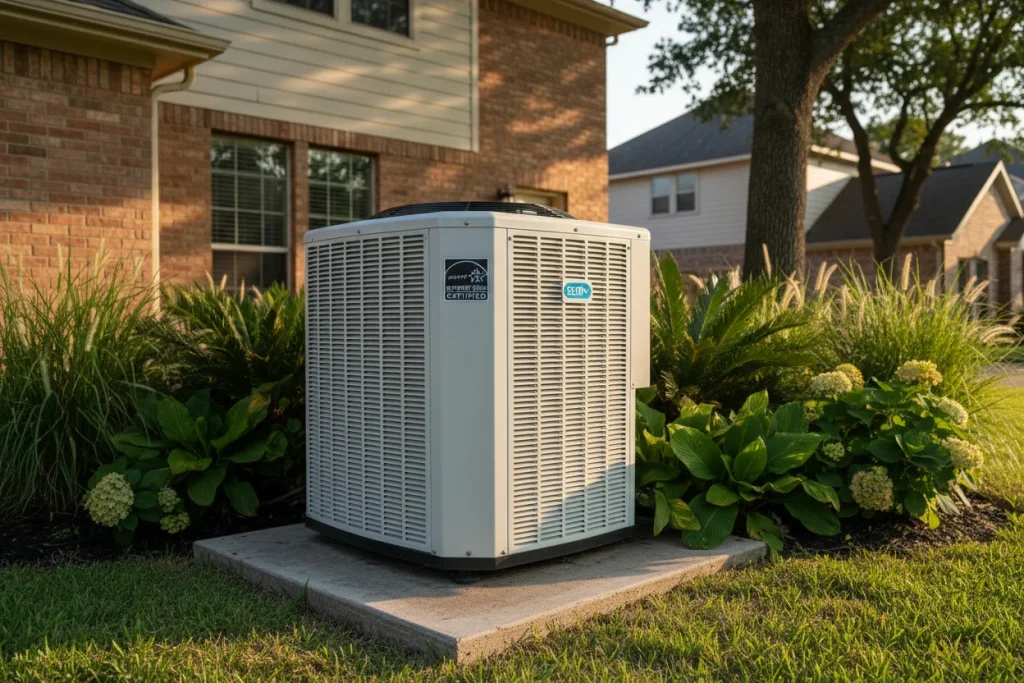
The federal minimum for Houston's region is 14.3 SEER2, but that's a floor, not a target. Most homeowners get the best balance of comfort and energy savings with systems rated 16 SEER2 or higher. Premium 20+ SEER2 systems make sense for larger homes or homeowners prioritizing humidity control and the lowest operating costs.
Here's how the tiers break down for Houston:
- 14.3-15 SEER2 (Budget tier): Meets the legal minimum. Single-stage operation that cycles on and off frequently, which can leave humidity hanging between cycles. Best for tight budgets or homes under 1,500 square feet.
- 16-18 SEER2 (Sweet spot): Two-stage systems that run at lower capacity most of the time and ramp up only when needed. Longer run cycles pull more moisture from the air. For a city where humidity is half the comfort battle, that matters more than the efficiency number alone.
- 19-21+ SEER2 (Premium tier): Variable-speed systems that continuously adjust output to match cooling demand, delivering exceptional humidity control and the most consistent room-to-room temperatures. Best for larger homes or anyone wanting the lowest lifetime operating costs.
The real question isn't "what rating should I buy?" It's "what makes sense for my home?" A two-story in Katy with west-facing windows has different needs than a single-story in Spring with mature tree coverage. Your home's insulation, ductwork, ceiling heights, and window orientation all influence which tier delivers the best return.
| SEER2 Range | System Type | Houston Suitability | Best For |
| 14.3-15 | Single-stage | Meets minimum, limited humidity control | Budget-conscious, smaller homes |
| 16-18 | Two-stage | Strong match for most Houston homes | Comfort and efficiency balance |
| 19-21+ | Variable-speed | Excellent for Houston's humidity | Larger homes, premium comfort |
This is also where the 2026 efficiency standards come into play. New equipment manufactured in 2026 must use next-generation refrigerants like R-454B or R-32, replacing R-410A. Higher SEER2 systems are already engineered around these new refrigerants, so buying at the 16+ tier positions positions you with current technology rather than an outgoing platform.
How SEER2 Ratings Affect Your Energy Bills in Houston
The difference between a 14.3 SEER2 system and an 18 SEER2 system translates directly into electricity consumption over eight to nine months of near-constant operation. Higher-rated systems use less energy to produce the same cooling output, and those savings compound across Houston's long, humid summers.
According to the U.S. Energy Information Administration, air conditioning accounts for a significant share of residential energy use in hot, humid climates. In Houston, where your AC runs from April through November, cooling is often the largest line item on your electricity bill. A system rated 18 SEER2 produces the same cooling as a 14.3 unit while consuming roughly 20% less electricity. Across an eight-month cooling season, that adds up.
Here's the catch. Those savings only materialize if the system is properly sized and correctly installed. An oversized unit will short-cycle, shutting off before it runs long enough to remove humidity. You end up with a home at the right temperature that still feels clammy. Sound familiar?
Real savings depend on your home's thermal envelope. A high-efficiency system in a home with leaky ductwork or poor insulation will never perform at its rated efficiency. That's why evaluating insulation, ductwork, ceiling heights, window orientation, and airflow distribution matters as much as the equipment rating.
| Factor | Impact on Real-World Efficiency |
| Proper system sizing | Prevents short-cycling; enables humidity removal |
| Ductwork condition | Leaky ducts can waste 20-30% of cooling output |
| Home insulation quality | Poor insulation forces longer run times |
| Installation quality | Refrigerant charge, airflow calibration, and electrical connections |
| Houston cooling season | 8-9 months amplifies any efficiency difference |
The bottom line: SEER2 ratings tell you what a system can do. Your installation determines what it actually does.
Why Installation Quality Affects Your Actual SEER2 Performance

Your AC's SEER2 rating is tested under controlled conditions with perfect installation. Industry organizations like ACCA and ASHRAE consistently show that improper installation can reduce actual efficiency by 30% or more. A poorly installed 18 SEER2 system might perform like a 12- or 13-SEER system in practice.
Manufacturers engineer systems to achieve high SEER2 ratings, but rated efficiency assumes proper sizing, an exact refrigerant charge, correct evaporator coil airflow, and ductwork that delivers air without significant losses. Miss any of those, and the EnergyGuide label becomes fiction.
Here's where it gets practical for Houston homes:
- Refrigerant charge: Even a 10% deviation from spec reduces capacity and efficiency. In Houston's heat, that shows up fast as longer run times and higher bills.
- Airflow calibration: Too little airflow causes the evaporator to freeze. Too much reduces dehumidification. Both kill efficiency.
- Ductwork integrity: Houston attics hit 140°F in summer. Every leak dumps conditioned air into that attic instead of your living space. A 20 SEER2 system on failing ductwork is like a sports car on flat tires.
- System sizing: An oversized system short-cycles and never reaches rated SEER2. An undersized system can't keep up on the hottest days. Getting it right requires evaluating insulation, ceiling heights, window orientation, and airflow.
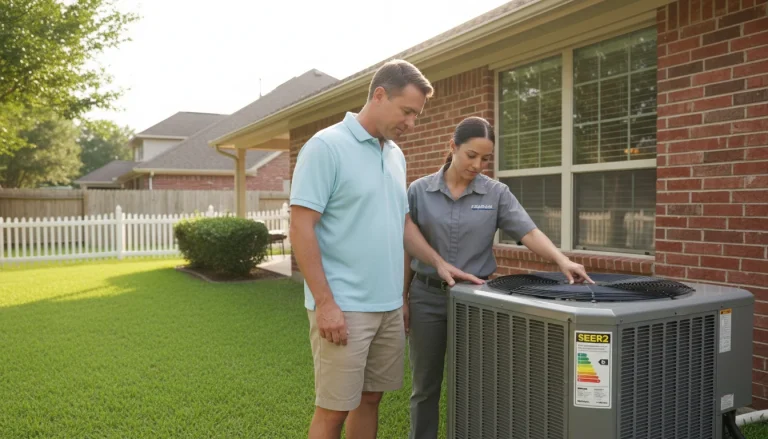
This is why choosing the right hvac contractor matters as much as choosing the right equipment. A professional AC installation in Houston should include verification testing after startup. VeriChill includes performance verification on every residential AC installation because a system that doesn't hit its rated efficiency isn't delivering what you paid for. We back every project with a 10-year parts and compressor warranty, and we handle equipment registration within 90 days, so your coverage is locked in from day one.
Key Takeaways
- SEER2 replaced SEER in 2023 with testing that better reflects real-world conditions, producing numbers about 4.7% lower for the same equipment.
- Houston's minimum is 14.3 SEER2, but that's a regulatory floor, not a recommendation for our climate.
- 16+ SEER2 is the practical target for most Houston homes, balancing investment with meaningful energy savings across our cooling season.
- Two-stage systems (16-18 SEER2) offer the best combination of efficiency and humidity control for most Greater Houston homeowners.
- Higher ratings only deliver savings when paired with proper sizing, quality installation, and a home that has been evaluated for ductwork, insulation, and airflow.
- 2026 refrigerant changes (R-454B/R-32) mean higher-tier systems are built on newer, more future-proof technology.
Frequently Asked Questions
What does SEER2 stand for?
SEER2 stands for Seasonal Energy Efficiency Ratio 2. It measures cooling efficiency over a full season using updated testing with realistic ductwork resistance.
Is a higher SEER2 rating always better?
Not necessarily. The best rating depends on your home's size, insulation, and budget. A properly sized 16 SEER2 often outperforms a poorly installed 20 SEER2.
What is the minimum SEER2 rating allowed in Houston?
The Southeast region requires a minimum 14.3 SEER2 for new residential AC installations. Equipment below this can't legally be installed.
Why are SEER2 numbers lower than SEER numbers?
SEER2 uses more realistic testing that accounts for actual ductwork resistance. The equipment isn't less efficient; the measurement is more accurate, producing numbers about 4.7% lower.
What SEER2 rating do you recommend for Houston homes?
We recommend 16 SEER2 or higher. Our extended cooling season and high humidity mean savings from higher-rated systems compound faster here than in milder climates.
Does SEER2 measure heating efficiency as well?
No. SEER2 measures cooling only. Heat pumps use HSPF2 to measure heating efficiency, and gas furnaces use AFUE to rate their heating performance.
Can I still buy a SEER-rated system?
Pre-2023 equipment may still be available, but new production carries SEER2 ratings. Any new AC installation in 2026 should use SEER2-rated equipment.
How much can I save with a higher SEER2 system?
Savings depend on your current system, home size, and usage. Upgrading from a 10 SEER to an 18 SEER2 can significantly reduce cooling energy consumption over Houston's long season.
What refrigerant changes should I be aware of in 2026?
New systems are transitioning from R-410A to R-454B and R-32. Higher SEER2 systems are already designed around these refrigerants, making them more future-proof.
Does VeriChill help me choose the right SEER2 rating?
Yes. Every consultation includes evaluation of your home's insulation, ductwork, ceiling heights, window orientation, and airflow to determine the best efficiency tier for your situation.
Conclusion
SEER2 ratings give you a more honest picture of AC efficiency, and for Houston homeowners, understanding these numbers is one of the smartest moves before investing in new equipment. For most Greater Houston families, targeting 16 SEER2 or higher delivers the best long-term value. The rating on the box is only half the story. If you're ready to find out which SEER2 rating fits your home and get an installation that delivers the efficiency you're paying for, contact VeriChill for a consultation. We'll evaluate your home, explain your options in plain language, and design a system built for Houston's climate.